
Which among the following is the strongest base in aqueous medium:
Answer & explanation
Correct answer: option 2
The correct answer is Option (2) → (CH3)2NH
An amine is basic because the lone pair on nitrogen can accept a proton. Anything that makes this lone pair more available increases basic strength; anything that pulls it away decreases it:
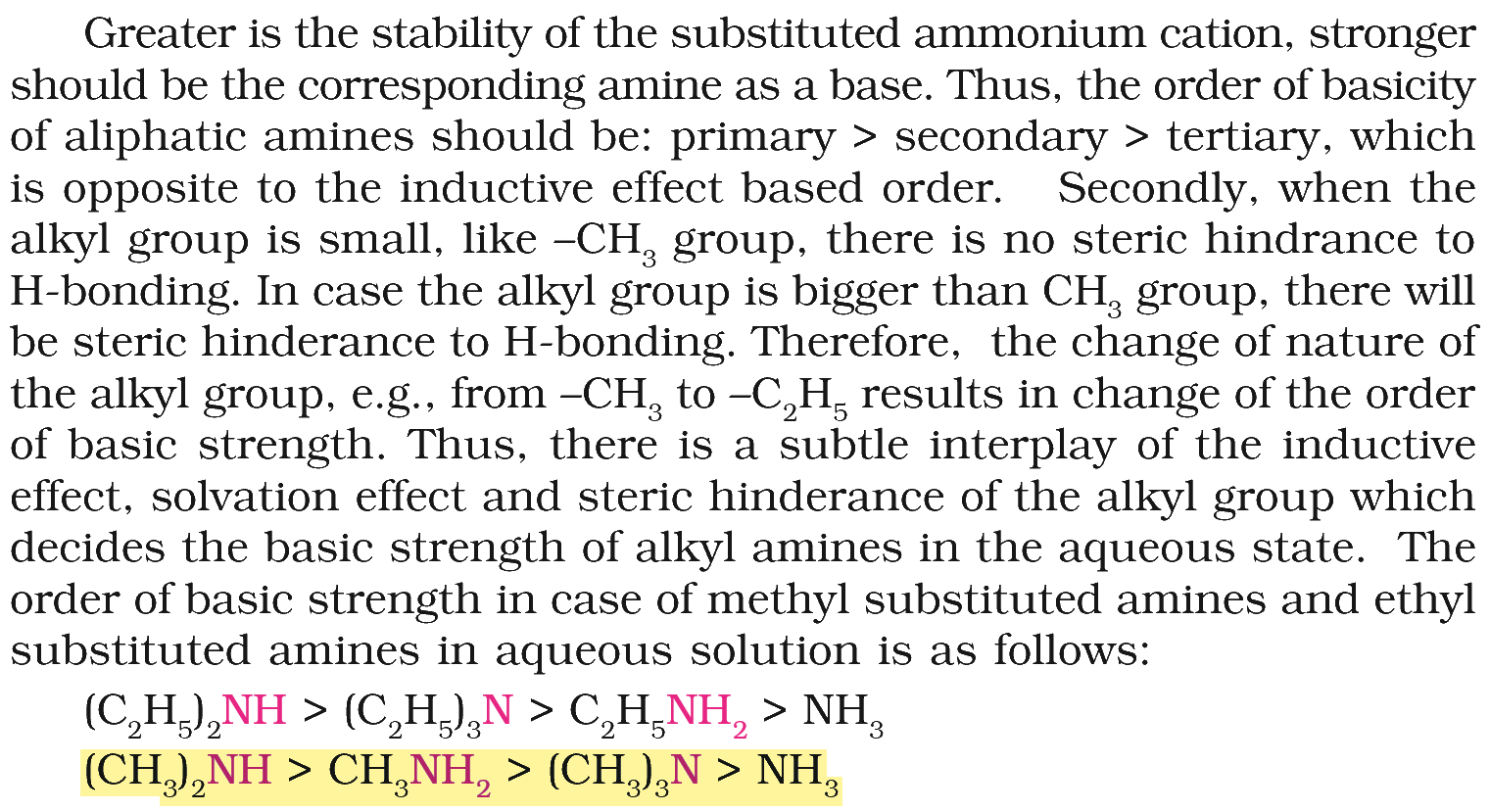
Alkyl groups (+I effect) push electrons towards nitrogen and increase basicity. In water, solvation of the protonated amine also matters, and for methyl amines the observed order is \( \ce{(CH3)2NH} \) > \( \ce{CH3NH2} \) > \( \ce{(CH3)3N} \) > \( \ce{NH3} \).
Electron withdrawing groups such as –CN pull electron density away from nitrogen and decrease basicity.
In aryl amines the lone pair is delocalised into the benzene ring, so it is much less available.
So the strongest base in aqueous medium is (CH3)2NH.
Why the other options are incorrect
Option (1) CH3NH2 — Incorrect. It has only one +I methyl group, so it is a little weaker than dimethylamine.
Option (3) NCCH2NH2 — Incorrect. The –CN group withdraws electrons from nitrogen and makes the amine a much weaker base.
Option (4) C6H5NHCH3 — Incorrect. Resonance with the benzene ring takes the lone pair away from nitrogen, so it is weaker than any of the aliphatic amines.
NCERT (2026-27 edition):
Chemical Reactions – …
Note: The same/similar question has been asked in different years by NTA as per the details given below:
| 2026 | 2025 | 2024 | 2023 | 2022 |
|---|---|---|---|---|
| 25-05 S2 24-05 S1 | 29-05 S1 | – | – | – |