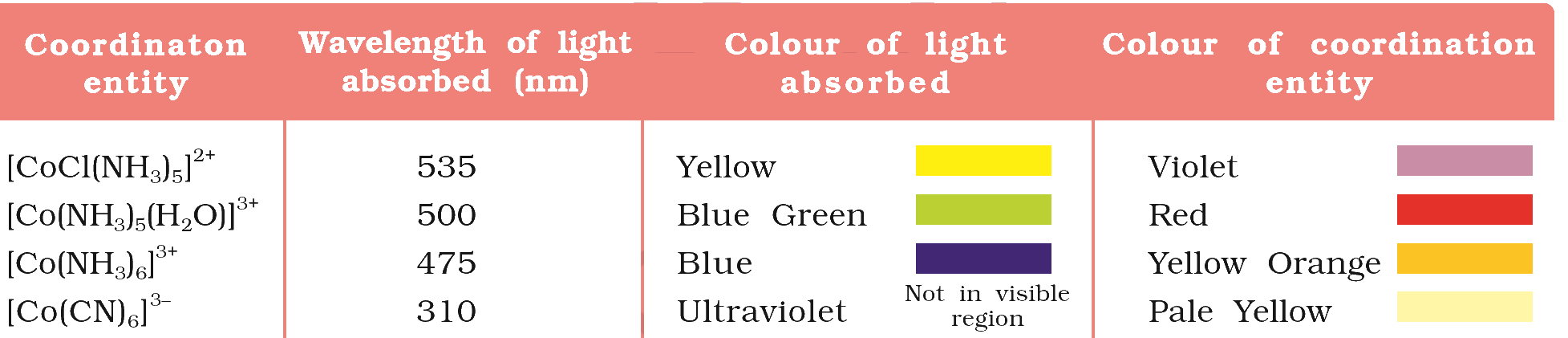
The color of the coordination compounds depends on the Crystal field splitting. What will be the correct decreasing order of absorption of wavelength of light for the given complexes ?
(A) [Co(NH3)5(H2O)]3+
(B) [Co(NH3)6]3+
(C) [Co(CN)6]3−
(D) [CoCl(NH3)5]2+
Choose the correct answer from the options given below:
Answer & explanation
Correct answer: option 1
The correct answer is Option (1) → (D), (A), (B), (C)
The colour of these cobalt(III) complexes comes from a d–d transition, and the energy absorbed equals the crystal field splitting Δo. A stronger field ligand gives a larger Δo, so light of higher energy, that is shorter wavelength, is absorbed. The spectrochemical series gives the ligand strength:
\( \displaystyle \ce{Cl^-} < \ce{H2O} < \ce{NH3} < \ce{CN^-} \)
\( \displaystyle \lambda=\frac{hc}{\Delta_o}\quad\Rightarrow\quad \text{larger }\Delta_o,\ \text{shorter }\lambda \)
All four complexes contain Co3+: Co (Z = 27) is [Ar]3d74s2, and losing the two 4s electrons and one 3d electron gives \( \ce{Co^{3+}} \): 3d6 (charge balance: (A) x + 0 = +3; (B) x + 0 = +3; (C) x − 6 = −3; (D) x − 1 = +2). The metal ion is the same, so only the ligands decide Δo.
(D) \( \ce{[CoCl(NH3)5]^{2+}} \): replacing one \( \ce{NH3} \) by the weak field \( \ce{Cl^{-}} \) gives the smallest splitting, so the longest wavelength is absorbed.
(A) \( \ce{[Co(NH3)5(H2O)]^{3+}} \): \( \ce{H2O} \) is a weaker ligand than \( \ce{NH3} \) but stronger than \( \ce{Cl^{-}} \), so the wavelength lies between.
(B) \( \ce{[Co(NH3)6]^{3+}} \): six \( \ce{NH3} \) ligands give a fairly large splitting.
(C) \( \ce{[Co(CN)6]^{3-}} \): \( \ce{CN^{-}} \) is the strongest field ligand here, so the splitting is largest and the shortest wavelength is absorbed.
Shortcut: \( \ce{CN^{-}} \) is the strongest field ligand, so (C) must be last and the \( \ce{Cl^{-}} \) complex (D) first. Only Option (1) starts with (D) and ends with (C).
NCERT (2026-27 edition):
Colour in Coordination Compounds – …