Read the passage and answer the questions:
Types of Farming
On the basis of the main source of moisture for crops, the farming can be classified as irrigated and rainfed (barani). There is a difference in the nature of irrigated farming, as well as based on the objective of irrigation, i.e., protective or productive.
The objective of protective irrigation is to protect the crops from adverse effects of moisture deficiency, which often means that irrigation acts as a supplementary source of water over and above the rainfall. The strategy of this kind of irrigation is to provide soil moisture to the maximum possible area. Productive irrigation is meant to provide sufficient soil moisture in the cropping season to achieve high productivity. In such irrigation, the water input per unit area of cultivated land is higher than protective irrigation.
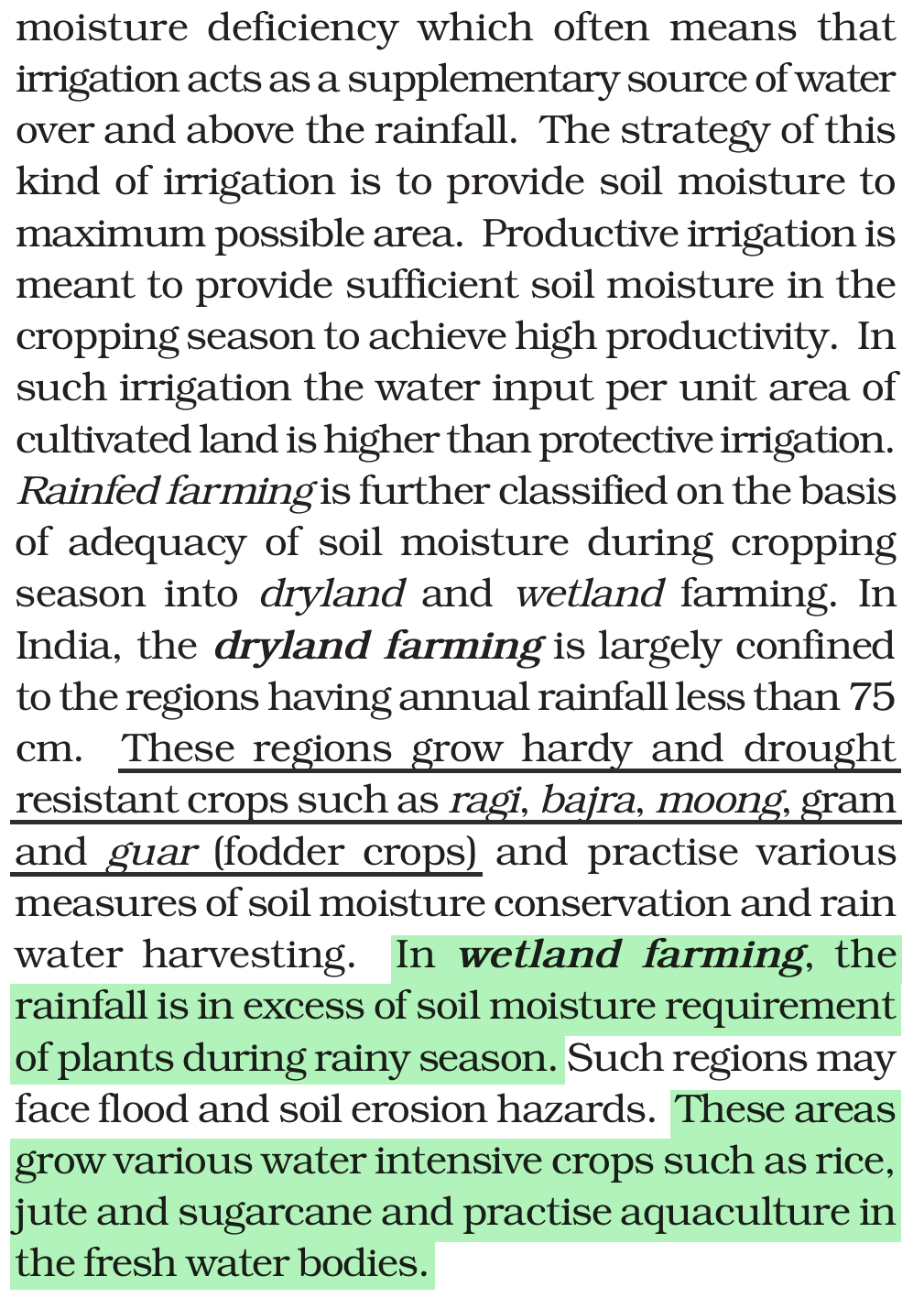
Rainfed farming is further classified on the basis of adequacy of soil moisture during the cropping season into dryland and wetland farming. In India, dryland farming is largely confined to the regions having annual rainfall less than 75 cm. These regions grow hardy and drought resistant crops such as ragi, bajra, moong, gram and guar (fodder crops) and practise various measures of soil moisture conservation and rain water harvesting. In wetland farming, the rainfall is in excess of the soil moisture requirement of plants during the rainy season. Such regions may face flood and soil erosion hazards. These areas grow various water intensive crops such as rice, jute and sugarcane and practise aquaculture in the fresh water bodies.
Which of the following crops is NOT grown in wetland farming?
Answer & explanation
Correct answer: option 2
The correct answer is Option (2) → Bajra
Wetland farming areas grow water intensive crops such as rice, jute and sugarcane. Bajra is one of the hardy, drought resistant crops of dryland farming, along with ragi, moong, gram and guar.
Note: This question was also asked in CUET (UG) 2023 on 08-06-2023 (Slot 3, same) and 25-05-2023 (Slot 2, similar).
NCERT: India - People and Economy — Chapter 3: Land Resources and Agriculture, Types of Farming (2025-26)
|