Read the passage and answer the questions:
Trade Liberalisation
The act of opening up economies for trading is known as free trade or trade liberalisation. This is done by bringing down trade barriers like tariffs. Trade liberalisation allows goods and services from everywhere to compete with domestic products and services.
Globalisation along with free trade can adversely affect the economies of developing countries by not giving equal playing field by imposing conditions which are unfavourable. With the development of transport and communication systems goods and services can travel faster and farther than ever before. But free trade should not only let rich countries enter the markets, but allow the developing countries to keep their own markets protected from foreign products.
Countries also need to be cautious about dumped goods; as along with free trade dumped goods of cheaper prices can harm the domestic producers.
Which of the following represents dumping?
Answer & explanation
Correct answer: option 1
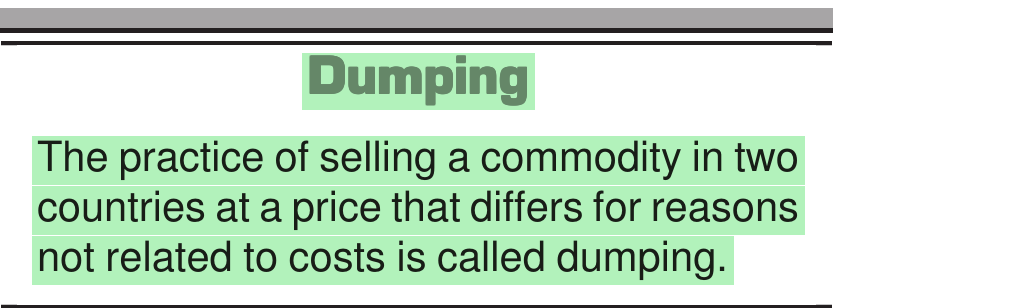
The correct answer is Option (1) → The practice of selling a commodity in two countries at a price that differs for reasons not related to costs.
Option (1) The practice of selling a commodity in two countries at a price that differs for reasons not related to costs. — Correct. This is the meaning of dumping. A firm sells the same commodity more cheaply in another country, though its costs give no reason for the lower price. Local producers there cannot match that price and lose their buyers, so the passage warns that dumped goods of cheaper prices can harm the domestic producers.
Option (2) The practice of free trading. — Incorrect. Free trade is opening economies by bringing down barriers like tariffs; dumped goods may come in with it, but it is not dumping.
Option (3) The process of globalisation. — Incorrect. Globalisation is the wider opening of economies to the world, not a way of pricing goods.
Option (4) Disposing the solid wastes in open oceans. — Incorrect. That is ‘dumping’ only in the everyday sense; in trade, dumping is about the price of goods sold in two countries.
Note: This passage is taken almost word for word from the NCERT chapter ‘International Trade’ (Fundamentals of Human Geography). The free-trade paragraph came straight from the International Trade chapter, and the little dumping box beside it was waiting for its turn too. Read the boxes of a chapter as closely as its paragraphs.
Note: A similar question was also asked in CUET (UG) 2026 on 24-05-2026 (Slot 1).
NCERT (2025-26): “Case for Free Trade The act of opening up economies for trading is known as free trade or trade liberalisation. This is done by bringing down trade barriers like tariffs. Trade liberalisation allows goods and services from everywhere to compete with domestic products and services. Case for Free Trade … Countries also need to be cautious about dumped goods; as along with free trade dumped goods of cheaper prices can harm the domestic producers.”
|