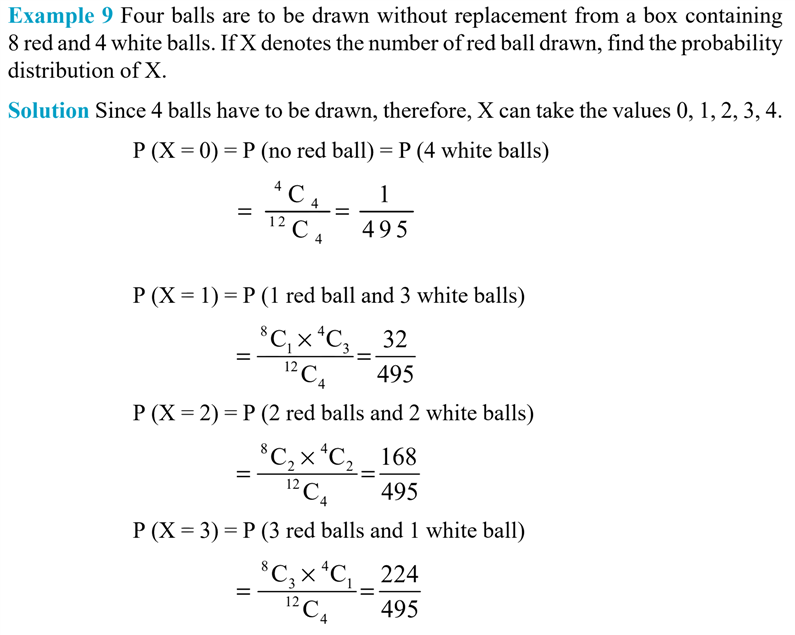
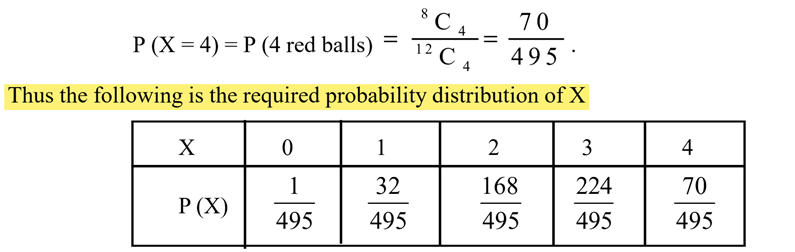
A bag contains 4 white and 6 red balls. Four balls are drawn at random, then match the probability of the numbers of white balls drawn. Where P(E) denotes the probability of an event E.
Then Match List-I with List-II
| LIST-I | LIST-II |
| A. P (no white ball) | I. \( \displaystyle\frac{8}{21} \) |
| B. P (all white balls) | II. \( \displaystyle\frac{1}{14} \) |
| C. P (one white ball) | III. \( \displaystyle\frac{6}{14} \) |
| D. P (two white balls) | IV. \( \displaystyle\frac{1}{210} \) |
Choose the correct answer from the options given below:
Answer & explanation
Correct answer: option 2
The correct answer is Option (2) → A-II, B-IV, C-I, D-III
Four balls can be chosen in \( {}^{10}C_4=210 \) ways, and each probability is a count of combinations divided by 210.
(A) P (no white ball)
This matches II. 1/14.
\( \displaystyle \frac{{}^{6}C_4}{210}=\frac{15}{210}=\frac{1}{14} \)
(B) P (all white balls)
This matches IV. 1/210.
\( \displaystyle \frac{{}^{4}C_4}{210}=\frac{1}{210} \)
(C) P (one white ball)
This matches I. 8/21.
\( \displaystyle \frac{{}^{4}C_1\times{}^{6}C_3}{210}=\frac{80}{210}=\frac{8}{21} \)
(D) P (two white balls)
This matches III. 6/14.
\( \displaystyle \frac{{}^{4}C_2\times{}^{6}C_2}{210}=\frac{90}{210}=\frac{6}{14} \)
So the matching is A-II, B-IV, C-I, D-III.
NCERT Exemplar:
Probability