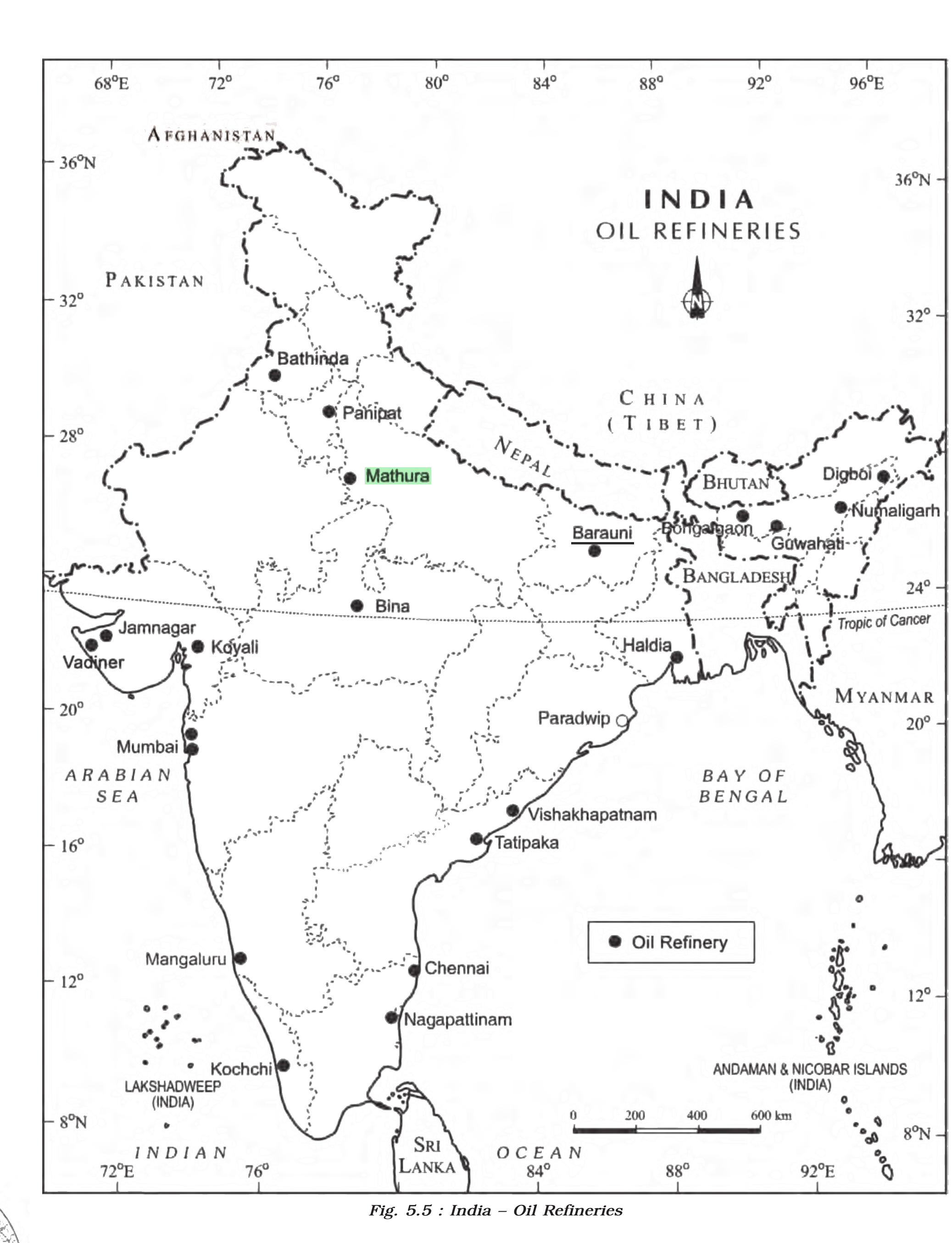
Read the passage and answer the questions:
Crude petroleum consists of hydrocarbons of liquid and gaseous states varying in chemical composition, color and specific gravity. It is an essential source of energy for all internal combustion engines in automobiles, railways and aircraft. Its numerous by-products are processed in petrochemical industries, such as fertilizer, synthetic rubber, synthetic fiber, medicines, vaseline, lubricants, wax, soap and cosmetics. Crude petroleum occurs in sedimentary rocks of the tertiary period. Oil exploration and production was systematically taken up after the Oil and Natural Gas Commission was set up in 1956. Till then, Digboi in Assam was the only oil producing region but the scenario changed after 1956. In recent years, new oil deposits have been found at the extreme western and eastern parts of the country. In Assam, Digboi, Naharkatiya and Moran are important oil producing areas. The major oilfields of Gujarat are Ankaleshwar, Kalol, Mehsana, Nawagam, Kosamba and Lunej. Mumbai High which lies 160 km off Mumbai was discovered in 1973 and production commenced in 1976. Oil and natural gas have been found in exploratory wells in Krishna-Godavari and Kaveri basin on the east coast. Oil extracted from the wells is crude oil and contains many impurities. It cannot be used directly. It needs to be refined. There are two types of refineries in India: (a) field-based and (b) market-based. Digboi is an example of field based and Barauni is an example of market based refinery.
Which of the following statements is NOT correct?
Answer & explanation
Correct answer: option 2
The correct answer is Option (2) → Mathura is an example of a field-based refinery.
Option (1) A market based refinery is generally located away from the oil fields. — True. A field-based refinery stands on the oil field, as Digboi does in Assam. A market-based refinery stands near the markets for its products, away from the fields: Barauni in Bihar gets its crude through a pipeline from the Naharkatiya oilfield in Assam.
Option (2) Mathura is an example of a field-based refinery. — False. Mathura, in western Uttar Pradesh, has no oil field near it; the oilfields lie in Assam, Gujarat, Mumbai High and the Krishna-Godavari and Kaveri basins. Its crude is brought from far away, so it is a market-based refinery, serving the markets of north-west India.
Option (3) The set-up of ONGC has increased the pace of oil exploration and production in India. — True. Oil exploration and production were systematically taken up after the Oil and Natural Gas Commission was set up in 1956; until then Digboi was the only oil producing region.
Option (4) Crude oil cannot be directly used as fuel in transportation like automobiles and railways. — True. Crude oil contains many impurities, so it cannot be used directly and needs to be refined.
Note: The current NCERT book (2025-26) gives Digboi and Barauni as examples of field-based and market-based refineries and shows Mathura on its map of oil refineries, but does not say which type Mathura is. The pre-rationalised NCERT (chapter ‘Manufacturing Industries’) settles it: “Petroleum refineries are also located near the markets as the transport of crude oil is easier and several products derived from them are used as raw material in other industries. Koyali, Mathura and Barauni refineries are typical examples.”
NCERT (2025-26): “Petroleum … Oil exploration and production was systematically taken up after the Oil and Natural Gas Commission was set up in 1956. Till then, Digboi in Assam was the only oil producing region but the scenario changed after 1956. In recent years, new oil deposits have been found at the extreme western and eastern parts of the country. In Assam, Digboi, Naharkatiya and Moran are important oil producing areas. The major oilfields of Gujarat are Ankaleshwar, Kalol, Mehsana, Nawagam, Kosamba and Lunej. Mumbai High which lies 160 km off Mumbai was discovered in 1973 and production commenced in 1976. Oil and natural gas have been found in exploratory wells in Krishna-Godavari and Kaveri basin on the east coast. Oil extracted from the wells is crude oil and contains many impurities. It cannot be used directly. It needs to be refined. There are two types of refineries in India: (a) field-based and (b) market-based. Digboi is an example of field-based and Barauni is an example of market-based refinery.…” “Oil and Gas Pipelines … Asia’s first cross country pipeline covering a distance of 1,157 km was constructed by OIL from Naharkatiya oilfield in Assam to Barauni refinery in Bihar. It was further extended up to Kanpur in 1966.…”
|