
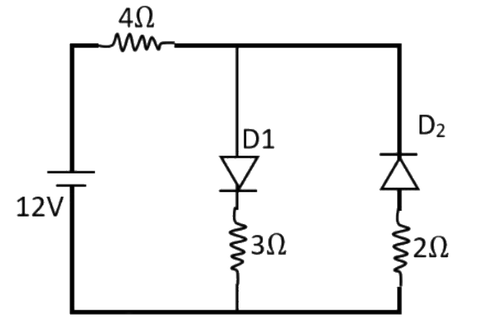
The circuit has two oppositely connected ideal diodes in parallel. The current flowing in the circuit will be
Answer & explanation
Correct answer: option 2
The correct answer is Option (2) → 1.71 A
The longer plate of the cell, at the top, is its positive terminal, so conventional current leaves the top of the cell, passes through the 4 Ω resistor and reaches the two diode branches. A diode conducts only when forward biased, i.e. when current can flow in the direction of its arrow. An ideal diode then has zero resistance; when reverse biased it acts as an open switch.
D1 points downwards, in the direction of the current, so it is forward biased and the 3 Ω branch conducts. D2 points upwards, against the current, so it is reverse biased and the 2 Ω branch carries no current. The circuit is therefore the cell in series with 4 Ω and 3 Ω.
\( \displaystyle I = \frac{V}{R_{\mathrm{total}}} = \frac{12\,\mathrm{V}}{4\,\Omega + 3\,\Omega} \)
\( \displaystyle I = \frac{12}{7}\,\mathrm{A} \approx 1.71\,\mathrm{A} \)