Match List-I with List-II
| List-I | List-II |
| (A) ion or molecule having two different donor atoms and either of the two ligates in the complex | (I) central atom or ion |
| (B) In a coordination entity, the atom/ion to which a fixed number of ions/groups are bound in a definite geometrical arrangement | (II) Chelate ligand |
| (C) ion or molecule using its two or more donor atoms simultaneously to bind a single metal ion | (III) Ambidentate ligand |
| (D) ion or molecule bound to the central atom/ion through two donor atoms | (IV) Didentate ligand |
Choose the correct answer from the options given below:
Answer & explanation
Correct answer: option 4
The correct answer is Option (4) → (A) - (III), (B) - (I), (C) - (II), (D) - (IV)
The terms in the list describe the parts of a coordination entity and the different ways a ligand can bind to the metal:
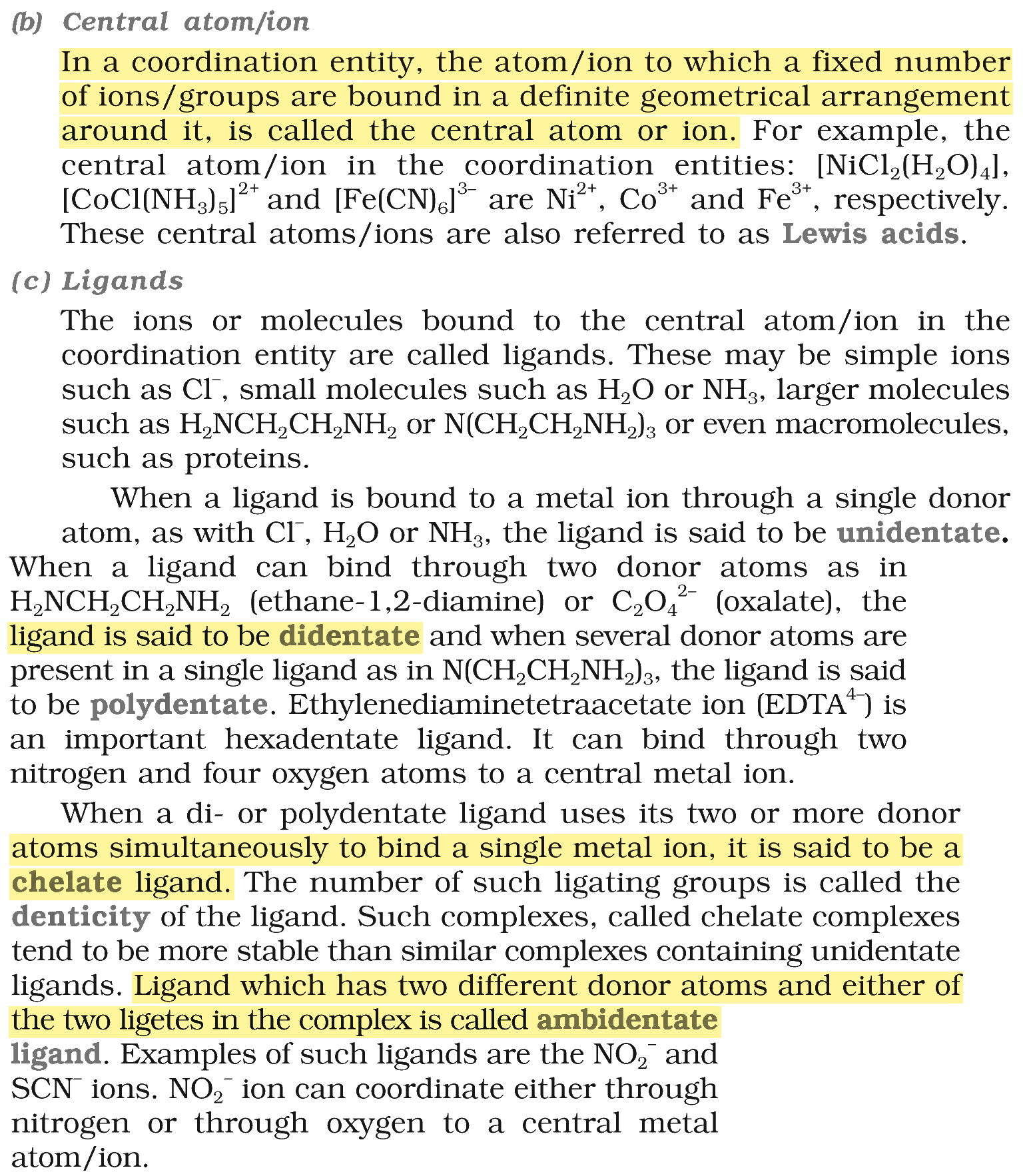
(A) ion or molecule having two different donor atoms and either of the two ligates in the complex — This matches (III) Ambidentate ligand. For example, \( \ce{NO2^{-}} \) can bind through N (nitrito-N) or through O (nitrito-O), and \( \ce{SCN^{-}} \) through S or through N.
(B) In a coordination entity, the atom/ion to which a fixed number of ions/groups are bound in a definite geometrical arrangement — This matches (I) central atom or ion. For example, \( \ce{Co^{3+}} \) is the central ion in \( \ce{[CoCl3(NH3)3]} \); it accepts electron pairs from the ligands, so it acts as a Lewis acid.
(C) ion or molecule using its two or more donor atoms simultaneously to bind a single metal ion — This matches (II) Chelate ligand. Binding one metal ion through two or more atoms closes a ring, and such chelate complexes are more stable than similar complexes of unidentate ligands.
(D) ion or molecule bound to the central atom/ion through two donor atoms — This matches (IV) Didentate ligand. Examples are ethane-1,2-diamine (en), which binds through two N atoms, and oxalate (\( \ce{C2O4^{2-}} \)), which binds through two O atoms.
Shortcut: The pair (A)–(III) appears only in Options (3) and (4), and (B)–(I) then leaves only Option (4).
NCERT (2026-27 edition):
Definitions of Some Important Terms Pertaining to Coordination Compounds – …