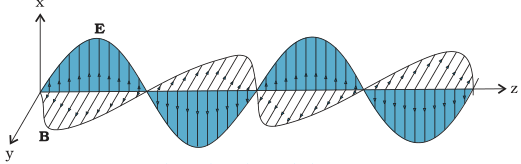
The oscillating electric and magnetic field vectors of electromagnetic wave are in-
Answer & explanation
Correct answer: option 3
The correct answer is Option (3) → mutually perpendicular directions and are in phase.
An electromagnetic wave is transverse: the electric field, the magnetic field and the direction of propagation are mutually perpendicular. The two fields are produced together and oscillate in the same phase, reaching their maximum and zero values at the same place and time.
\( \displaystyle E_x = E_0 \sin(kz - \omega t), \quad B_y = B_0 \sin(kz - \omega t) \)
\( \displaystyle E_0 = cB_0 \)
Both fields have the same argument \( (kz - \omega t) \), so there is no phase difference between them.
Why the other options are incorrect
Option (1) the same direction and in phase — Incorrect. The two fields cannot point in the same direction; they are always perpendicular to each other.
Option (2) the same direction but have a phase difference of 90°. — Incorrect. The fields are neither parallel nor out of phase.
Option (4) mutually perpendicular directions with a phase difference of 90°. — Incorrect. The directions are right, but there is no 90° phase difference. A 90° shift between electric and magnetic energy occurs in an LC oscillator, not in a travelling electromagnetic wave.
NCERT (2026-27):
Nature of Electromagnetic Waves – “It can be shown from Maxwell’s equations that electric and magnetic fields in an electromagnetic wave are perpendicular to each other, and to the direction of propagation. … We can write \( E_x \) and \( B_y \) as follows:
\( \displaystyle E_x = E_0 \sin\,(kz - \omega t) \qquad [8.7(a)] \)
\( \displaystyle B_y = B_0 \sin\,(kz - \omega t) \qquad [8.7(b)] \)”