In a LPP, Let R be the feasible region ,then which of the following are TRUE?
A. If R is bounded, then the objective function Z has both a maximum and minimum value on R.
B. If R is unbounded, then the objective function Z may or may not have a maximum or minimum value.
C. If a optimal solution exists. It must occur at at least one corner point of R.
D. If R is bounded, then maximum value will exist but minimum may or may not exist for an objective function Z.
Choose the correct answer from the options given below:
Answer & explanation
Correct answer: option 1
The correct answer is Option (1) → A, B and C only
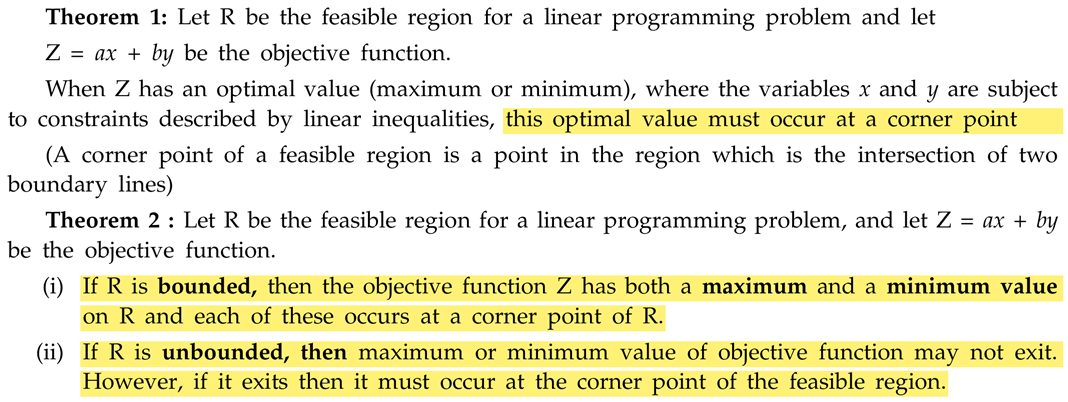
These are the basic results on the feasible region R of a linear programming problem, including the corner point theorem.
So on a bounded R, Z has both a maximum and a minimum value; on an unbounded R, either may fail to exist; and an optimal value, when it exists, occurs at a corner point of R.
Checking the statements
(A) If R is bounded, then the objective function Z has both a maximum and minimum value on R — Correct. A bounded region always gives both a maximum and a minimum.
(B) If R is unbounded, then the objective function Z may or may not have a maximum or minimum value — Correct. On an unbounded region an optimal value may not exist.
(C) If a optimal solution exists. It must occur at at least one corner point of R — Correct. This is the corner point theorem.
(D) If R is bounded, then maximum value will exist but minimum may or may not exist for an objective function Z — Incorrect. On a bounded region the minimum also always exists.
CBSE Applied Mathematics (Class XII):
Solving a Linear Programming Problem