The correct increasing order of acidity of the following molecules is
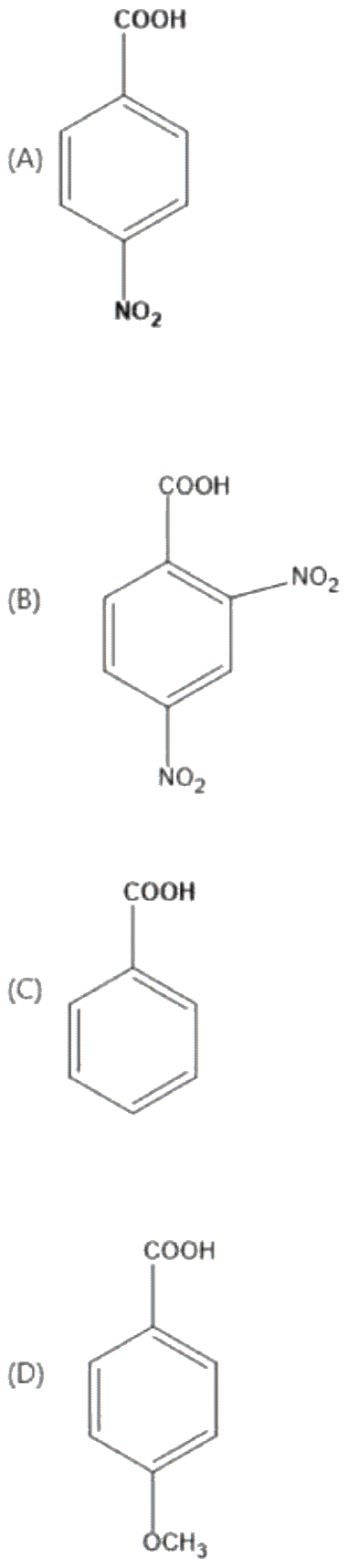
Choose the correct answer from the options given below:
Answer & explanation
Correct answer: option 2
The correct answer is Option (2) → (D), (C), (A), (B)
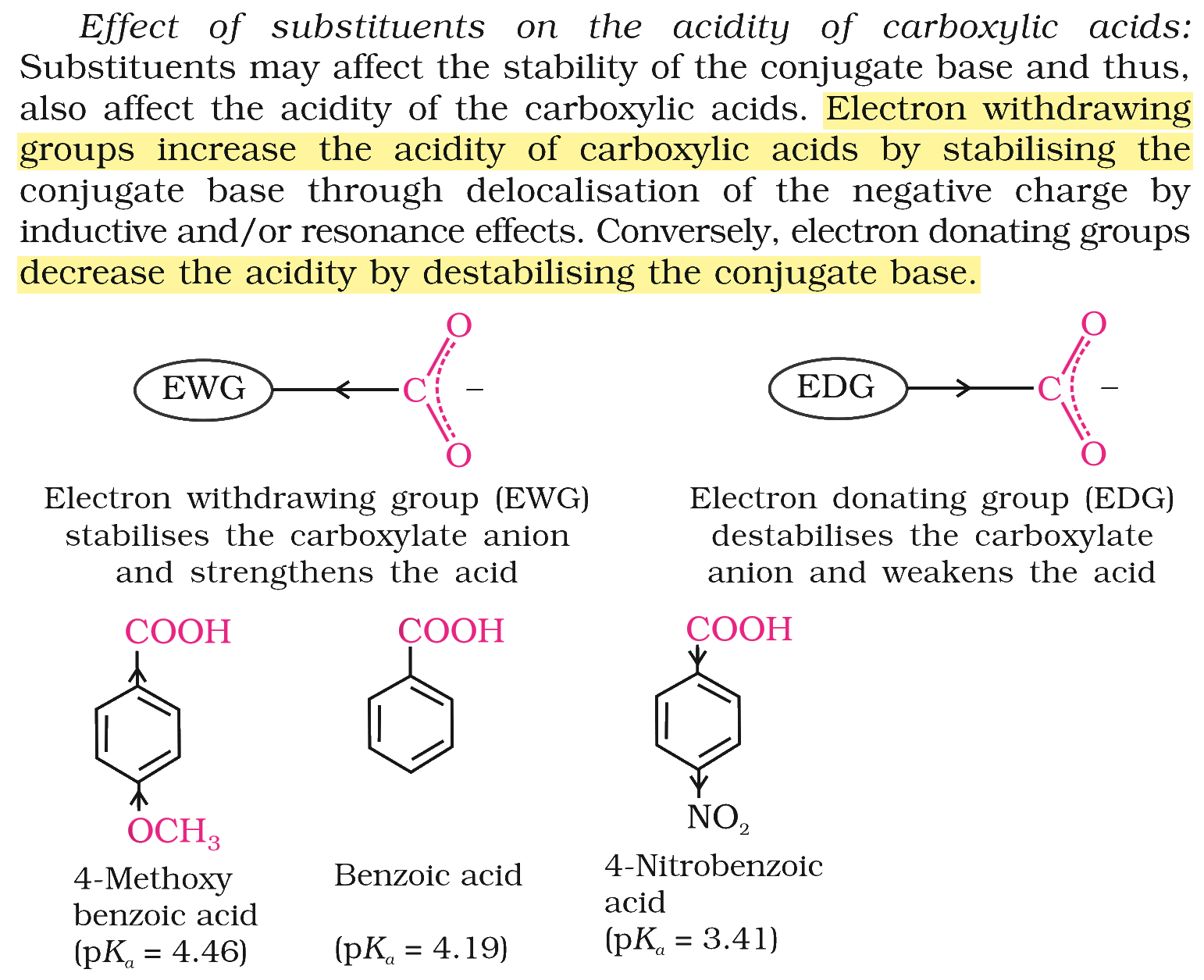
The acidity of a benzoic acid depends on how well the carboxylate anion is stabilised. Substituents on the ring change this:
Electron withdrawing groups such as –\( \ce{NO2} \) spread the negative charge, stabilise the anion and increase acidity. More such groups increase it further.
Electron donating groups such as –\( \ce{OCH3} \) at the para position push electrons towards the carboxylate group, destabilise the anion and decrease acidity.
Combining these:
donating group < no substituent < one –\( \ce{NO2} \) < two –\( \ce{NO2} \)
Matching the given acids:
(D) 4-methoxybenzoic acid: electron donating –\( \ce{OCH3} \)
(C) benzoic acid: no substituent
(A) 4-nitrobenzoic acid: one –\( \ce{NO2} \) group
(B) 2,4-dinitrobenzoic acid: two –\( \ce{NO2} \) groups, the strongest acid
Shortcut: The methoxy acid (D) is the weakest and the dinitro acid (B) the strongest. Only Option (2) starts with (D) and ends with (B).
NCERT (2026-27 edition):
Effect of Substituents on the Acidity of Carboxylic Acids