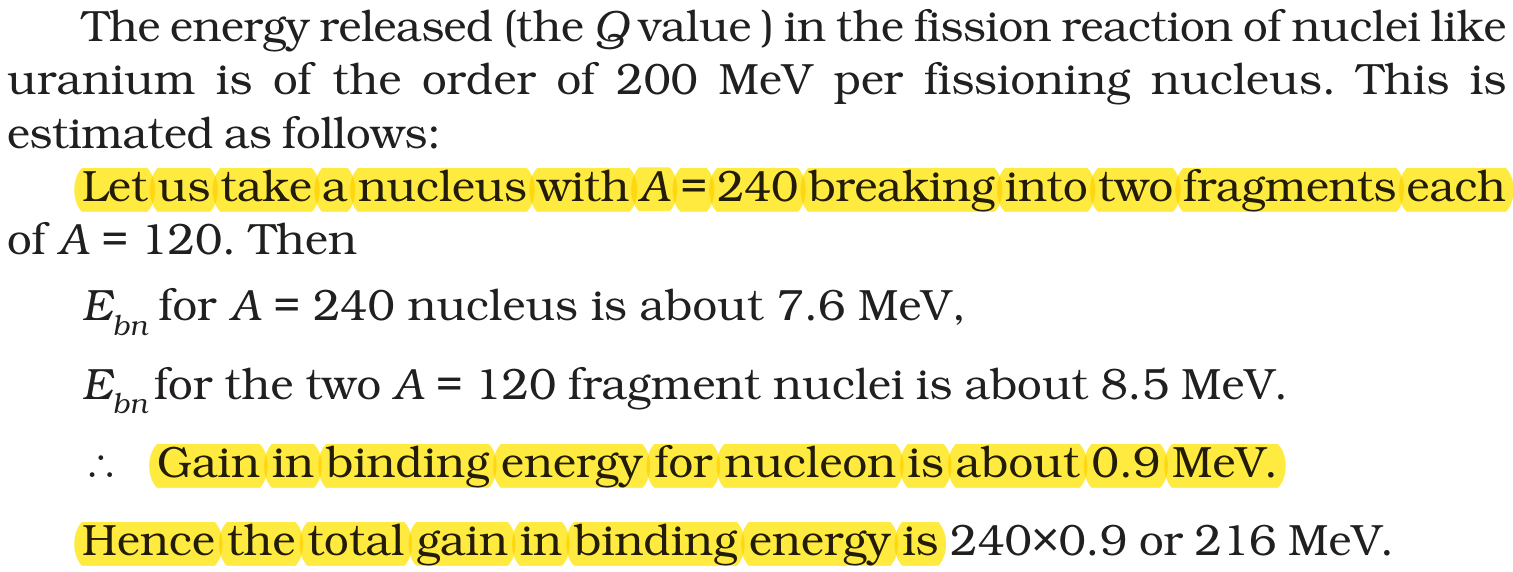
A nucleus ‘X’ of mass number \(A = 240\) breaks into two fragments each of \(A = 120\). If the binding energy per nucleon for X is about \(7.5\) MeV and that of each of the fragments is \(8.1\) MeV per nucleon. What will be the total gain in the binding energy in the process?
Answer & explanation
Correct answer: option 2
The correct answer is Option (2) → \(144\) MeV
The binding energy of a nucleus is the binding energy per nucleon multiplied by the number of nucleons. The gain is the total binding energy of the products minus that of the original nucleus.
\( \displaystyle E_X = 240 \times 7.5\,\mathrm{MeV} = 1800\,\mathrm{MeV} \)
\( \displaystyle E_{\mathrm{fragments}} = 2 \times (120 \times 8.1\,\mathrm{MeV}) = 1944\,\mathrm{MeV} \)
\( \displaystyle \Delta E = 1944\,\mathrm{MeV} - 1800\,\mathrm{MeV} = 144\,\mathrm{MeV} \)
Shortcut: The number of nucleons is unchanged (240), so the gain is \( 240 \times (8.1 - 7.5)\,\mathrm{MeV} = 240 \times 0.6\,\mathrm{MeV} = 144\,\mathrm{MeV} \).
Note: NTA picked this question from an NCERT (2026-27) example and changed the figures. Do not ignore NCERT while practising numericals.
NCERT (2026-27):
Fission – …