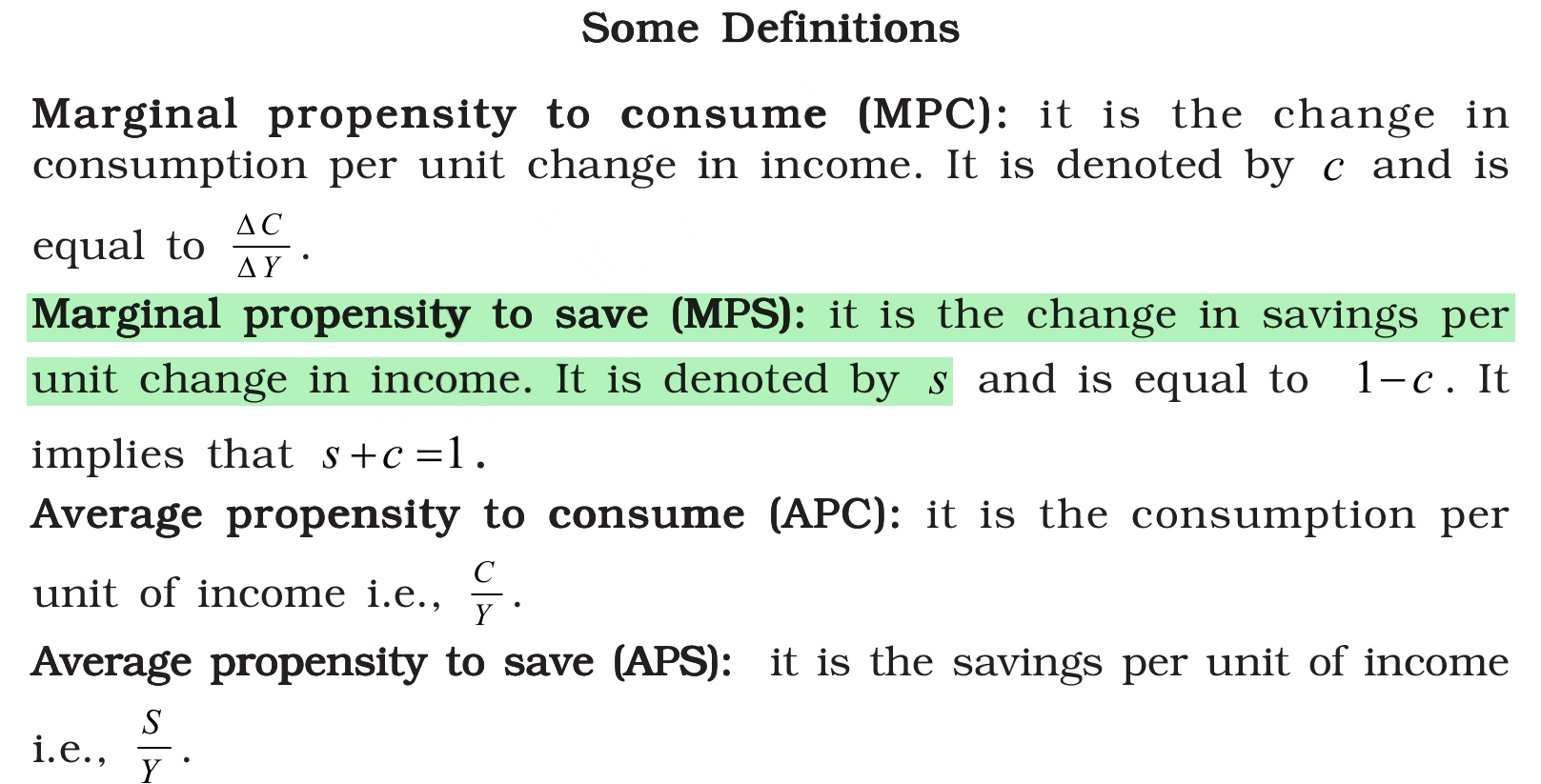
The change in savings as per unit change in income is defined as.
Answer & explanation
Correct answer: option 4
The correct answer is Option (4) → Marginal propensity to save
Saving is the part of income a household does not consume. When income goes up, saving goes up by only a part of the increase, and the ratio of the two changes, the change in savings per unit change in income (ΔS/ΔY), shows how much of each extra rupee is put aside. It is the marginal propensity to save (MPS), denoted by s.
Because each extra rupee is either consumed or saved, s = 1 − c, that is, MPC + MPS = 1.
Why the other options are incorrect
Option (1) Induced savings — Incorrect. Induced saving is the amount of saving that depends on income, a quantity of saving, not the rate at which saving changes per unit of income.
Option (2) Saving function — Incorrect. The saving function, S = −C̄ + (1 − c)Y, is the whole relation between saving and income; the MPS is the slope of that relation.
Option (3) Average propensity to save — Incorrect. The APS is saving per unit of income, S/Y, a ratio of totals and not of changes.
NCERT: Introductory Macroeconomics — Chapter 4: Determination of Income and Employment (2025-26)
|