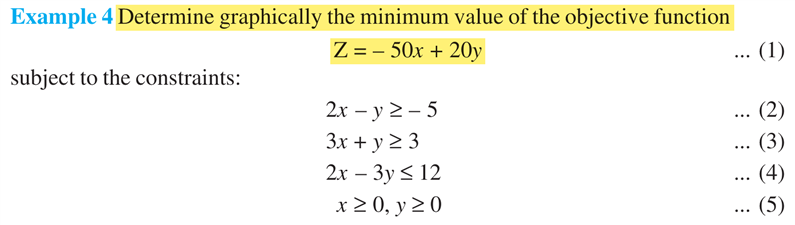
Consider the LPP: Minimize \( z=-50x+20y \) subject to \( 2x-y\ge -5,3x+y\ge 3,2x-3y\le 12,x\ge 0,y\ge 0 \).
Then which of the following statements are TRUE?
(A) Corner points of the feasible region of the LPP are (0, 5), (0, 3), (1, 0), (6, 0).
(B) The optimum value of the objective function is -300
(C) Optimum value does not exist
(D) The optimum value of the objective function is 100
Choose the correct answer from the options given below:
Answer & explanation
Correct answer: option 1
The correct answer is Option (1) → (A) and (C) only
The boundary lines meet the axes as follows:
\( \displaystyle 2x-y=-5:\ (0,5) \)
\( \displaystyle 3x+y=3:\ (0,3)\ \text{and}\ (1,0) \)
\( \displaystyle 2x-3y=12:\ (6,0) \)
The feasible region lies above \( 3x+y=3 \), below \( 2x-y=-5 \) and above \( 2x-3y=12 \) in the first quadrant. It has corner points (0, 5), (0, 3), (1, 0), (6, 0) and is unbounded: it extends to the right between the lines \( y=2x+5 \) and \( 2x-3y=12 \).
\( \displaystyle z(0,5)=100 \)
\( \displaystyle z(0,3)=60 \)
\( \displaystyle z(1,0)=-50 \)
\( \displaystyle z(6,0)=-300 \)
The smallest corner value is −300. Because the region is unbounded, check the open half-plane \( -50x+20y\lt -300 \), that is, \( 5x-2y\gt 30 \). It contains feasible points, e.g. (9, 2): \( 2(9)-3(2)=12\le 12 \), \( 3(9)+2\ge 3 \), \( 18-2\ge -5 \), and z = −450 + 40 = −410 < −300.
In fact, along the edge \( 2x-3y=12 \), that is, \( y=\frac{2x-12}{3} \),
\( \displaystyle z=-50x+\frac{20(2x-12)}{3} \)
\( \displaystyle =-\frac{110x}{3}-80 \)
which decreases without limit as x increases. So z has no minimum.
So the corner points are (0, 5), (0, 3), (1, 0), (6, 0), the smallest corner value −300 is not the minimum, and z has no minimum value.
Checking the statements
(A) Corner points of the feasible region of the LPP are (0, 5), (0, 3), (1, 0), (6, 0). — Correct. These are the points where the boundary lines \( 2x-y=-5 \), \( 3x+y=3 \) and \( 2x-3y=12 \) meet the axes.
(B) The optimum value of the objective function is -300 — Incorrect. −300 is only the smallest corner value; at (9, 2), z = −410.
(C) Optimum value does not exist — Correct. Along the edge \( 2x-3y=12 \), \( z=-\frac{110x}{3}-80 \) decreases without limit.
(D) The optimum value of the objective function is 100 — Incorrect. 100 is the largest corner value, and the question asks for a minimum.
Tip: In an unbounded region the smallest corner value is the minimum only if the half-plane \( z\lt \) that value has no point in common with the region; always make this check.
NCERT (2026-27 edition):
Graphical Method of Solving Linear Programming Problems