The standard electrode potential values are as follows:
(A). K K+/K = −2.93V.
(B). Ag Ag+/Ag = 0.80V.
(C). Br– Br2/Br– = 1.09V.
(D). Co2+ Co3+/Co2+ = 1.81V.
Arrange the given species in the increasing order of their reducing strength.
Choose the correct answer from the options given below:
Answer & explanation
Correct answer: option 4
The correct answer is Option (4) → (D), (C), (B), (A).
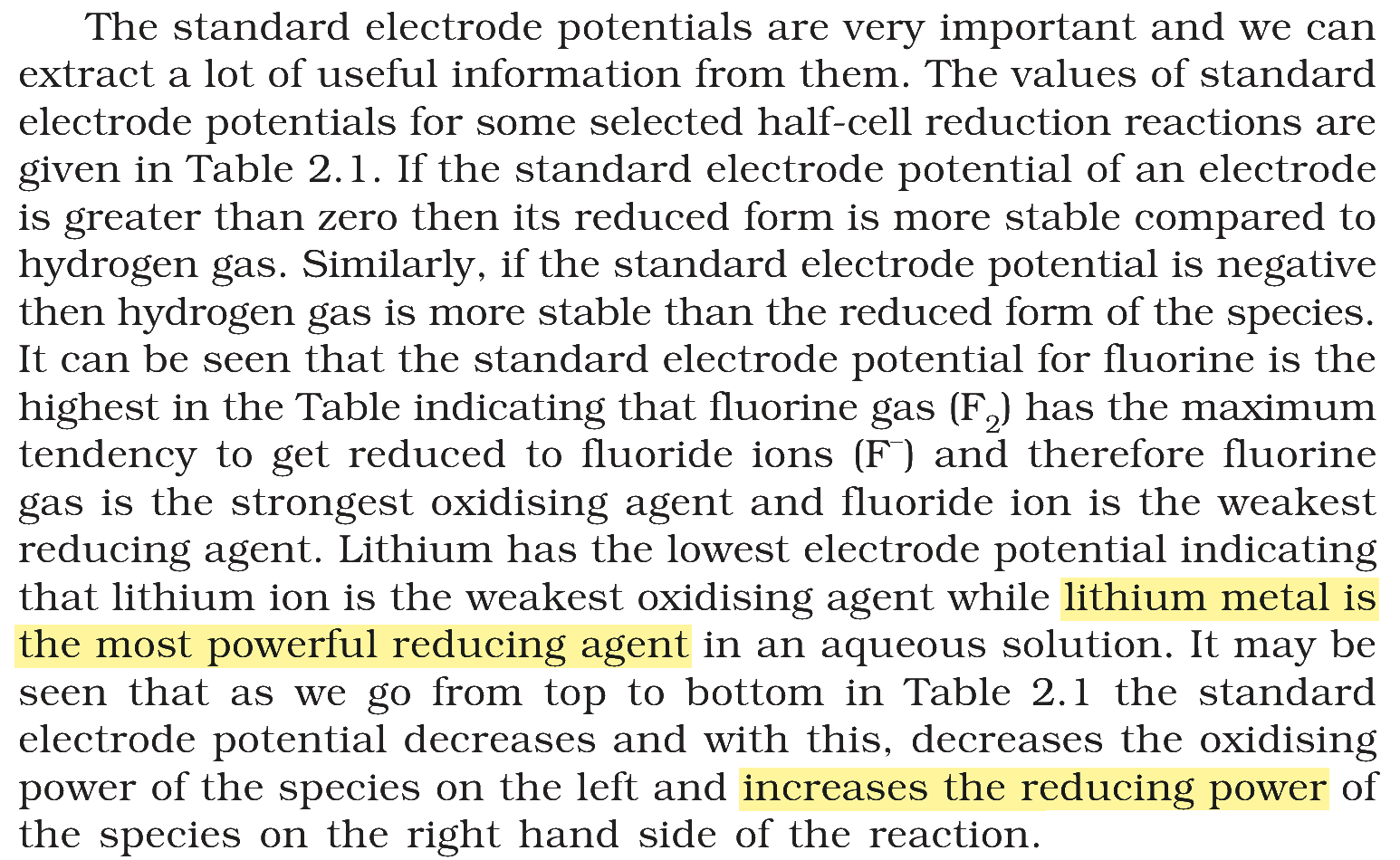
A standard electrode potential is always written as a reduction potential (oxidised form / reduced form). A reducing agent works by losing electrons, and the reduced form of a couple loses electrons more easily when its reduction potential is lower:
More negative E°: the reduced form is a stronger reducing agent, because it is easily oxidised.
More positive E°: the oxidised form is a stronger oxidising agent, and the reduced form is a weaker reducing agent.
So reducing strength increases as E° decreases.
Matching the given species with their couples:
(A) K: \( \ce{K^{+}} \)/K, E° = −2.93 V
(B) Ag: \( \ce{Ag^{+}} \)/Ag, E° = 0.80 V
(C) \( \ce{Br^{-}} \): \( \ce{Br2} \)/\( \ce{Br^{-}} \), E° = 1.09 V
(D) \( \ce{Co^{2+}} \): \( \ce{Co^{3+}} \)/\( \ce{Co^{2+}} \), E° = 1.81 V
Arranging by decreasing E° gives increasing reducing strength:
\( \displaystyle 1.81\ \mathrm{V} > 1.09\ \mathrm{V} > 0.80\ \mathrm{V} > -2.93\ \mathrm{V} \)
\( \displaystyle \ce{Co^2+} < \ce{Br^-} < \ce{Ag} < \ce{K} \)
Shortcut: \( \ce{Co^{2+}} \) (D) has the highest E°, so it is the weakest reducing agent, and K (A) is the strongest. Only Option (4) starts with (D) and ends with (A).
NCERT (2026-27 edition):
Measurement of Electrode Potential – …