
CUETMOCK
  • Pricing
  • Mentors
Log inStart freeStart free mocks→

First test, then trust

Try a free CUET mock test.

Join 5,00,000+ students who rehearsed exam day on the exact NTA screen before sitting CUET. On the web and on Android.

Start free mocks →Get the Android app
CUETMOCK

India's #1 CUET Mock Test Platform. Original NCERT-based questions on the exact NTA exam screen — trusted by 5,00,000+ students since CUET 2022.

Get it onGoogle PlayScan to download the CUETMOCK app

Mock tests

  • CUET mock test series
  • Commerce mocks
  • Humanities (Arts) mocks
  • Science mocks
  • Languages & GAT mocks
  • Free practice questions
  • Pricing

Resources

  • CUET exam guide
  • CUET syllabus
  • Universities accepting CUET
  • Expert blogs
  • News & notifications
  • Webinars & counselling
  • CUET score calculator
  • How we estimate your rank
  • FAQs

Company

  • About us
  • Our leadership & team
  • Our toppers
  • Mentors
  • For schools
  • Contact us
  • Terms
  • Privacy
  • Refund policy

Talk to us

+91 7696 6630 56info@cuetmock.comWhatsApp us

Our other platforms

  • JEE Mock — For IIT-JEE aspirants
  • NEET Mock — For NEET aspirants

Newsletter

Exam updates, study material and offers — no spam.

© 2026 NYC Ventures Pvt. Ltd.

701-702, Royal Business Park, Zirakpur, Punjab - 140603

  • Terms of use
  • Privacy policy
  • Refund policy
  • Contact us

iCUETMOCK is an independent preparation platform, not affiliated with the National Testing Agency (NTA). Always check exam details on the official NTA website.

  • Home
  • Mock tests
  • CUET guide
  • Pricing
  • Log in
Home/Practice questions/Chemistry
ChemistryOrganic: Alcohols, Phenols and Ethers

The following chemical transformations can be achieved through a 4-st…

The following chemical transformations can be achieved through a 4-step reaction involving the step-wise use of the reagents given below in a particular sequence:

A. Cl2/FeCl3

B. Zn dust

C. Zn(Hg)/HCl

D. CH3COCl/AlCl3

Choose the correct answer from the options given below:
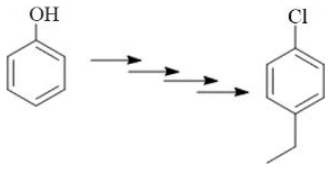
Figure for Q28

Answer & explanation+

Correct answer: option 2

The correct answer is Option (2) → B, A, D, C

In a multi-step synthesis on a benzene ring, the order of the steps matters, because each group already on the ring directs where the next group goes. –Cl is ortho/para directing, while an acyl group (–COCH3) is meta directing. The product has Cl and the ethyl group para to each other and no –OH group.

(B) Zn dust first: heating phenol with zinc dust removes the –OH group and gives benzene.

    \( \displaystyle \ce{C6H5OH + Zn -> C6H6 + ZnO} \)

(A) Cl2/FeCl3: electrophilic chlorination gives chlorobenzene.

    \( \displaystyle \ce{C6H6 + Cl2} \xrightarrow{\ce{FeCl3}} \ce{C6H5Cl + HCl} \)

(D) CH3COCl/AlCl3: Friedel–Crafts acylation. Because Cl is ortho/para directing, the acetyl group enters mainly at the para position, giving 4-chloroacetophenone.

    \( \displaystyle \ce{C6H5Cl + CH3COCl} \xrightarrow{\ce{AlCl3}} \ce{4-ClC6H4COCH3 + HCl} \)

(C) Zn(Hg)/HCl: Clemmensen reduction turns the C=O into \( \ce{CH2} \), giving 1-chloro-4-ethylbenzene.

    \( \displaystyle \ce{4-ClC6H4COCH3} \xrightarrow{\ce{Zn(Hg)/HCl}} \ce{4-ClC6H4CH2CH3} \)

If the acylation were done before the chlorination (B, D, A, C), the meta directing acetyl group would send Cl to the meta position, and the para product would not form.

Advertisement

Practise more on Organic: Alcohols, Phenols and Ethers

Chapter-wise mocks on the real NTA exam screen, with solutions and your rank. Your first mocks are free.

Start free mocks →

Advertisement

Next questions

  1. Choose the word, opposite in meaning to the underlined word in the given sentence:-The benevolent king was very popular with the masses.English · Antonyms
  2. For the function f(x)=|sin 4x+3| , then which of the following statements are correct ?(A) Minimum value of f(x) is 2(B) There is no minimu…Maths. Section B1 · Applications of Derivatives
  3. In the given question, find out which of the answer figures (1), (2), (3), and (4) complete the figure matrix?General Aptitude Test · Non-Verbal Reasoning
  4. Amongst the following, the strongest base in the aqueous medium is :Chemistry · Organic: Amines
  5. The particular solution of the differential equation dy=e^2x+ydx , y(0)=0 isApplied Maths. Section A · Differential Equations (Section A)
  6. According to which of the following schools of thought do human beings move from a state of necessity to a state of freedom, and man is no…Geography · Fundamentals of Human Geography: Human Geography-Nature and Scope
  7. Parents of a 3 year old child want him to develop a favourable attitude towards touching the feet of elders as a sign of respect for them.…Psychology · Attitudes and Social Cognition
  8. Determine which of the answer options complete the figure matrix given below.General Aptitude Test · Non-Verbal Reasoning
  9. A proton accelerated through a potential difference V has a de-Broglie wavelength λ. On doubling the potential difference, the de-Broglie w…Physics · Dual Nature of Radiation and Matter
  10. The smallest wavelength of electromagnetic radiation is forPhysics · Electromagnetic Waves