CUETMOCK
  • Pricing
  • Mentors
Log inStart freeStart free mocks→

First test, then trust

Try a free CUET mock test.

Join 5,00,000+ students who rehearsed exam day on the exact NTA screen before sitting CUET. On the web and on Android.

Start free mocks →Get the Android app
CUETMOCK

India's #1 CUET Mock Test Platform. Original NCERT-based questions on the exact NTA exam screen — trusted by 5,00,000+ students since CUET 2022.

Get it onGoogle PlayScan to download the CUETMOCK app

Mock tests

  • CUET mock test series
  • Commerce mocks
  • Humanities (Arts) mocks
  • Science mocks
  • Languages & GAT mocks
  • Free practice questions
  • Pricing

Resources

  • CUET exam guide
  • CUET syllabus
  • Universities accepting CUET
  • Expert blogs
  • News & notifications
  • Webinars & counselling
  • CUET score calculator
  • How we estimate your rank
  • FAQs

Company

  • About us
  • Our leadership & team
  • Our toppers
  • Mentors
  • For schools
  • Contact us
  • Terms
  • Privacy
  • Refund policy

Talk to us

+91 7696 6630 56info@cuetmock.comWhatsApp us

Our other platforms

  • JEE Mock — For IIT-JEE aspirants
  • NEET Mock — For NEET aspirants

Newsletter

Exam updates, study material and offers — no spam.

© 2026 NYC Ventures Pvt. Ltd.

701-702, Royal Business Park, Zirakpur, Punjab - 140603

  • Terms of use
  • Privacy policy
  • Refund policy
  • Contact us

iCUETMOCK is an independent preparation platform, not affiliated with the National Testing Agency (NTA). Always check exam details on the official NTA website.

  • Home
  • Mock tests
  • CUET guide
  • Pricing
  • Log in
Home/Practice questions/Political Science
Political ScienceContemporary World Politics: Environment and Natural Resources

When did India ratify Kyoto Protocol?

Read the passage and answer the questions:

India’s stand on environmental issues

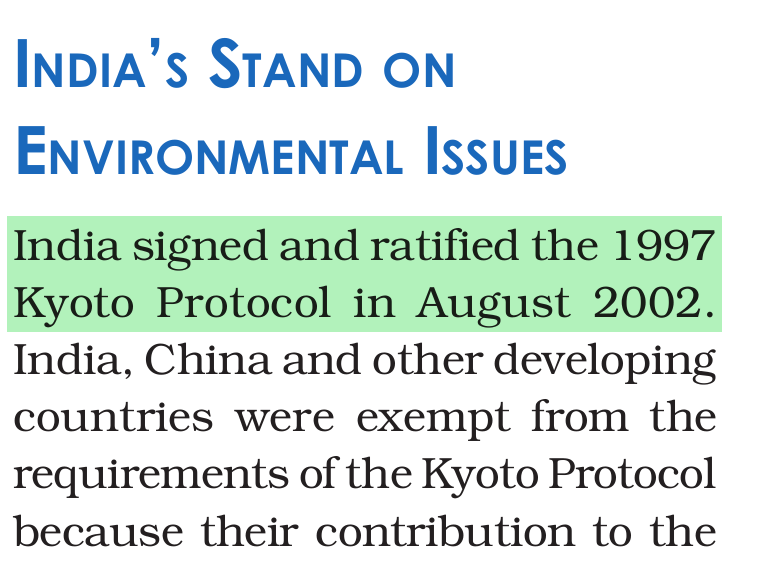
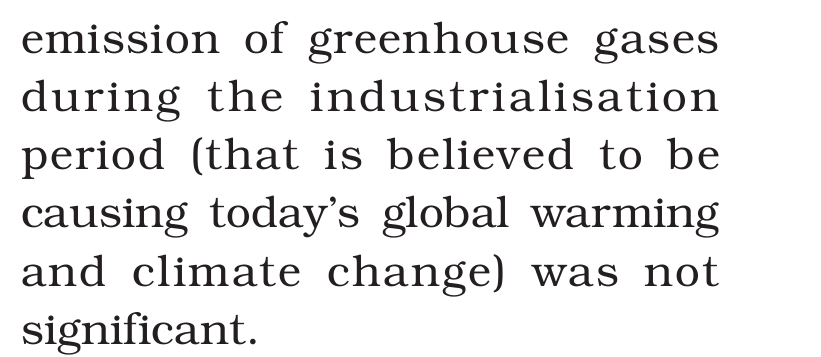
India signed and ratified the 1997 Kyoto Protocol in August 2002. India, China and other developing countries were exempt from the requirements of the Kyoto Protocol because their contribution to the emission of greenhouse gases during the industrialisation period (that is believed to be causing today’s global warming and climate change) was not significant. However, the critics of the Kyoto Protocol point out that sooner or later, both India and China, along with other developing countries, will be among the leading contributors to greenhouse gas emissions. At the G-8 meeting in June 2005, India pointed out that the per capita emission rates of the developing countries are a tiny fraction of those in the developed world. Following the principle of common but differentiated responsibilities, India is of the view that the major responsibility of curbing emission rests with the developed countries, which have accumulated emissions over a long period of time.

India’s international negotiating position relies heavily on principles of historical responsibility, as enshrined in UNFCCC. This acknowledges that developed countries are responsible for most historical and current greenhouse gas emissions, and emphasizes that ‘economic and social development are the first and overriding priorities of the developing country parties’.

So India is wary of recent discussions within UNFCCC about introducing binding commitments on rapidly industrializing countries (such as Brazil, China and India) to reduce their greenhouse gas emissions. India feels this contravenes the very spirit of UNFCCC. Neither does it seem fair to impose restrictions on India when the country’s rise in per capita carbon emissions by 2030 is likely to still represent less than half the world average of 3.8 tonnes in 2000. Indian emissions are predicted to rise from 0.9 tonnes per capita in 2000 to 1.6 tonnes per capita in 2030.

A review of the implementation of the agreements at the Earth Summit in Rio was undertaken by India in 1997. One of the key conclusions was that there had been no meaningful progress with respect to transfer of new and additional financial resources and environmentally-sound technology on concessional terms to developing nations. India finds it necessary that developed countries take immediate measures to provide developing countries with financial resources and clean technologies to enable them to meet their existing commitments under UNFCCC.

When did India ratify Kyoto Protocol?

Answer & explanation+

Correct answer: option 4

The correct answer is Option (4) → 2002

India signed and ratified the 1997 Kyoto Protocol in August 2002.

Note: A same/similar question was asked in CUET (UG) in the papers below.

20262025202420232022
15-05 S116-05 S1*
29-05 S1*
03-06 S2*
–24-05 S1*
28-05 S1*
30-05 S2*
02-06 S1*
09-06 S3*
12-06 S2*
12-06 S3*
18-06 S1*
19-06 S3*
–

* A similar question.


NCERT: Contemporary World Politics — Chapter 6: Environment and Natural Resources (2025-26)

NCERT extract

NCERT extract

Advertisement

Practise more on Contemporary World Politics: Environment and Natural Resources

Chapter-wise mocks on the real NTA exam screen, with solutions and your rank. Your first mocks are free.

Start free mocks →

Advertisement

Next questions

  1. Which of the given molecules were utilized in the Miller’s experiment?A. CH4B. H2SC. NH3D. N2Choose the correct answer from the options giv…Biology · Evolution
  2. Consider the function f(x)=x^4-2x^2 , then which of the following are TRUE?(A) f(x) is increasing on (-1,0) (B) f(x) is decreasing on (0,1)…Maths. Section B1 · Applications of Derivatives
  3. Which of the following is NOT a power/function of the Parliament of India?General Aptitude Test · General Knowledge
  4. Goodwill, if existing in the books of the firm, is written off at the time of admission of a partner, and is:Accountancy Part A · Admission of a Partner
  5. Identify the steps involved in the treatment of sewage in correct sequence.A. Physical removal of particles through filtration and sediment…Biology · Microbes in Human Welfare
  6. Which one is correctA. √3 is irrationalB. Sum of two irrational numbers is always irrationalC. √p , where p is prime, is irrationalD. Every…General Aptitude Test · Numerical Ability
  7. To ascertain the exact amount payable to the retiring partner, some adjustments are usually required. Arrange the following in proper seque…Accountancy Part A · Reconstitution of Partnership Firm: Retirement and Death
  8. Which of the following is a written instrument acknowledging a debt under the common seal of the company?Accountancy Part A · Issue and Redemption of Debentures
  9. A metal sheet 27 cm long, 8 cm broad and 1 cm thick is melted into a cube. Find the difference between the surface areas (in cm2) of the tw…General Aptitude Test · Quantitative Reasoning
  10. K. Santhanam belonged to which state?History · Modern India: Framing the Constitution