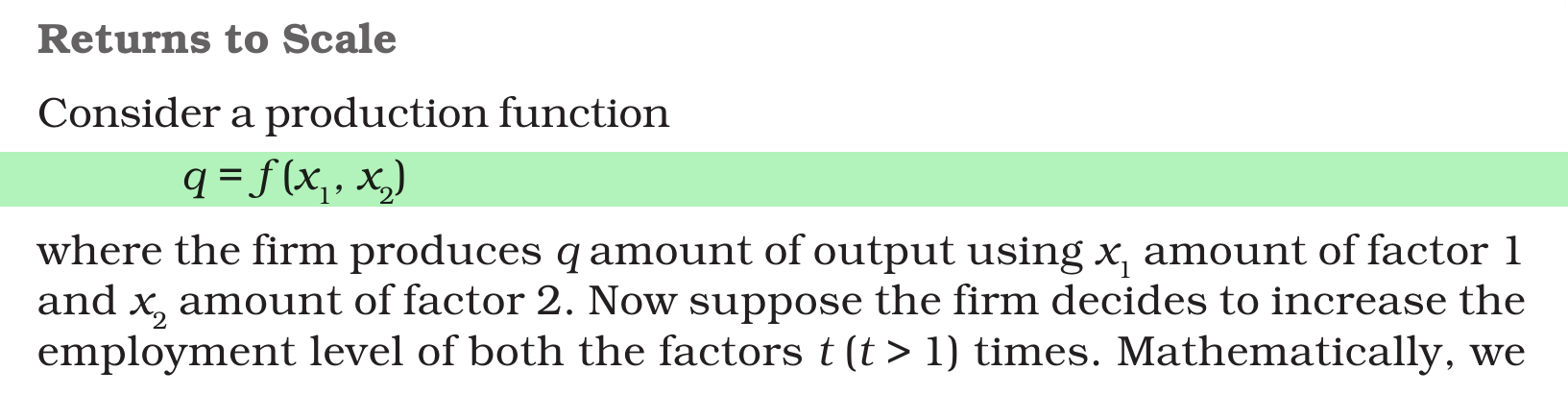
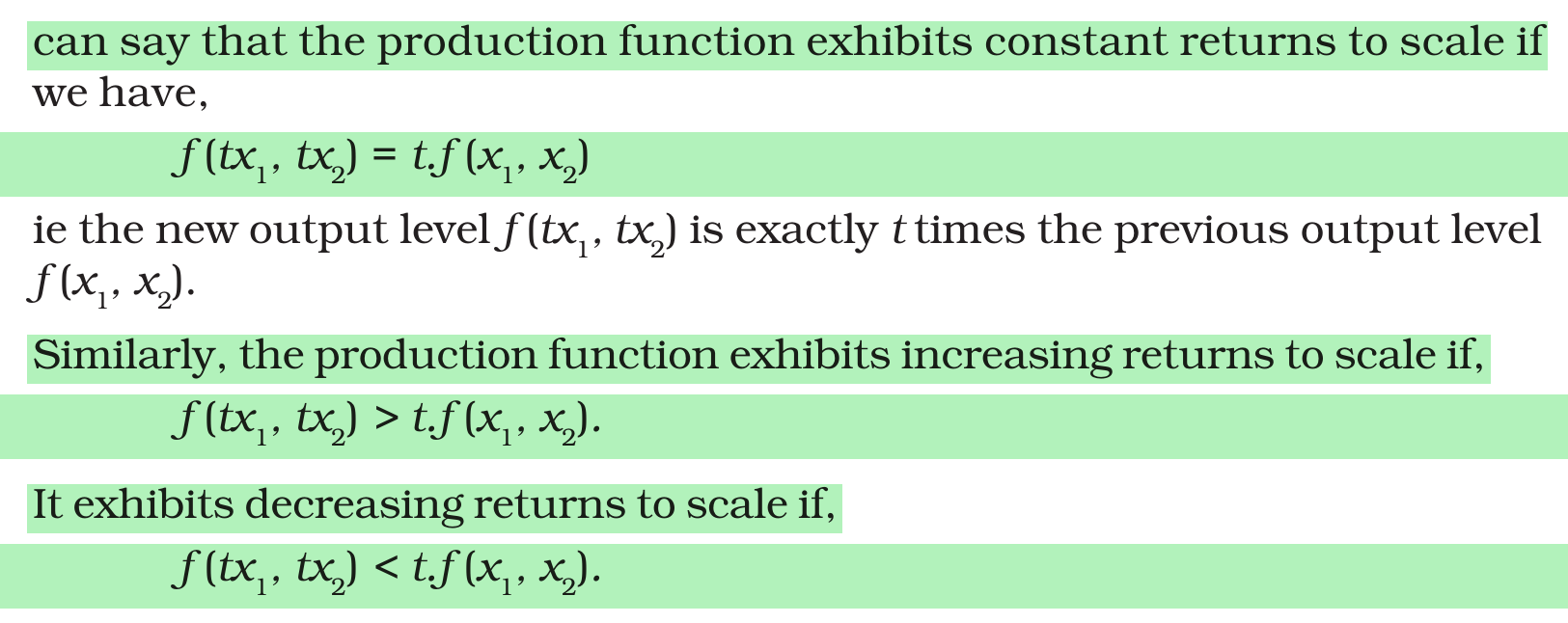
Match List-I with List-II
| List-I | List-II |
| (A) q = f (y1, y2) | (I) Increasing Returns to Scale |
| (B) f (ty1, ty2) = t.f (y1, y2) | (II) Decreasing Returns to Scale |
| (C) f (ty1, ty2) > t.f (y1, y2) | (III) Production Function |
| (D) f (ty1, ty2) < t.f (y1, y2) | (IV) Constant Returns to Scale |
Choose the correct answer from the options given below:
Answer & explanation
Correct answer: option 4
The correct answer is Option (4) → (A) – (III), (B) – (IV), (C) – (I), (D) – (II)
A firm makes output q from two factors, y1 and y2, and the rule that turns inputs into output is its production function. If the firm increases both factors t times (t > 1), output may rise t times, more than t times or less than t times; these three cases are the returns to scale.
(A) q = f (y1, y2) — this matches (III) Production Function. It states the relationship between the inputs used and the maximum output that can be produced from them.
(B) f (ty1, ty2) = t.f (y1, y2) — this matches (IV) Constant Returns to Scale. Output rises t times, in the same proportion, when both inputs rise t times: doubling the inputs doubles the output.
(C) f (ty1, ty2) > t.f (y1, y2) — this matches (I) Increasing Returns to Scale. Output rises by a larger proportion than the inputs: doubling the inputs more than doubles the output.
(D) f (ty1, ty2) < t.f (y1, y2) — this matches (II) Decreasing Returns to Scale. Output rises by a smaller proportion than the inputs: doubling the inputs gives less than double the output.
NCERT: Introductory Microeconomics — Chapter 3: Production and Costs (2025-26)
|