
CUETMOCK
  • Pricing
  • Mentors
Log inStart freeStart free mocks→

First test, then trust

Try a free CUET mock test.

Join 5,00,000+ students who rehearsed exam day on the exact NTA screen before sitting CUET. On the web and on Android.

Start free mocks →Get the Android app
CUETMOCK

India's #1 CUET Mock Test Platform. Original NCERT-based questions on the exact NTA exam screen — trusted by 5,00,000+ students since CUET 2022.

Get it onGoogle PlayScan to download the CUETMOCK app

Mock tests

  • CUET mock test series
  • Browse all papers
  • Commerce mocks
  • Humanities (Arts) mocks
  • Science mocks
  • Languages & GAT mocks
  • Free practice questions
  • Pricing

Resources

  • CUET exam guide
  • CUET syllabus
  • Universities accepting CUET
  • Expert blogs
  • News & notifications
  • Webinars & counselling
  • CUET score calculator
  • How we estimate your rank
  • FAQs

Company

  • About us
  • Our leadership & team
  • Our toppers
  • Mentors
  • For schools
  • Contact us
  • Terms
  • Privacy
  • Refund policy

Talk to us

+91 7696 6630 56info@cuetmock.comWhatsApp us

Our other platforms

  • JEE Mock — For IIT-JEE aspirants
  • NEET Mock — For NEET aspirants

Newsletter

Exam updates, study material and offers — no spam.

© 2026 NYC Ventures Pvt. Ltd.

701-702, Royal Business Park, Zirakpur, Punjab - 140603

  • Terms of use
  • Privacy policy
  • Refund policy
  • Contact us

iCUETMOCK is an independent preparation platform, not affiliated with the National Testing Agency (NTA). Always check exam details on the official NTA website.

  • Home
  • Mock tests
  • CUET guide
  • Pricing
  • Log in
Home/Practice questions/Biology
BiologyOrganisms and Populations

Identify the correct Verhulst-Pearl logistic growth equation.

Identify the correct Verhulst-Pearl logistic growth equation.

Answer & explanation+

Correct answer: option 1

The correct answer is Option (1) → \( \displaystyle\frac{dN}{dt} = rN\left(\frac{K-N}{K}\right) \)

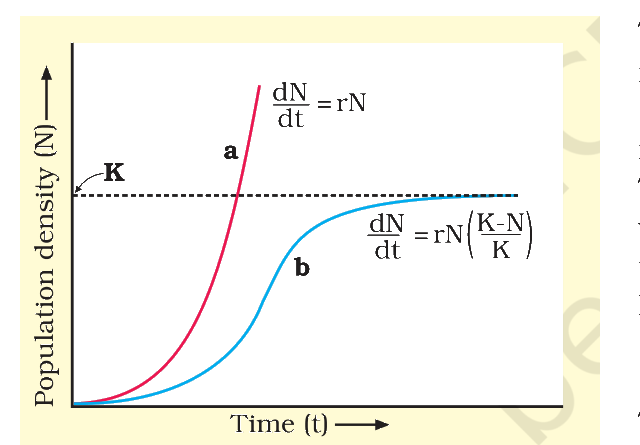
When growth is limited by resources, a population grows in a sigmoid curve. This is Verhulst-Pearl logistic growth. In the equation, N is the population density at time t, r is the intrinsic rate of natural increase and K is the carrying capacity. The factor \( \displaystyle\frac{K-N}{K} \) shows how much room is left. We can test any form with two cases: N very small, and N equal to K.

(1) \( \displaystyle\frac{dN}{dt} = rN\left(\frac{K-N}{K}\right) \) — Correct. For a small N, the bracket is close to 1, so the growth is almost rN, as in exponential growth.

    \( \displaystyle N=K:\quad \frac{dN}{dt} = rN\left(\frac{K-K}{K}\right) = 0 \)

So growth stops at the carrying capacity.

(2) \( \displaystyle\frac{dN}{dt} = rN\left(\frac{K-N}{N}\right) \) — Incorrect. Dividing by N cancels the N outside. The growth rate becomes \( r(K-N) \), which does not fall to rN for a small population.

(3) \( \displaystyle\frac{dN}{dt} = rN\left(\frac{N-K}{K}\right) \) — Incorrect. The sign is reversed. For N below K the bracket is negative, so the population would shrink while it is still below the carrying capacity.

(4) \( \displaystyle\frac{dN}{dt} = rN\left(\frac{N-K}{N}\right) \) — Incorrect. It has both faults: the sign is reversed and the denominator is N.

Note: A similar question was also asked in CUET (UG) 2026 on 21-05-2026 (Slot 1), in CUET (UG) 2025 on 30-05-2025 (Slot 1), in CUET (UG) 2024 on 29-05-2024 (Slot 1), and in CUET (UG) 2023 on 25-05-2023 (Slot 3).

NCERT Extract:
Population Growth – “… A plot of N in relation to time (t) results in a sigmoid curve. This type of population growth is called Verhulst-Pearl Logistic Growth (Figure 11.3) and is described by the following equation:
\( \displaystyle\frac{dN}{dt} = rN\left(\frac{K-N}{K}\right) \)
Where N = Population density at time t
r = Intrinsic rate of natural increase
K = Carrying capacity
Since resources for growth for most animal populations are finite and become limiting sooner or later, the logistic growth model is considered a more realistic one.”
Textbook figure

Figure 11.3 Population growth curve a when responses are not limiting the growth, plot is exponential, b when responses are limiting the growth, plot is logistic, K is carrying capacity

Advertisement

Practise more on Organisms and Populations

Chapter-wise mocks on the real NTA exam screen, with solutions and your rank. Your first mocks are free.

Start free mocks →

Advertisement

Next questions

  1. What is the political consequence of the entry and increased role of multinational companies?Political Science · Contemporary World Politics: Globalisation
  2. At a game of billiards, A can give B 15 points in 60 and A can give C 20 points in 60. How many points can B give C in a game of 180?Applied Maths. Section B2 · Numbers, Quantification and Numerical Applications
  3. In the aftermath of 1967 elections, when Indira Gandhi emerged as a towering leader, what allegation did the Congress make against the judi…Political Science · Politics in India Since Independence: Crisis of democratic Order
  4. Given that the mean of the normal variate X is 10 and the standard deviation is 2, then what will be the z-score of the data point 16?Applied Maths. Section B2 · Inferential Statistics
  5. When smooth walled bacteria were heated, the DNA became non functional due to:Biology · Molecular Basis of Inheritance
  6. If the feasible region (shaded portion) of a LPP is as shown in the graph, then max z=50x+15y is:Applied Maths. Section A · Linear Programming (Section A)
  7. Jhabua district is located in the __________agroclimatic zone of Madhya Pradesh?Geography · India-People and Economy: Geographical Perspective on selected issues and Problems
  8. A magnet of magnetic moment 2 mathrmJ T^-1 is kept along a magnetic field of strength 0.2 T , the work done to turn it in the opposite dire…Physics · Magnetism and Matter
  9. Select the correct words given in List-I to complete the sentences given in List-II :-LIST-ILIST-IIA.laid offI.The wise people always___ mo…English · Grammar: Phrasal Verb
  10. If the matrix A= […] is skew-symmetric, then 4a+3b+2c is equal toApplied Maths. Section B2 · Algebra