
CUETMOCK
  • Pricing
  • Mentors
Log inStart freeStart free mocks→

First test, then trust

Try a free CUET mock test.

Join 5,00,000+ students who rehearsed exam day on the exact NTA screen before sitting CUET. On the web and on Android.

Start free mocks →Get the Android app
CUETMOCK

India's #1 CUET Mock Test Platform. Original NCERT-based questions on the exact NTA exam screen — trusted by 5,00,000+ students since CUET 2022.

Get it onGoogle PlayScan to download the CUETMOCK app

Mock tests

  • CUET mock test series
  • Commerce mocks
  • Humanities (Arts) mocks
  • Science mocks
  • Languages & GAT mocks
  • Free practice questions
  • Pricing

Resources

  • CUET exam guide
  • CUET syllabus
  • Universities accepting CUET
  • Expert blogs
  • News & notifications
  • Webinars & counselling
  • CUET score calculator
  • How we estimate your rank
  • FAQs

Company

  • About us
  • Our leadership & team
  • Our toppers
  • Mentors
  • For schools
  • Contact us
  • Terms
  • Privacy
  • Refund policy

Talk to us

+91 7696 6630 56info@cuetmock.comWhatsApp us

Our other platforms

  • JEE Mock — For IIT-JEE aspirants
  • NEET Mock — For NEET aspirants

Newsletter

Exam updates, study material and offers — no spam.

© 2026 NYC Ventures Pvt. Ltd.

701-702, Royal Business Park, Zirakpur, Punjab - 140603

  • Terms of use
  • Privacy policy
  • Refund policy
  • Contact us

iCUETMOCK is an independent preparation platform, not affiliated with the National Testing Agency (NTA). Always check exam details on the official NTA website.

  • Home
  • Mock tests
  • CUET guide
  • Pricing
  • Log in
Home/Practice questions/Biology
BiologyBiotechnology -Principles and Processes

The selectable marker, which differentiate recombinants from non-reco…

Cloning Vectors

Read the following passage carefully and answer the given questions.

In order to link the alien DNA, the vector needs to have very few, preferably single, recognition sites for the commonly used restriction enzymes. The ligation of alien DNA is carried out at a restriction site present in one of the two antibiotic resistance genes. For example, you can ligate a foreign DNA at the BamH I site of tetracycline resistance gene in the vector pBR322. The recombinant plasmids will lose tetracycline resistance due to insertion of foreign DNA but can still be selected out from non-recombinant ones by plating the transformants on ampicillin containing medium. The transformants growing on ampicillin containing medium are then transferred on a medium containing tetracycline. The recombinants will grow in ampicillin containing medium but not on that containing tetracycline. But, non-recombinants will grow on the medium containing both the antibiotics. In this case, one antibiotic resistance gene helps in selecting the transformants, whereas the other antibiotic resistance gene gets ‘inactivated due to insertion’ of alien DNA, and helps in selection of recombinants. Therefore, alternative selectable markers have been developed which differentiate recombinants from non-recombinants on the basis of their ability to produce colour in the presence of a chromogenic substrate.

The selectable marker, which differentiate recombinants from non-recombinants on the basis of ability to produce colour, is due to -

Answer & explanation+

Correct answer: option 3

The correct answer is Option (3) → Insertional inactivation

(1) Antibiotic resistance genes — Incorrect. These are the older selectable markers. They need the cells to be plated on two plates with different antibiotics, and they do not give any colour.

(2) Insertional activation — Incorrect. This is not a term used for markers. Insertion of the alien DNA switches the gene off, not on.

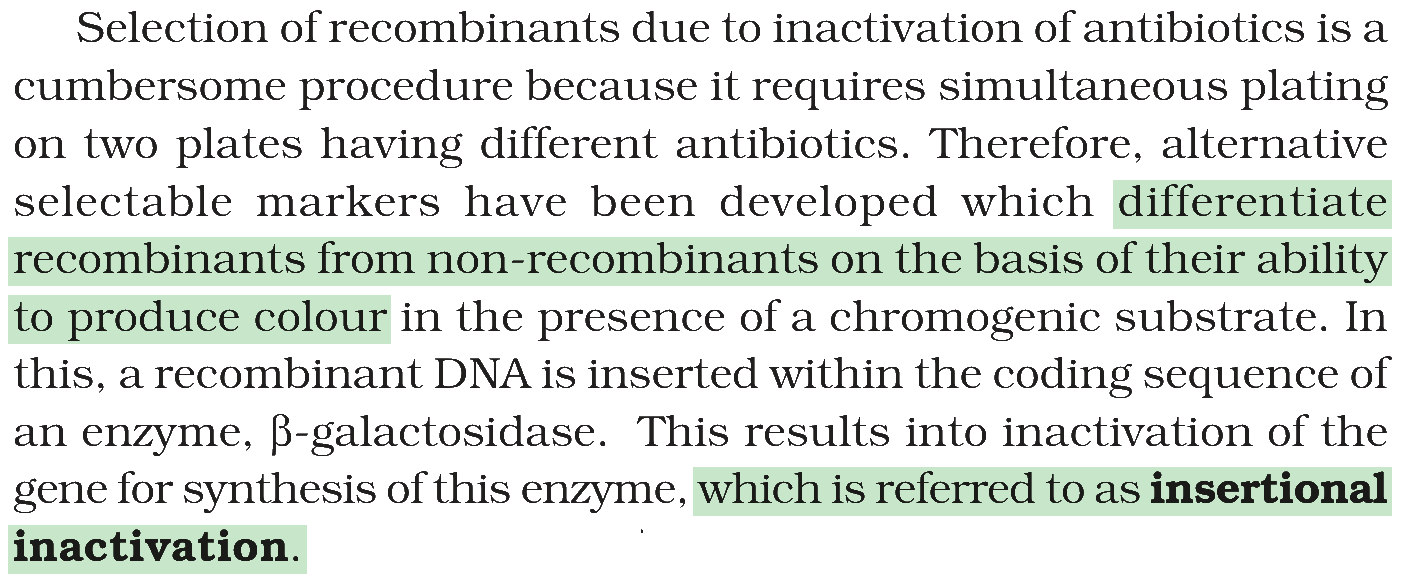
(3) Insertional inactivation — Correct. The alien DNA is inserted inside the coding sequence of an enzyme, β-galactosidase. This inactivates the gene for this enzyme. With a chromogenic substrate, colonies without an insert are blue, and colonies with an insert stay colourless. So the recombinants are told apart by colour.

(4) Non-insertional inactivation — Incorrect. This is not a real term.

Note: The passage is taken from NCERT. NTA has put lines of the NCERT text together to make it. Most CUET (UG) questions come straight from NCERT, so study the book line by line, including figures and their titles.

NCERT Extract:
Cloning Vectors – …
Textbook extract

Advertisement

Practise more on Biotechnology -Principles and Processes

Chapter-wise mocks on the real NTA exam screen, with solutions and your rank. Your first mocks are free.

Start free mocks →

Advertisement

Next questions

  1. Match the LIST-I with LIST-IILIST-ILIST-IIA.Section 43 of Companies Act, 2013I.Calls in advanceB.Interest @10% p.aII.One person companyC.Se…Accountancy Part A · Accounting for Shares
  2. Main workers work for at least __________ days in a year.Geography · India-People and Economy: Population-Distribution,Density, Growth and Composition
  3. A wire of resistance 5 Ω is stretched to three times its original length. The new resistance of the wire isPhysics · Current Electricity
  4. If in a certain code, GO = 32 and SHE = 49, then how will you code SOME?General Aptitude Test · Verbal Reasoning
  5. Which one of the following statements is not correct regarding the Rio Earth Summit?Political Science · Contemporary World Politics: Environment and Natural Resources
  6. What is the essence of law?Sociology · Social Change and Development in India: The Constitution and Social Change
  7. Arrange the following events related to South Asia in the correct chronological order.A. Indo-Soviet Treaty of Friendship was signed.B. Con…Political Science · Contemporary World Politics: Contemporary South Asia
  8. The need of Codification is :Accountancy Part C · Overview of Computerised Accounting System
  9. Which of the following principles of management are not discussed here in passage:Business Studies · Nature and significance of Management
  10. Resistances of a wire at 20^°C and at 500^°C are 20\ Ω and 60\ Ω , respectively. The temperature at which its resistance becomes 25\ Ω will…Physics · Current Electricity