Coordination compounds
The coordination compounds are very important in biological systems (like human, plant and animal's body), metallurgy, analytical chemistry, medicine etc. Chlorophyll, Hemoglobin, vitamin B12 etc. are coordination compounds of various metals. They are also called complex compounds and formed by two main entities, metal and ligands. Some ligands are Poly-dentate, like EDTA, which is used in the estimation of hardness of water with Ca2+ and Mg2+ ions. Gold and silver make [Au(CN)2]− and [Ag(CN)2]− type complex ions in aqueous solution during extraction of metals. In photography, developing film form a complex ion [Ag (S2O3)2]3−. A complex compound of platinum (Pt), cis-platin is used in the treatment of cancer. Some metals can be refined by making their complex compounds, like impure Nickel is converted to [Ni(CO)4] complex. All these coordination compounds may be colored or colorless, paramagnetic or diamagnetic, low spin or high spin, and arranged in particular geometry and hybridization. Isomerism is shown by these complexes due to different arrangement of ligands around the central metal atom.
Choose the chelating ligand from the following:
Answer & explanation
Correct answer: option 4
The correct answer is Option (4) → EDTA4-
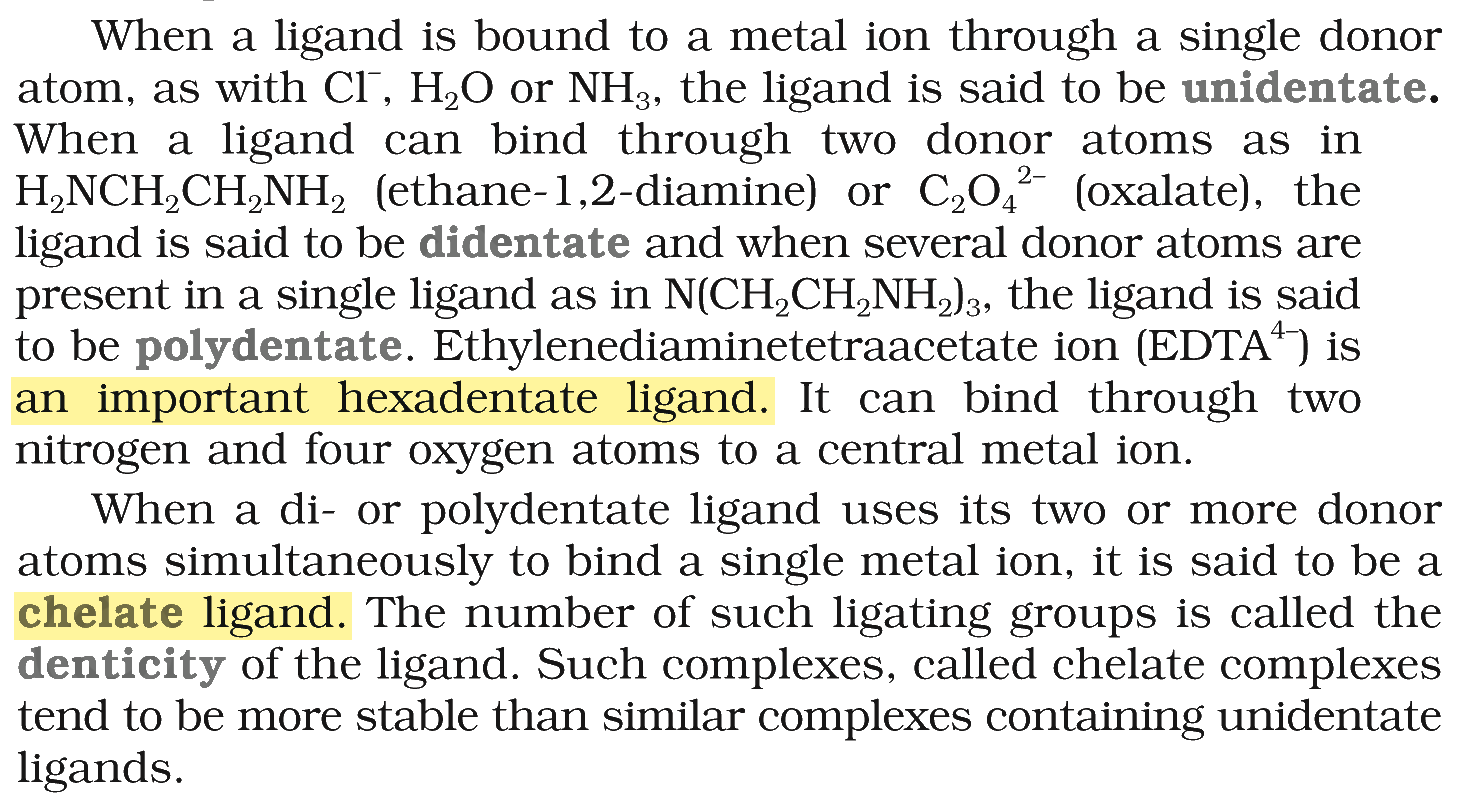
A chelating ligand binds the metal through two or more donor atoms at the same time, so it forms a ring with the metal.
EDTA4− binds through two nitrogen and four oxygen atoms, so it is a chelating ligand.
Why the other options are incorrect
Option (1) CN- — Incorrect. \( \ce{CN^{-}} \) binds through one atom at a time, so it cannot form a ring.
Option (2) (S2O3)2- — Incorrect. In \( \ce{[Ag(S2O3)2]^{3-}} \), each thiosulphate ion binds through a single sulphur atom.
Option (3) CO — Incorrect. CO is unidentate; it binds only through its carbon atom.
NCERT (2026-27 edition):
Definitions of Some Important Terms Pertaining to Coordination Compounds – …