
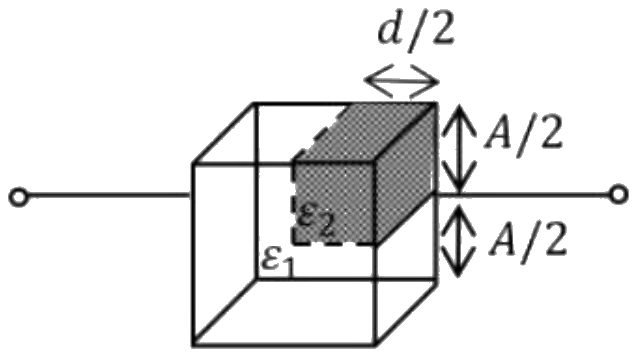
A parallel plate capacitor having air between the plates with separation \( d \) and area \( A \) has capacitance \( C_{0} \). When two dielectrics having dielectric constants \( \varepsilon_{1} = 3,\ \varepsilon_{2} = 4 \), are introduced between the capacitor plates (as shown in figure) the capacitance becomes \( C \). Then \( C/C_{0} \) is equal to
Answer & explanation
Correct answer: option 2
The correct answer is Option (2) → 3.21
Split the capacitor into parts, and combine them in series (dielectric layers stacked between the plates) or in parallel (regions side by side across the plate area).
\( C_{0} = \varepsilon_{0}A/d \)
From the figure, the plates are the left and right faces. The upper half of the plate area \( (A/2) \) holds two layers, \( \varepsilon_{1} \) and \( \varepsilon_{2} \), each \( d/2 \) thick. The lower half \( (A/2) \) is filled with \( \varepsilon_{1} \) across the whole gap \( d \).
Upper half, two layers in series:
\( \displaystyle C_{\mathrm{up}} = \frac{\varepsilon_{0}(A/2)}{\displaystyle\frac{d/2}{\varepsilon_{1}} + \frac{d/2}{\varepsilon_{2}}} = \frac{\varepsilon_{0}A}{d}\cdot\frac{1}{\displaystyle\frac{1}{3} + \frac{1}{4}} = \frac{12}{7}\,C_{0} \)
Lower half:
\( \displaystyle C_{\mathrm{low}} = \frac{\varepsilon_{1}\varepsilon_{0}(A/2)}{d} = \frac{3}{2}\,C_{0} \)
The two halves are in parallel:
\( \displaystyle \frac{C}{C_{0}} = \frac{12}{7} + \frac{3}{2} = \frac{24 + 21}{14} = \frac{45}{14} \approx 3.21 \)