
Comprehension:
Meselson and Stahl experiment
Read the following passage carefully and answer the given questions.
While proposing the double helical structure for DNA, Watson and Crick had immediately proposed a scheme for replication of DNA. To quote their original statement that is as follows: “It has not escaped our notice that the specific pairing we have postulated immediately suggests a possible copying mechanism for the genetic material” (Watson and Crick, 1953). Matthew Meselson and Franklin Stahl performed the following experiment. They grew E. coli in 15N medium and then shifted to 14N medium. After 20 minutes (One generation), DNA shows intermediate density. After 40 minutes, two bands appeared - One intermediate and one light. The study used density gradient centrifugation to demonstrate the mechanism of DNA replication. Very similar experiments involving use of radioactive thymidine to detect distribution of newly synthesised DNA in the chromosomes was performed on Vicia faba by Taylor and colleagues in 1958.
The two bands seen after the second generation are due to:
Answer & explanation
Correct answer: option 1
The correct answer is Option (1) → Some DNA become fully light while some remain hybrid
Follow the strands. After one generation, every DNA molecule has one old 15N strand and one new 14N strand, so all are hybrid. In the second generation, each hybrid molecule opens up. The old 15N strand pairs with a new 14N strand, which gives a hybrid molecule again. The old 14N strand pairs with a new 14N strand, which gives a fully light molecule. So there are equal amounts of hybrid and light DNA, and they form two bands.
(1) Some DNA become fully light while some remain hybrid — Correct. Half of the molecules are hybrid and half are light.
(2) All DNA become fully light — Incorrect. The old 15N strands are still present. They stay in the hybrid molecules.
(3) All DNA become fully hybrid — Incorrect. This is the result after the first generation, which gives only one band.
(4) All DNA are degraded — Incorrect. The DNA was extracted as intact double-stranded helices. Nothing was broken down.
Note: The passage is taken from NCERT. NTA has put lines of the NCERT text together to make it. Most CUET (UG) questions come straight from NCERT, so study the book line by line, including figures and their titles.
NCERT Extract:
The Experimental Proof – “… (ii) Then they transferred the cells into a medium with normal 14NH4Cl and took samples at various definite time intervals as the cells multiplied, and extracted the DNA that remained as double-stranded helices. The various samples were separated independently on CsCl gradients to measure the densities of DNA (Figure 5.7).
(iii) Thus, the DNA that was extracted from the culture one generation after the transfer from 15N to 14N medium [that is after 20 minutes; E. coli divides in 20 minutes] had a hybrid or intermediate density. DNA extracted from the culture after another generation [that is after 40 minutes, II generation] was composed of equal amounts of this hybrid DNA and of ‘light’ DNA.”
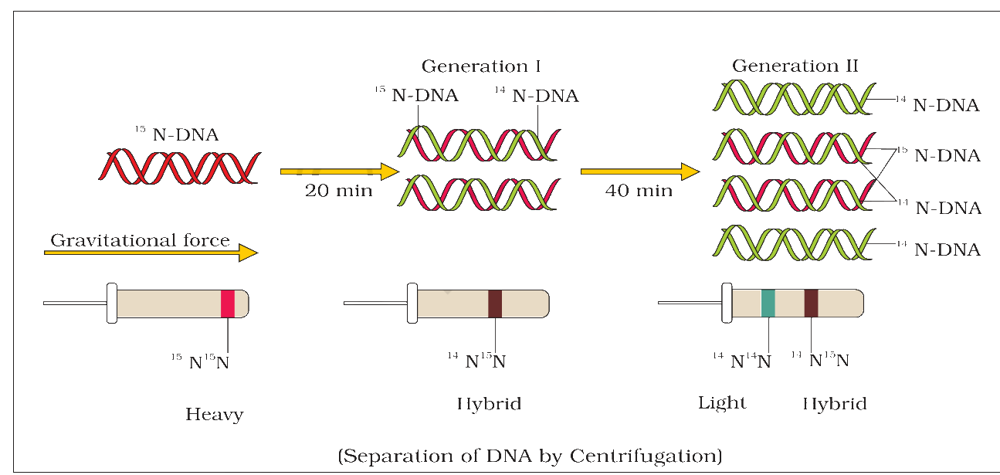
Figure 5.7 Meselson and Stahl’s Experiment