Malaria
Read the following passage carefully and answer the given questions.
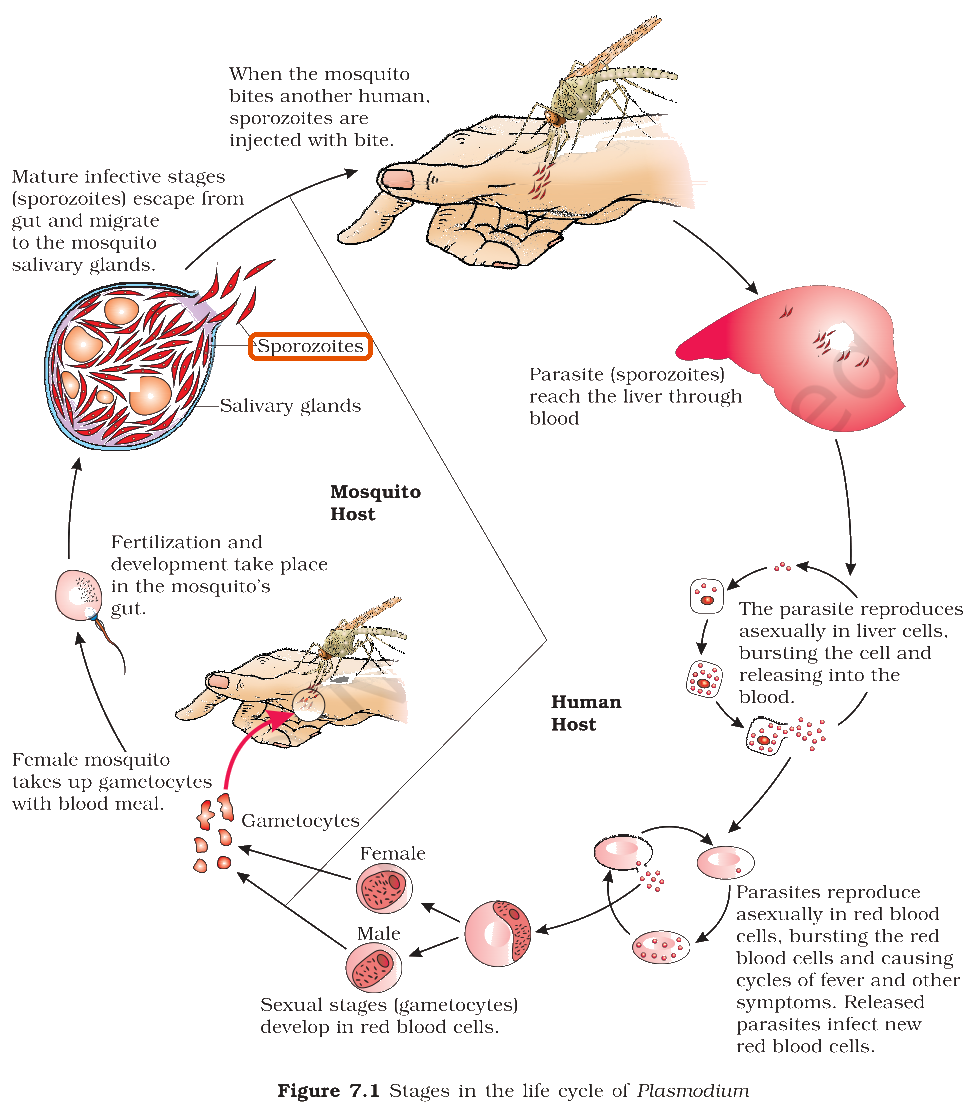
Plasmodium, a tiny protozoan is responsible for malaria. Different species of Plasmodium (P. vivax, P. malaria and P. falciparum) are responsible for different types of malaria. Plasmodium enters the human body as sporozoites through the bite of infected female Anopheles mosquito. The parasites initially multiply within the liver cells and then attack the RBCs resulting in their rupture. The rupture of RBCs is associated with release of a toxic substance, which is responsible for the chill and high fever recurring every three to four days. When a female Anopheles mosquito bites an infected person, these parasites enter the mosquito’s body and undergo further development. The parasites multiply within them to form sporozoites that are stored in their salivary glands. When these mosquitos bite a human, the sporozoites are introduced in the body, thereby initiating the life cycle of parasite. It is interesting to note that the malarial parasite requires two hosts to complete its life cycle.
Identify the correct infective stage of Plasmodium.
Answer & explanation
Correct answer: option 4
The correct answer is Option (4) → Sporozoites
The sporozoite is the infectious form of Plasmodium. It enters the human body through the bite of an infected female Anopheles mosquito. Sporozoites are stored in the salivary glands of the mosquito until it bites.
(1) Liver cells — Incorrect. These are cells of the human body, not a stage of the parasite. They are the first place where the parasite multiplies.
(2) Red blood cells — Incorrect. These are also human cells. The parasite attacks them and bursts them.
(3) Gametocytes — Incorrect. They are the sexual stage. They are formed in the red blood cells and are taken up by the mosquito. They are not the stage that infects humans.
(4) Sporozoites — Correct. This is the form that is passed to humans.
Note 1: The passage is taken from NCERT. NTA has put lines of the NCERT text together to make it. Most CUET (UG) questions come straight from NCERT, so study the book line by line, including figures and their titles.
Note 2: A similar question was also asked in CUET (UG) 2025 on 22-05-2025 (Slot 2).
NCERT Extract:
Common Diseases in Humans – …