When DNA is hydrolyzed, the equal amount of bases guanine and cytosine are obtained. What does this fact suggest about two bases?
Answer & explanation
Correct answer: option 3
The correct answer is Option (3) → These two bases are complementary in the DNA helix.
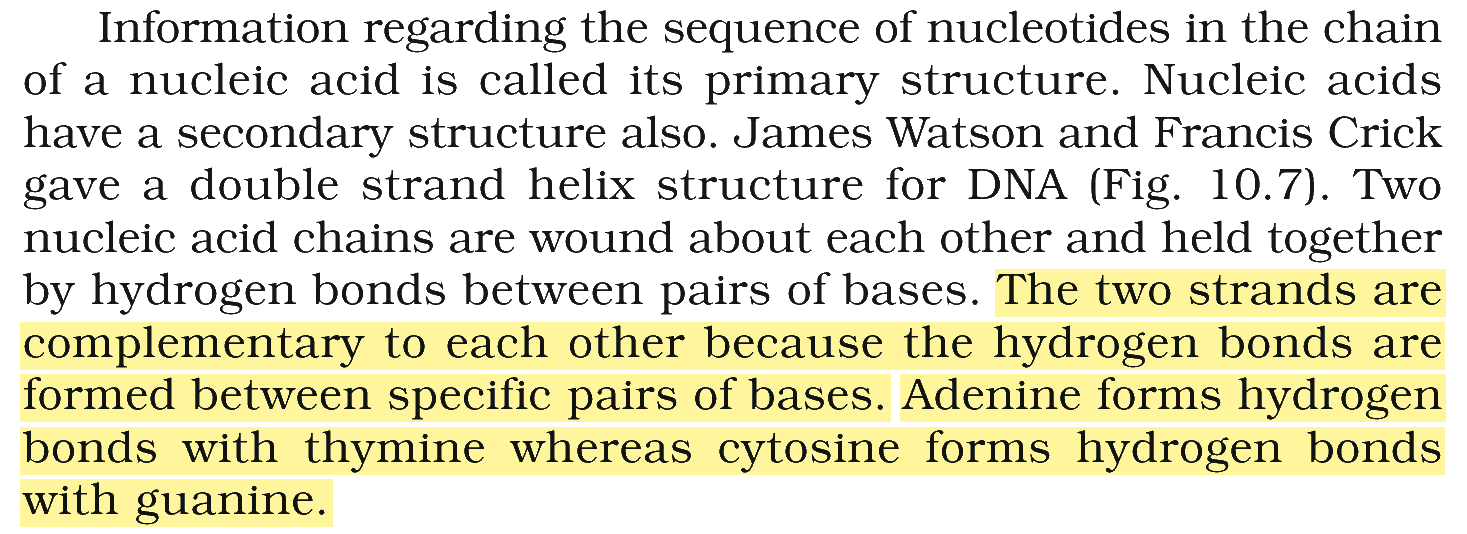
DNA is a double helix: two polynucleotide strands are held together by hydrogen bonds formed only between specific pairs of bases, adenine with thymine (two hydrogen bonds) and guanine with cytosine (three hydrogen bonds). Bases that pair in this way are called complementary bases.
Every guanine on one strand faces a cytosine on the other strand, so when DNA is hydrolysed the amounts of guanine and cytosine come out equal (and likewise adenine and thymine). So the equal amounts show that guanine and cytosine are complementary in the DNA helix.
Why the other options are incorrect
Option (1) These bases are only present in DNA — Incorrect. Guanine and cytosine occur in RNA as well. Only thymine is found in DNA alone.
Option (2) These two bases are capable of separating on hydrolysis of DNA — Incorrect. Hydrolysis sets free all the bases; this says nothing about why two of them come out in equal amounts.
Option (4) DNA has a single stranded structure — Incorrect. A single strand has no reason to contain equal amounts of G and C. The equality is evidence for the double-stranded structure.
NCERT (2026-27 edition):
Structure of Nucleic Acids – …