CUETMOCK
  • Pricing
  • Mentors
Log inStart freeStart free mocks→

First test, then trust

Try a free CUET mock test.

Join 5,00,000+ students who rehearsed exam day on the exact NTA screen before sitting CUET. On the web and on Android.

Start free mocks →Get the Android app
CUETMOCK

India's #1 CUET Mock Test Platform. Original NCERT-based questions on the exact NTA exam screen — trusted by 5,00,000+ students since CUET 2022.

Get it onGoogle PlayScan to download the CUETMOCK app

Mock tests

  • CUET mock test series
  • Commerce mocks
  • Humanities (Arts) mocks
  • Science mocks
  • Languages & GAT mocks
  • Free practice questions
  • Pricing

Resources

  • CUET exam guide
  • CUET syllabus
  • Universities accepting CUET
  • Expert blogs
  • News & notifications
  • Webinars & counselling
  • CUET score calculator
  • How we estimate your rank
  • FAQs

Company

  • About us
  • Our leadership & team
  • Our toppers
  • Mentors
  • For schools
  • Contact us
  • Terms
  • Privacy
  • Refund policy

Talk to us

+91 7696 6630 56info@cuetmock.comWhatsApp us

Our other platforms

  • JEE Mock — For IIT-JEE aspirants
  • NEET Mock — For NEET aspirants

Newsletter

Exam updates, study material and offers — no spam.

© 2026 NYC Ventures Pvt. Ltd.

701-702, Royal Business Park, Zirakpur, Punjab - 140603

  • Terms of use
  • Privacy policy
  • Refund policy
  • Contact us

iCUETMOCK is an independent preparation platform, not affiliated with the National Testing Agency (NTA). Always check exam details on the official NTA website.

  • Home
  • Mock tests
  • CUET guide
  • Pricing
  • Log in
Home/Practice questions/History
HistoryAncient India: Thinkers, Beliefs and Buildings

Which of the following is not identified as a Buddhist text?

Which of the following is not identified as a Buddhist text?

Answer & explanation+

Correct answer: option 1

The correct answer is Option (1) → Panchatantra

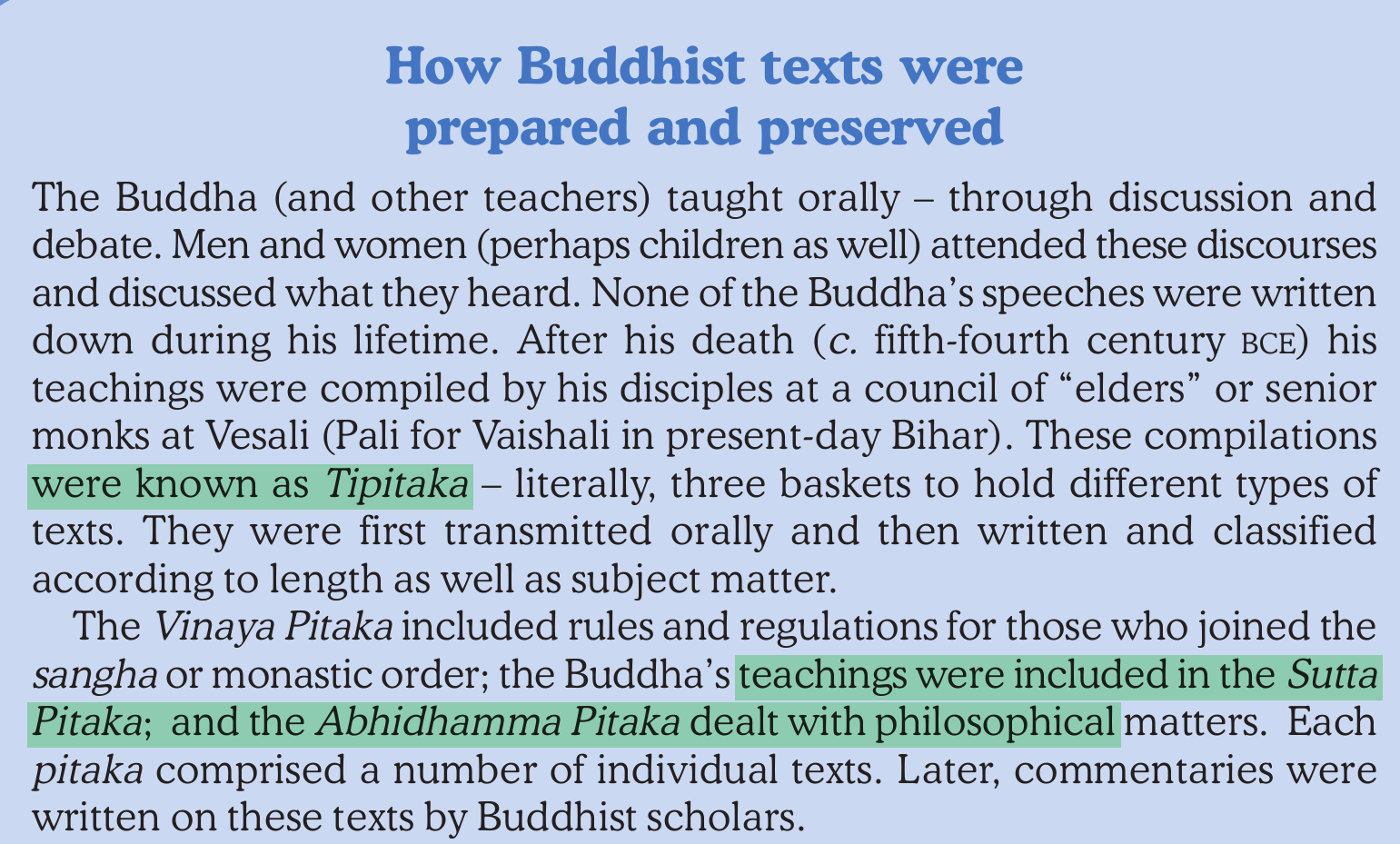
After the Buddha’s death his teachings were compiled into the Tipitaka, the ‘three baskets’: the Vinaya Pitaka (rules for the sangha), the Sutta Pitaka (the Buddha’s teachings) and the Abhidhamma Pitaka (philosophical matters). The Ashokavadana is also a Buddhist text; it says that Asoka sent portions of the Buddha’s relics to every important town and had stupas built over them. The Panchatantra is not a Buddhist text: it is a collection of stories, many of which began as popular oral tales.


NCERT (2025-26): “7.1 Why were stupas built? … According to a Buddhist text known as the Ashokavadana, Asoka distributed portions of the Buddha’s relics to every important town and ordered the construction of stupas over them.…

5.1 Popular perceptions of kings … Nevertheless, historians have tried to solve this problem by examining stories contained in anthologies such as the Jatakas and the Panchatantra. Many of these stories probably originated as popular oral tales that were later committed to writing.…”

NCERT extract

Advertisement

Practise more on Ancient India: Thinkers, Beliefs and Buildings

Chapter-wise mocks on the real NTA exam screen, with solutions and your rank. Your first mocks are free.

Start free mocks →

Advertisement

Next questions

  1. Which political ideas associated with the artist are used in folk themes?Fine Arts · The Bengal School and Cultural Nationalism
  2. Identify the correct statements in regards to ‘Vijayanagara Empire’:A. The chiefs were known as ‘nayakas’ and usually spoke in Tamil or Ben…History · Medieval India: An Imperial Capital: Vijayanagara
  3. What miracle did the protagonist witness in the given passage?English · Comprehension - (Narrative / Factual)
  4. The altitude drawn to the base of an isosceles triangle is 16 cm and its perimeter is 64 cm. What is the area of the triangle?General Aptitude Test · Quantitative Reasoning
  5. Match the LIST-I with LIST-IILIST-ILIST-IIInequalitySolution SpaceA. 2x+3y≥ 6 I.half plane contains the origin, also points on the line 2x+…Applied Maths. Section A · Linear Programming (Section A)
  6. The present value of a perpetuity of Rs. 5,000 payable at the beginning of each year, if the money is worth 8% effective isApplied Maths. Section B2 · Financial Mathematics
  7. What is the least value of n (n is number of years), the sum of money put out at 20% of CI (Compound Interest) will be more than double?General Aptitude Test · Numerical Ability
  8. Fill in the blank with the correct option given below to complete the sentence:She must abide _____ my decision.English · Grammar: Preposition
  9. “From this first circuit until you enter the city there is great distance, in which are fields in which they sow rice and have many gardens…History · Medieval India: An Imperial Capital: Vijayanagara
  10. Which among the following was the initial impact of British industrialisation in India?Sociology · Social Change and Development in India: Structural Change