
CUETMOCK
  • Pricing
  • Mentors
Log inStart freeStart free mocks→

First test, then trust

Try a free CUET mock test.

Join 5,00,000+ students who rehearsed exam day on the exact NTA screen before sitting CUET. On the web and on Android.

Start free mocks →Get the Android app
CUETMOCK

India's #1 CUET Mock Test Platform. Original NCERT-based questions on the exact NTA exam screen — trusted by 5,00,000+ students since CUET 2022.

Get it onGoogle PlayScan to download the CUETMOCK app

Mock tests

  • CUET mock test series
  • Browse all papers
  • Commerce mocks
  • Humanities (Arts) mocks
  • Science mocks
  • Languages & GAT mocks
  • Free practice questions
  • Pricing

Resources

  • CUET exam guide
  • CUET syllabus
  • Universities accepting CUET
  • Expert blogs
  • News & notifications
  • Webinars & counselling
  • CUET score calculator
  • How we estimate your rank
  • FAQs

Company

  • About us
  • Our leadership & team
  • Our toppers
  • Mentors
  • For schools
  • Contact us
  • Terms
  • Privacy
  • Refund policy

Talk to us

+91 7696 6630 56info@cuetmock.comWhatsApp us

Our other platforms

  • JEE Mock — For IIT-JEE aspirants
  • NEET Mock — For NEET aspirants

Newsletter

Exam updates, study material and offers — no spam.

© 2026 NYC Ventures Pvt. Ltd.

701-702, Royal Business Park, Zirakpur, Punjab - 140603

  • Terms of use
  • Privacy policy
  • Refund policy
  • Contact us

iCUETMOCK is an independent preparation platform, not affiliated with the National Testing Agency (NTA). Always check exam details on the official NTA website.

  • Home
  • Mock tests
  • CUET guide
  • Pricing
  • Log in
Home/Practice questions/Maths. Section B1
Maths. Section B1Linear Programming

Which of the following group of constraints represents the feasible r…

Which of the following group of constraints represents the feasible region given as shaded area below ?
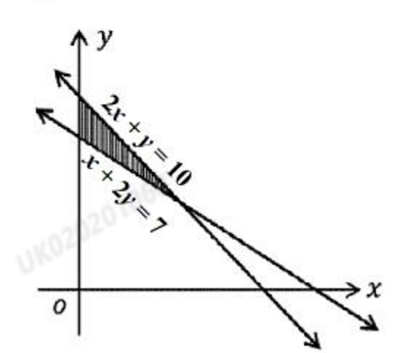
Feasible region for Q35

Answer & explanation+

Correct answer: option 3

The correct answer is Option (3) → \( x+2y\ge 7,2x+y\le 10,x,y\ge 0 \)

The line x + 2y = 7 meets the y-axis at (0, 3.5) and the line 2x + y = 10 at (0, 10). The shaded region lies between these two lines, to the right of the y-axis, so it is above x + 2y = 7 and below 2x + y = 10.

A test point inside the shaded region confirms this, for example (1, 5) (at x = 1 the lines are at y = 3 and y = 8):

    \( \displaystyle x+2y=1+10=11\ge 7 \)
    \( \displaystyle 2x+y=2+5=7\le 10 \)

So the constraints are \( x+2y\ge 7,\ 2x+y\le 10,\ x,y\ge 0 \).

Advertisement

Practise more on Linear Programming

Chapter-wise mocks on the real NTA exam screen, with solutions and your rank. Your first mocks are free.

Start free mocks →

Advertisement

Next questions

  1. Which of the following term is related to Beck’s cognitive therapy?Psychology · Therapeutic Approaches
  2. Why is water pollution a major cause of concern for India?Geography · India-People and Economy: Geographical Perspective on selected issues and Problems
  3. Wipro shifted from:Business Studies · Organising
  4. If the beams of electrons and protons are moving parallel to each other in the same direction, then, they willPhysics · Moving Charges and Magnetism
  5. Aspirin is chemically known asChemistry · Organic: Alcohols, Phenols and Ethers
  6. Every company registered under The Companies Act 2013 shall prepare its balance sheet, accordance with the manner prescribed in the revised…Accountancy Part B · Financial Statements of a Company
  7. Identify the correct statements about population growth.(A) The number of deaths in a population during a given period is called mortality.…Biology · Organisms and Populations
  8. Let the median of a variable equilateral triangle is increasing at the rate of 2√3 cm/s. Then the rate at which its each side is increasing…Maths. Section B1 · Applications of Derivatives
  9. The BJP continued to consolidate its position in which elections?Political Science · Politics in India Since Independence: Recent Developments in Indian Politics
  10. Which amino acids are obtained by hydrolysis of proteins ?Chemistry · Organic: Biomolecules