CUETMOCK
  • Pricing
  • Mentors
Log inStart freeStart free mocks→

First test, then trust

Try a free CUET mock test.

Join 5,00,000+ students who rehearsed exam day on the exact NTA screen before sitting CUET. On the web and on Android.

Start free mocks →Get the Android app
CUETMOCK

India's #1 CUET Mock Test Platform. Original NCERT-based questions on the exact NTA exam screen — trusted by 5,00,000+ students since CUET 2022.

Get it onGoogle PlayScan to download the CUETMOCK app

Mock tests

  • CUET mock test series
  • Commerce mocks
  • Humanities (Arts) mocks
  • Science mocks
  • Languages & GAT mocks
  • Free practice questions
  • Pricing

Resources

  • CUET exam guide
  • CUET syllabus
  • Universities accepting CUET
  • Expert blogs
  • News & notifications
  • Webinars & counselling
  • CUET score calculator
  • How we estimate your rank
  • FAQs

Company

  • About us
  • Our leadership & team
  • Our toppers
  • Mentors
  • For schools
  • Contact us
  • Terms
  • Privacy
  • Refund policy

Talk to us

+91 7696 6630 56info@cuetmock.comWhatsApp us

Our other platforms

  • JEE Mock — For IIT-JEE aspirants
  • NEET Mock — For NEET aspirants

Newsletter

Exam updates, study material and offers — no spam.

© 2026 NYC Ventures Pvt. Ltd.

701-702, Royal Business Park, Zirakpur, Punjab - 140603

  • Terms of use
  • Privacy policy
  • Refund policy
  • Contact us

iCUETMOCK is an independent preparation platform, not affiliated with the National Testing Agency (NTA). Always check exam details on the official NTA website.

  • Home
  • Mock tests
  • CUET guide
  • Pricing
  • Log in
Home/Practice questions/Chemistry
ChemistryOrganic: Haloalkanes and Haloarenes

Match List-I with List-IIReactionName of Reaction(A) (I) Finkelstein…

Match List-I with List-II

ReactionName of Reaction
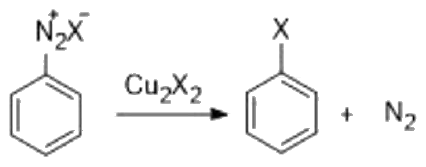
(A) Reaction A for Q2(I) Finkelstein Reaction
(B) CH3–Br + AgF → CH3–F + AgBr(II) Swarts Reaction
(C) CH3–Cl + NaI → CH3–I + NaCl(III) Fittig Reaction
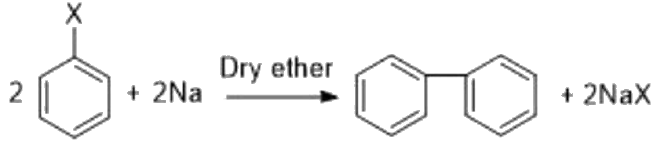
(D) Reaction D for Q2(IV) Sandmeyer’s Reaction

Choose the correct answer from the options given below:

Answer & explanation+

Correct answer: option 3

The correct answer is Option (3) → (A) - (IV), (B) - (II), (C) - (I), (D) - (III)

The four named reactions belong to three families, and each is recognised by its starting material and reagent:

  • Halogen exchange: Finkelstein (alkyl chloride or bromide + NaI in dry acetone gives an alkyl iodide) and Swarts (alkyl chloride or bromide + a metallic fluoride gives an alkyl fluoride).

  • From diazonium salts: Sandmeyer (\( \ce{Cu2Cl2} \)/HCl or \( \ce{Cu2Br2} \)/HBr) and its relative Gattermann (copper powder with HCl or HBr) replace the –\( \ce{N2^+} \) group by Cl or Br.

  • Coupling with sodium in dry ether: Wurtz joins two alkyl groups, Fittig joins two aryl groups, and Wurtz–Fittig joins an alkyl and an aryl group.

Each item of the list:

  • (A) Reaction A — This matches (IV) Sandmeyer’s Reaction. A benzenediazonium salt treated with cuprous chloride or cuprous bromide gives the aryl halide, and nitrogen gas is released.

        \( \displaystyle \ce{C6H5N2^+X^-} \xrightarrow{\ce{Cu2X2}} \ce{C6H5X + N2} \)

  • (B) \( \ce{CH3-Br} \) + AgF → \( \ce{CH3-F} \) + AgBr — This matches (II) Swarts Reaction. An alkyl chloride or bromide heated with a metallic fluoride such as AgF, \( \ce{Hg2F2} \), \( \ce{CoF2} \) or \( \ce{SbF3} \) gives an alkyl fluoride.

        \( \displaystyle \ce{CH3-Br + AgF -> CH3-F + AgBr} \)

  • (C) \( \ce{CH3-Cl} \) + NaI → \( \ce{CH3-I} \) + NaCl — This matches (I) Finkelstein Reaction. An alkyl chloride or bromide reacts with NaI in dry acetone to give an alkyl iodide. The NaCl formed is insoluble in acetone and precipitates, which drives the reaction forward.

        \( \displaystyle \ce{CH3-Cl + NaI} \xrightarrow{\text{dry acetone}} \ce{CH3-I + NaCl v} \)

  • (D) Reaction D — This matches (III) Fittig Reaction. Two molecules of an aryl halide react with sodium in dry ether, and the two aryl groups join to form a diaryl.

        \( \displaystyle \ce{2C6H5X + 2Na} \xrightarrow{\text{Dry ether}} \ce{C6H5-C6H5 + 2NaX} \)

Advertisement

Practise more on Organic: Haloalkanes and Haloarenes

Chapter-wise mocks on the real NTA exam screen, with solutions and your rank. Your first mocks are free.

Start free mocks →

Advertisement

Next questions

  1. Udyami Bharat Program was launched in 2022 to boost:General Aptitude Test · Current Affairs
  2. Identify the incorrect fact about the pedigree analysis.Biology · Principles of Inheritance and Variation
  3. Arrange the following events related to regional aspirations in the correct chronological order.(A) The Assam Accord(B) Sikkim asking for f…Political Science · Politics in India Since Independence: Regional Aspirations
  4. Identify the second most populous state of India as per Census 2011.Geography · India-People and Economy: Population-Distribution,Density, Growth and Composition
  5. Match List-I with List-II:List-ITravellerList-IITimeline(A)Afanasii Nikitich Nikitin(I)Thirteenth-Century(B)Marco Polo(II)Fifteenth-Century…History · Medieval India: Through the Eyes of Travellers
  6. Which of the following are related to forfeiture of shares issued on premium:(A) Share capital is debited with called up amount(B) Calls in…Accountancy Part A · Accounting for Shares
  7. Viticulture is a speciality of which region?Geography · Fundamentals of Human Geography: Primary Activities
  8. A newly admitted partner has a right to:Accountancy Part A · Admission of a Partner
  9. In which of the following year Thomas Malthus proposed his theory on population?Geography · Fundamentals of Human Geography: World Population-Distribution, Density and growth
  10. Tao Ying's son's concern about the ticket shows that children, compared to adults, are :English · Comprehension - (Poetry / Literary)