During the process of formation of a p-n junction
Answer & explanation
Correct answer: option 2
The correct answer is Option (2) → Initially the diffusion current is much larger than the drift current.
When a p-n junction is formed, there is a large concentration difference: many holes on the p-side and many electrons on the n-side. So at first holes diffuse into the n-side and electrons into the p-side, and the diffusion current is large.
This diffusion leaves behind immobile ions: positive donor ions on the n-side and negative acceptor ions on the p-side. These form a depletion layer with an electric field from n to p, which drives a drift current opposite to the diffusion current. The drift current grows until it equals the diffusion current, and then the junction is in equilibrium.
Option (1) Initially the drift current is much larger than the diffusion current. — Incorrect. At the start there is no depletion layer and hence no field, so the drift current is nearly zero; it builds up only as diffusion proceeds.
Option (2) Initially the diffusion current is much larger than the drift current. — Correct. The concentration gradient is largest at the start, so diffusion dominates until the field of the depletion layer builds up.
Option (3) There is a negative space charge region on the n-side of the junction. — Incorrect. The n-side loses electrons and keeps positive donor ions, so the space charge on the n-side is positive; the negative space charge is on the p-side.
Option (4) There is no net electric field across the junction. — Incorrect. The space charges set up an electric field across the junction (from the n-side to the p-side), which gives the barrier potential.
NCERT (2026-27):
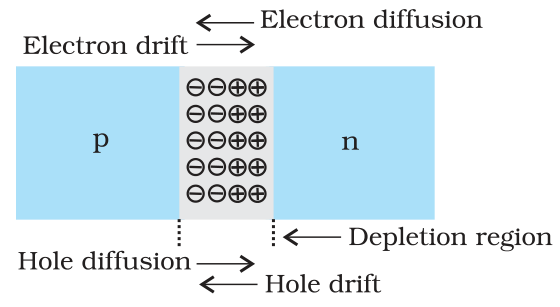
p-n Junction Formation – “… Two important processes occur during the formation of a p-n junction: diffusion and drift. We know that in an n-type semiconductor, the concentration of electrons (number of electrons per unit volume) is more compared to the concentration of holes. Similarly, in a p-type semiconductor, the concentration of holes is more than the concentration of electrons. During the formation of p-n junction, and due to the concentration gradient across p-, and n- sides, holes diffuse from p-side to n-side (p → n) and electrons diffuse from n-side to p-side (n → p). This motion of charge carries gives rise to diffusion current across the junction.
When an electron diffuses from n → p, it leaves behind an ionised donor on n-side. This ionised donor (positive charge) is immobile as it is bonded to the surrounding atoms. As the electrons continue to diffuse from n → p, a layer of positive charge (or positive space-charge region) on n-side of the junction is developed.
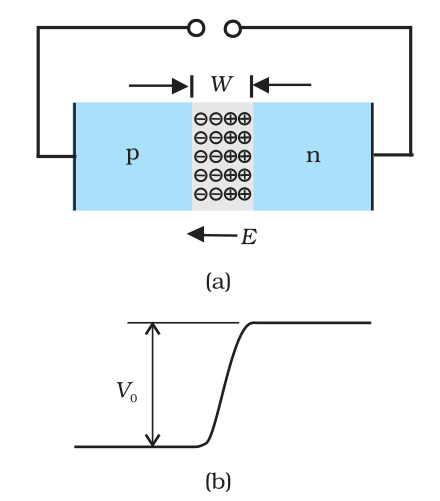
Similarly, when a hole diffuses from p → n due to the concentration gradient, it leaves behind an ionised acceptor (negative charge) which is immobile. As the holes continue to diffuse, a layer of negative charge (or negative space-charge region) on the p-side of the junction is developed. This space-charge region on either side of the junction together is known as depletion region as the electrons and holes taking part in the initial movement across the junction depleted the region of its free charges …. The thickness of depletion region is of the order of one-tenth of a micrometre. Due to the positive space-charge region on n-side of the junction and negative space charge region on p-side of the junction, an electric field directed from positive charge towards negative charge develops. Due to this field, an electron on p-side of the junction moves to n-side and a hole on n-side of the junction moves to p-side. The motion of charge carriers due to the electric field is called drift. Thus a drift current, which is opposite in direction to the diffusion current … starts.
Initially, diffusion current is large and drift current is small. As the diffusion process continues, the space-charge regions on either side of the junction extend, thus increasing the electric field strength and hence drift current. This process continues until the diffusion current equals the drift current. Thus a p-n junction is formed. In a p-n junction under equilibrium there is no net current.
The loss of electrons from the n-region and the gain of electron by the p-region causes a difference of potential across the junction of the two regions. The polarity of this potential is such as to oppose further flow of carriers so that a condition of equilibrium exists. … The n-material has lost electrons, and p material has acquired electrons. The n material is thus positive relative to the p material. Since this potential tends to prevent the movement of electron from the n region into the p region, it is often called a barrier potential.”