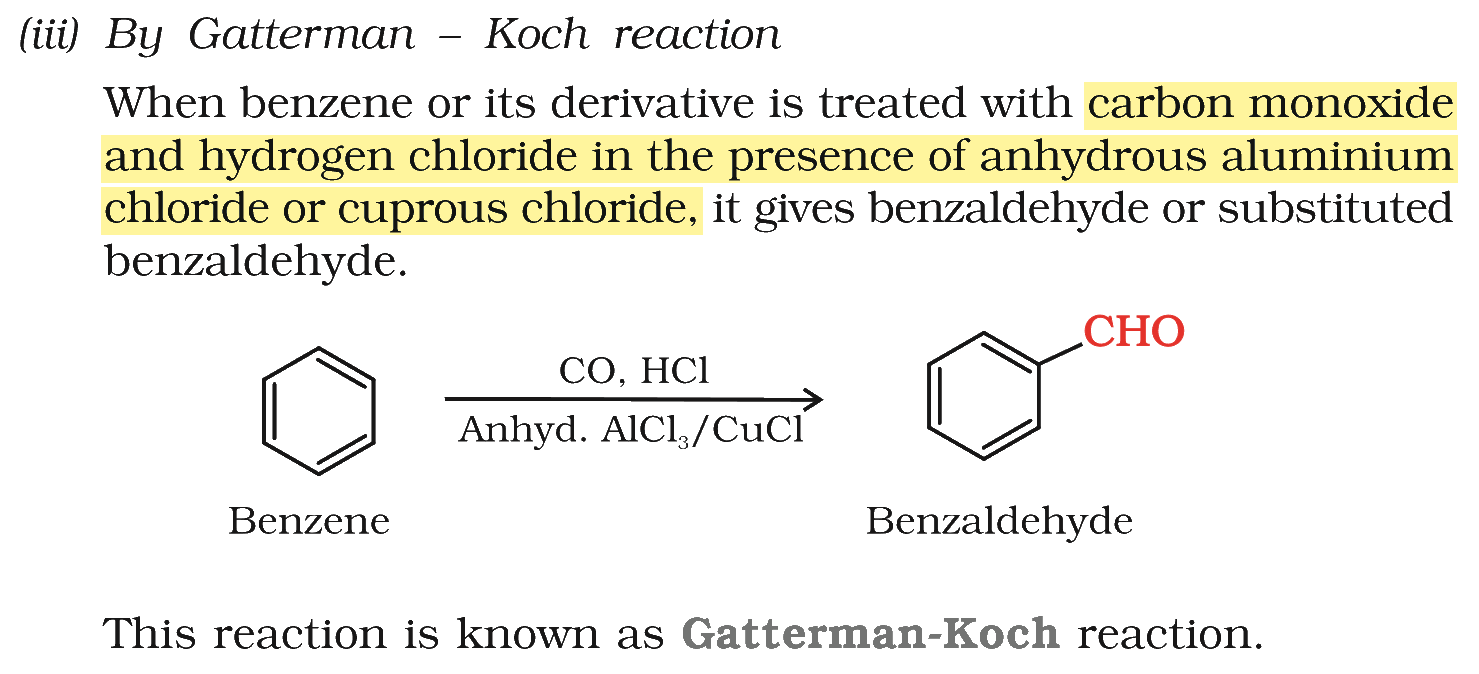
The reagents used in the Gattermann-Koch reaction for the synthesis of benzaldehyde from benzene are
Answer & explanation
Correct answer: option 4
The correct answer is Option (4) → CO, HCl, anhyd. AlCl3 /CuCl.
Benzaldehyde can be made from benzene or toluene in several ways, and each named reaction has its own reagents. In the Gattermann–Koch reaction, benzene is treated with carbon monoxide and hydrogen chloride in the presence of anhydrous AlCl3 or CuCl; the CO and HCl together put a –CHO group on the ring:
\( \displaystyle \ce{C6H6} \xrightarrow[\text{anhyd. }\ce{AlCl3}/\ce{CuCl}]{\ce{CO},\ \ce{HCl}} \ce{C6H5CHO} \)
Two other reactions that look similar use different reagents and starting materials:
Etard reaction: toluene is oxidised by chromyl chloride in \( \ce{CS2} \); the chromium complex formed is hydrolysed to benzaldehyde.
\( \displaystyle \ce{C6H5CH3} \xrightarrow[\text{(ii) }\ce{H3O+}]{\text{(i) }\ce{CrO2Cl2},\ \ce{CS2}} \ce{C6H5CHO} \)
Reimer–Tiemann reaction: phenol with chloroform and aqueous alkali, then acid, gives salicylaldehyde (2-hydroxybenzaldehyde), not benzaldehyde.
\( \displaystyle \ce{C6H5OH} \xrightarrow[\text{(ii) }\ce{H+}]{\text{(i) }\ce{CHCl3}\text{ + aq. }\ce{NaOH}} \text{2-hydroxybenzaldehyde} \)
Why the other options are incorrect
Option (1) CHCl3, KOH, anhyd. AlCl3. — Incorrect. Chloroform with an alkali belongs to the Reimer–Tiemann reaction, which works on phenol and gives salicylaldehyde.
Option (2) CO, KOH, anhyd. AlCl3. — Incorrect. CO is right, but the reaction needs HCl, not KOH; a base would destroy the Lewis acid catalyst.
Option (3) CrO2Cl2 in CS2 , H3O+, Heat. — Incorrect. These are the reagents of the Etard reaction, which starts from toluene, not benzene.
NCERT (2026-27 edition):
By Gattermann-Koch Reaction