
CUETMOCK
  • Pricing
  • Mentors
Log inStart freeStart free mocks→

First test, then trust

Try a free CUET mock test.

Join 5,00,000+ students who rehearsed exam day on the exact NTA screen before sitting CUET. On the web and on Android.

Start free mocks →Get the Android app
CUETMOCK

India's #1 CUET Mock Test Platform. Original NCERT-based questions on the exact NTA exam screen — trusted by 5,00,000+ students since CUET 2022.

Get it onGoogle PlayScan to download the CUETMOCK app

Mock tests

  • CUET mock test series
  • Commerce mocks
  • Humanities (Arts) mocks
  • Science mocks
  • Languages & GAT mocks
  • Free practice questions
  • Pricing

Resources

  • CUET exam guide
  • CUET syllabus
  • Universities accepting CUET
  • Expert blogs
  • News & notifications
  • Webinars & counselling
  • CUET score calculator
  • How we estimate your rank
  • FAQs

Company

  • About us
  • Our leadership & team
  • Our toppers
  • Mentors
  • For schools
  • Contact us
  • Terms
  • Privacy
  • Refund policy

Talk to us

+91 7696 6630 56info@cuetmock.comWhatsApp us

Our other platforms

  • JEE Mock — For IIT-JEE aspirants
  • NEET Mock — For NEET aspirants

Newsletter

Exam updates, study material and offers — no spam.

© 2026 NYC Ventures Pvt. Ltd.

701-702, Royal Business Park, Zirakpur, Punjab - 140603

  • Terms of use
  • Privacy policy
  • Refund policy
  • Contact us

iCUETMOCK is an independent preparation platform, not affiliated with the National Testing Agency (NTA). Always check exam details on the official NTA website.

  • Home
  • Mock tests
  • CUET guide
  • Pricing
  • Log in
Home/Practice questions/Chemistry
ChemistryPhysical: Chemical Kinetics

The rate constant of a nuclear decay is k = 6.5 × 10⁻¹⁴ s−1. Which of…

The rate constant of a nuclear decay is k = 6.5 × 10⁻¹⁴ s−1. Which of the following statements is true for the half-life of the reaction and the time taken for the reaction to go to completion?

Answer & explanation+

Correct answer: option 3

The correct answer is Option (3) → t1/2 = 1.07 × 10¹³ s and it will go to completion in infinite time.

Every radioactive (nuclear) decay follows first order kinetics. This is clear from the unit of the rate constant here, s−1. For a first order reaction the integrated rate equation and the half-life are:

    \( \displaystyle [R]=[R]_0\,e^{-kt} \)

    \( \displaystyle t_{1/2}=\frac{0.693}{k} \)

Two facts follow:

  • The half-life is independent of the starting amount; it depends only on k.

  • After every half-life only half of what is left decays, so [R] becomes 1/2, 1/4, 1/8 ... of [R]0 but never becomes zero. A first order reaction therefore reaches completion only in infinite time. (In practice about 99.9% is over after 10 half-lives.)

Here k = 6.5 × 10⁻¹⁴ s−1:

    \( \displaystyle t_{1/2}=\frac{0.693}{6.5\times10^{-14}\ \mathrm{s^{-1}}} \)

    \( \displaystyle t_{1/2}=0.1066\times10^{14}\ \mathrm{s}\approx1.07\times10^{13}\ \mathrm{s} \)

So t1/2 = 1.07 × 10¹³ s, and the decay goes to completion only in infinite time.

Why the other options are incorrect

  • Option (1) t1/2 = 1.26 × 10¹³ s and it will go to completion in time equal to 5 half lives — Incorrect. The half-life value is wrong, and after 5 half-lives 1/32 (about 3%) of the substance is still left.

  • Option (2) t1/2 = 1.26 × 10¹³ s and it will go to completion in time equal to 50 half lives — Incorrect. The half-life value is wrong, and even after 50 half-lives a fraction (1/2)50 remains; a first order reaction is never fully complete.

  • Option (4) t1/2 = 1.07 × 10¹³ s and it will go to completion in time equal to 14 half lives — Incorrect. The half-life is correct, but after 14 half-lives (1/2)14 of the substance is still left, so the decay is not complete.

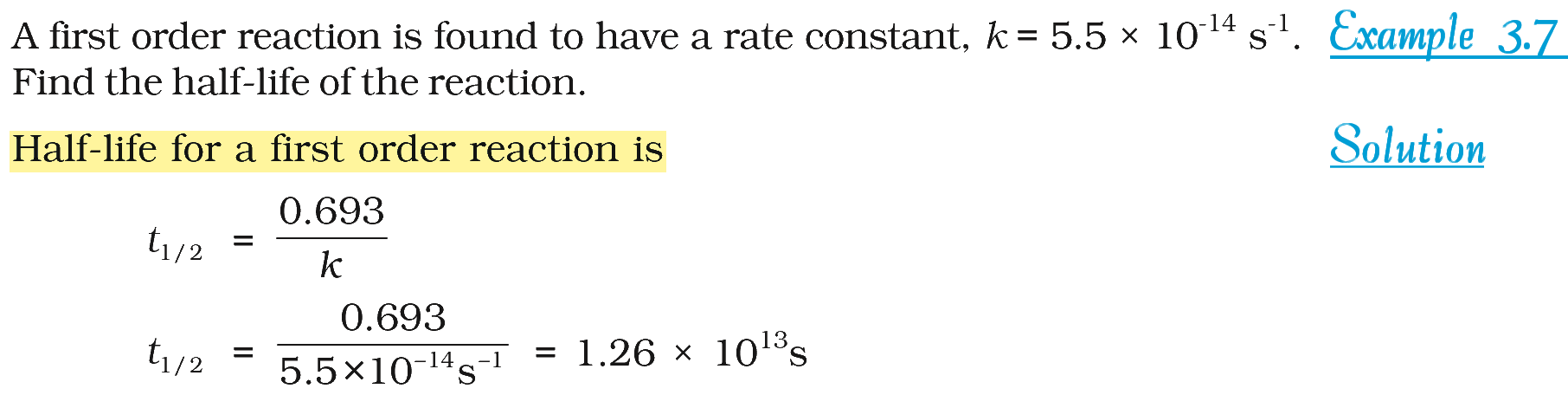
Note: NTA picked this question from an NCERT (2026-27) example and changed the figures. Do not ignore NCERT while practising numericals.

NCERT (2026-27 edition):
Half-Life of a Reaction – …
Textbook extract

Advertisement

Practise more on Physical: Chemical Kinetics

Chapter-wise mocks on the real NTA exam screen, with solutions and your rank. Your first mocks are free.

Start free mocks →

Advertisement

Next questions

  1. If the objective function z=10(x-7y+190) and the corner points of the bounded feasible region are A(0,4), B(0,5), C(3,5), D(5,3), E(5,0), F…Applied Maths. Section B2 · Linear Programming
  2. The minimum value of e^x+e^-x isApplied Maths. Section A · Applications of Derivatives (Section A)
  3. Find the area of triangle whose base measures 22 cm and the corresponding height measures 18 cm.General Aptitude Test · Quantitative Reasoning
  4. The following points summarize the nature of principles of managementA. Universal applicabilityB. Formed by practice and Science laboratory…Business Studies · Principles of Management
  5. The scientists, who independently rediscovered Mendel’s results on the inheritance of characters were:Biology · Principles of Inheritance and Variation
  6. Identify the limitations of Behavioral Ratings.A. Halo effectB. Middle category biasC. FakingD. Extreme response biasE. PrejudiceChoose the…Psychology · Self and Personality
  7. Which of the following cannot be prepared by Sandmeyer reaction ?Chemistry · Organic: Amines
  8. Two-thirds of the consignment was sold at a profit of 8% and the remainder at a loss of 4%. If the total profit was ₹500, find the value of…General Aptitude Test · Numerical Ability
  9. If y=3e^2x+2e^3x , then (d^2y)/(dx^2)-5dy/dx is equal toApplied Maths. Section A · Continuity and Differentiability (Section A)
  10. What is the average time taken for a new person to pick up the skills?Business Studies · Staffing