Which of the following reactions/tests can be used to distinguish between primary, secondary and tertiary amines?
Answer & explanation
Correct answer: option 3
The correct answer is Option (3) → Hinsberg test
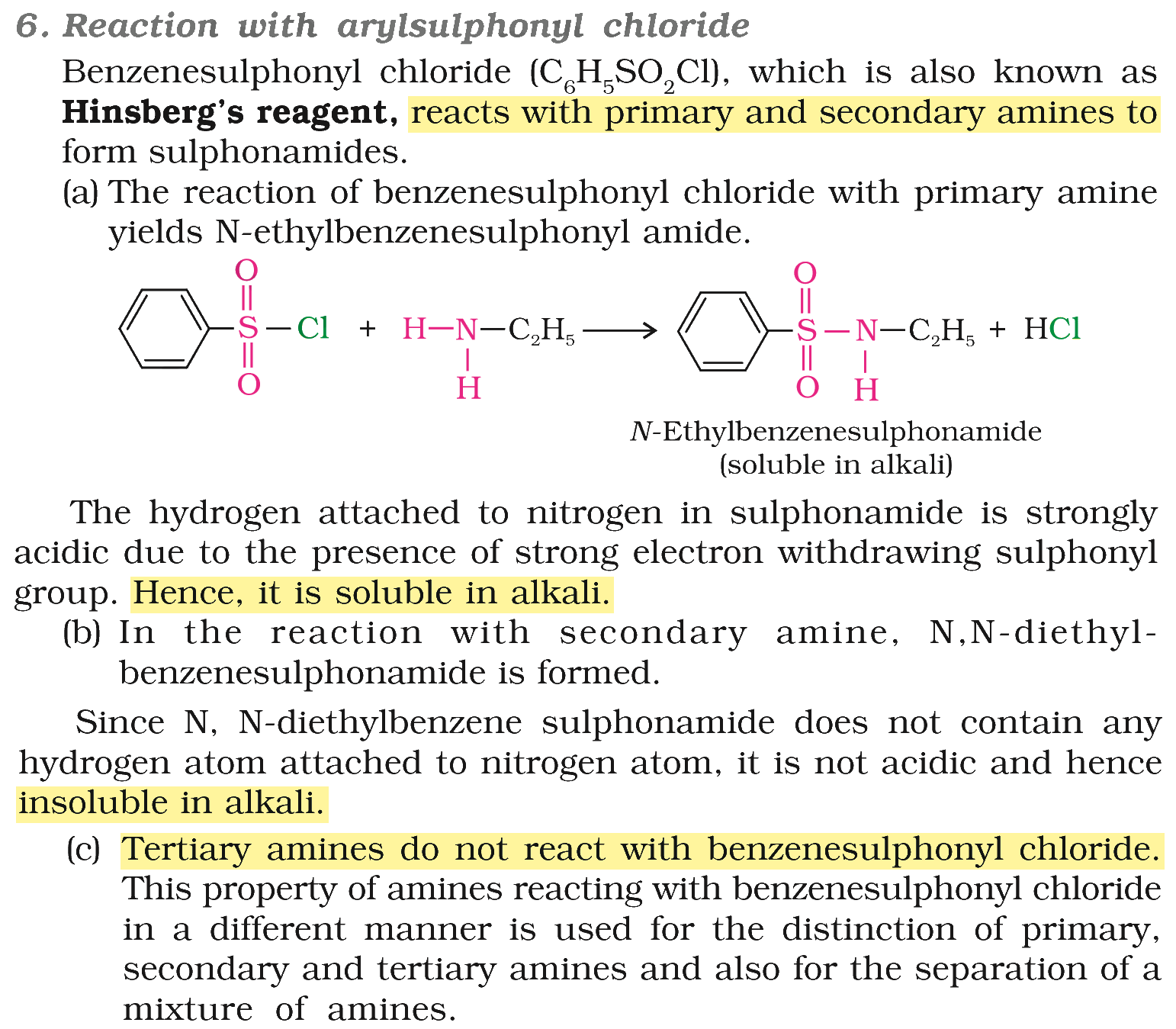
Hinsberg’s reagent, benzenesulphonyl chloride (\( \ce{C6H5SO2Cl} \)), reacts with an N–H bond of an amine, so the three classes of amines give three different results:
\( \displaystyle \ce{C6H5SO2Cl + H2N-R -> C6H5SO2NH-R + HCl}\quad(1^{\circ}) \)
\( \displaystyle \ce{C6H5SO2Cl + HNR2 -> C6H5SO2NR2 + HCl}\quad(2^{\circ}) \)
The primary product dissolves in alkali, the secondary one does not, and a tertiary amine does not react, so the Hinsberg test tells the three classes apart.
Why the other options are incorrect
Option (1) Carbylamine test — Incorrect. Only primary amines give the foul-smelling isocyanide with \( \ce{CHCl3} \) and ethanolic KOH. Secondary and tertiary amines both give no reaction, so they cannot be told apart.
\( \displaystyle \ce{R-NH2 + CHCl3 + 3KOH} \xrightarrow{\Delta} \ce{R-NC + 3KCl + 3H2O} \)
Option (2) Bromine water test — Incorrect. Aniline gives a white precipitate of 2,4,6-tribromoaniline. This tests for an activated aromatic ring, not for the class of an amine.
\( \displaystyle \ce{C6H5NH2 + 3Br2} \xrightarrow{\ce{H2O}} \ce{C6H2Br3NH2 v + 3HBr} \)
Option (4) Lucas test — Incorrect. \( \ce{ZnCl2} \) in concentrated HCl distinguishes primary, secondary and tertiary alcohols, not amines; a tertiary alcohol gives turbidity at once:
\( \displaystyle \ce{ROH + HCl} \xrightarrow{\text{anhyd. }\ce{ZnCl2}} \ce{RCl + H2O} \)
NCERT (2026-27 edition):
Reaction with Arylsulphonyl Chloride