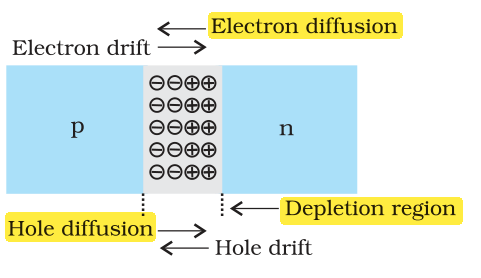
The depletion layer in a p-n junction is formed due to
Answer & explanation
Correct answer: option 3
The correct answer is Option (3) → diffusion of charge carriers
When the junction is formed, there are many electrons on the n-side and many holes on the p-side. This concentration difference makes electrons diffuse into the p-side and holes into the n-side, where they recombine. They leave behind uncovered, immobile donor and acceptor ions near the junction. This region with no free carriers is the depletion layer, and it is created by diffusion.
Why the other options are incorrect
Option (1) drift of holes — Incorrect. Drift of carriers is caused by the junction field after the layer has formed; it opposes diffusion and limits the layer's width.
Option (2) drift of electrons — Incorrect. The same applies to drift of electrons; drift is a consequence of the depletion layer, not its cause.
Option (4) migration of impurity ions — Incorrect. The impurity ions are fixed in the crystal lattice and do not move.
Note: The same question was also asked in CUET (UG) 2025 on 16-05-2025 (Slot 1).
NCERT (2026-27):
p-n Junction Formation – “… When an electron diffuses from \( \mathrm{n}\rightarrow\mathrm{p} \), it leaves behind an ionised donor on n-side. … Similarly, when a hole diffuses from \( \mathrm{p}\rightarrow\mathrm{n} \) due to the concentration gradient, it leaves behind an ionised acceptor (negative charge) which is immobile. … This space-charge region on either side of the junction together is known as depletion region as the electrons and holes taking part in the initial movement across the junction depleted the region of its free charges (Fig. 14.10).”