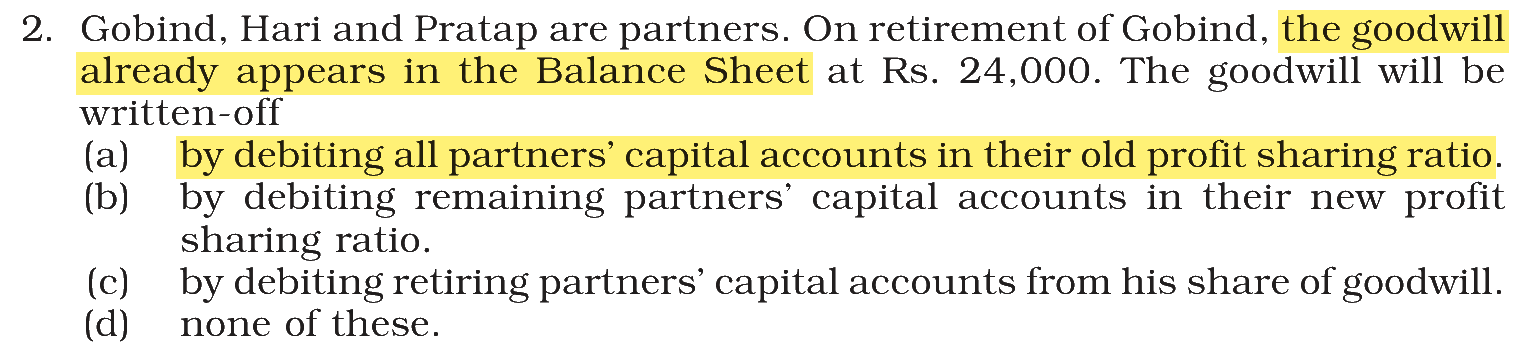
Ganesh, Hari and Mahadev are partners. On retirement of Ganesh, the goodwill already appears in the Balance Sheet at Rs. 24,000. The goodwill will be written-off by:
Answer & explanation
Correct answer: option 1
The correct answer is Option (1) → Debiting capital accounts of Ganesh, Hari and Mahadev in their old profit sharing ratio.
Goodwill that already appears in the Balance Sheet was recorded while all three partners were in the firm, so it belongs to all of them. Before the retirement is settled, this old goodwill is written off by debiting all the partners’ capital accounts, the retiring partner included, in their old profit sharing ratio, and crediting Goodwill Account with Rs. 24,000.
Ganesh’s share of the goodwill valued at the time of retirement is a separate step: the gaining partners pay it to him through their capital accounts.
Why the other options are incorrect
Option (2) Debiting capital accounts of Hari and Mahadev in their new profit sharing ratio — Incorrect. This leaves Ganesh out of the write-off, though the old goodwill was his as much as theirs. The new ratio governs only the profits earned after he leaves.
Option (3) Debiting Ganesh’s Capital Account from his share of goodwill — Incorrect. It charges the retiring partner alone. Writing off an asset the firm owned falls on every partner who owned it, in the old ratio.
Option (4) Crediting Ganesh’s Capital Account and debiting capital accounts of Hari and Mahadev in their old profit sharing ratio — Incorrect. A credit to Ganesh pays him for his share of goodwill; it does not remove the Rs. 24,000 from the books. Even that payment is borne by the remaining partners in their gaining ratio, not their old ratio.
NCERT (2026-27 edition):
|