
CUETMOCK
  • Pricing
  • Mentors
Log inStart freeStart free mocks→

First test, then trust

Try a free CUET mock test.

Join 5,00,000+ students who rehearsed exam day on the exact NTA screen before sitting CUET. On the web and on Android.

Start free mocks →Get the Android app
CUETMOCK

India's #1 CUET Mock Test Platform. Original NCERT-based questions on the exact NTA exam screen — trusted by 5,00,000+ students since CUET 2022.

Get it onGoogle PlayScan to download the CUETMOCK app

Mock tests

  • CUET mock test series
  • Browse all papers
  • Commerce mocks
  • Humanities (Arts) mocks
  • Science mocks
  • Languages & GAT mocks
  • Free practice questions
  • Pricing

Resources

  • CUET exam guide
  • CUET syllabus
  • Universities accepting CUET
  • Expert blogs
  • News & notifications
  • Webinars & counselling
  • CUET score calculator
  • How we estimate your rank
  • FAQs

Company

  • About us
  • Our leadership & team
  • Our toppers
  • Mentors
  • For schools
  • Contact us
  • Terms
  • Privacy
  • Refund policy

Talk to us

+91 7696 6630 56info@cuetmock.comWhatsApp us

Our other platforms

  • JEE Mock — For IIT-JEE aspirants
  • NEET Mock — For NEET aspirants

Newsletter

Exam updates, study material and offers — no spam.

© 2026 NYC Ventures Pvt. Ltd.

701-702, Royal Business Park, Zirakpur, Punjab - 140603

  • Terms of use
  • Privacy policy
  • Refund policy
  • Contact us

iCUETMOCK is an independent preparation platform, not affiliated with the National Testing Agency (NTA). Always check exam details on the official NTA website.

  • Home
  • Mock tests
  • CUET guide
  • Pricing
  • Log in
Home/Practice questions/Chemistry
ChemistryPhysical: Electro Chemistry

If the concentration of all the reacting species is unity then find t…

Electrochemistry

A galvanic cell is an electrochemical cell that converts the chemical energy of a spontaneous redox reaction into electrical energy whereas, an electrolytic cell is a device which uses electrical energy to carry out the non-spontaneous chemical reactions. We can construct innumerable number of galvanic cells on the pattern of Daniell cell (Cu-Zn cell) by taking combinations of different half-cells. Each half-cell consists of a metallic electrode dipped into an electrolyte. The two half-cells are connected by a metallic wire through a voltmeter and a switch externally. The electrolytes of the two half-cells are connected internally through a salt bridge. In a galvanic cell, the half-cell in which oxidation takes place is called anode and it has a negative potential with respect to the solution and in an accepted convention we keep the anode on the left and the cathode on the right side. The potential difference between the two electrodes of a galvanic cell is called the cell potential and is measured in volts. The cell potential is the difference between the electrode potentials (reduction potentials) of the cathode and anode. It is called the cell electromotive force (emf) of the cell when no current is drawn through the cell.

If the concentration of all the reacting species is unity then find the standard Gibbs free energy (in kJ mol−1) for the given redox reaction:

Ni(s) + 2Ag+(aq) → Ni2+(aq) + 2Ag(s)

Given \( E^{\circ}_{\mathrm{Ni^{2+}/Ni}} \) = −0.25 V, \( E^{\circ}_{\mathrm{Ag^{+}/Ag}} \) = +0.80 V; F = 96500 C/mol

Answer & explanation+

Correct answer: option 2

The correct answer is Option (2) → −202.65

The standard Gibbs energy of a cell reaction is related to its standard emf: the electrical work the cell can do is the charge passed (nF) times the voltage (E°), and this equals the fall in Gibbs energy:

    \( \displaystyle \Delta_rG^{\circ}=-nFE^{\circ}_{\text{cell}} \)

A positive E° gives a negative ΔrG°, i.e. a spontaneous reaction.

In Ni(s) + 2Ag+(aq) → Ni2+(aq) + 2Ag(s), each Ni atom gives 2 electrons, so n = 2. Nickel is oxidised (anode) and silver ion is reduced (cathode):

    \( \displaystyle E^{\circ}_{\text{cell}}=E^{\circ}_{\text{cathode}}-E^{\circ}_{\text{anode}}=0.80-(-0.25)=1.05\ \mathrm{V} \)

    \( \displaystyle \Delta_rG^{\circ}=-2\times96500\times1.05 \)

    \( \displaystyle \Delta_rG^{\circ}=-202650\ \mathrm{J\,mol^{-1}} \)

    \( \displaystyle \Delta_rG^{\circ}=-202.65\ \mathrm{kJ\,mol^{-1}} \)

The question asks for the value in kJ mol−1, so the answer is −202.65.

Note: NTA picked this question from an NCERT (2026-27) example and changed the figures. Do not ignore NCERT while practising numericals.

NCERT (2026-27 edition):
Electrochemical Cell and Gibbs Energy of the Reaction – …
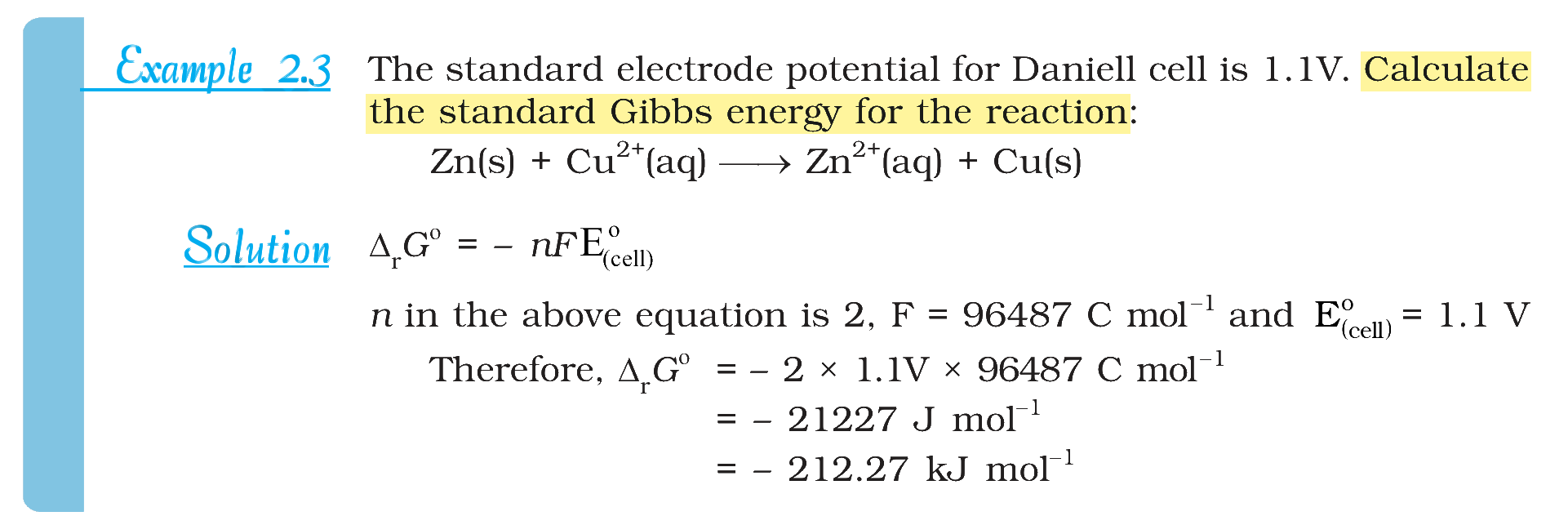
Textbook extract

Advertisement

Practise more on Physical: Electro Chemistry

Chapter-wise mocks on the real NTA exam screen, with solutions and your rank. Your first mocks are free.

Start free mocks →

Advertisement

Next questions

  1. Arrange the following events in the correct chronological order:A. Shah Bano CaseB. The constitutional bench of the Supreme Court gave the…Political Science · Politics in India Since Independence: Recent Developments in Indian Politics
  2. The electric charges are distributed in a small volume. The electric flux through a spherical surface of radius 10 cm enclosing the charges…Physics · Electric Charges and Fields
  3. Fill in the blanks with the most appropriate option out of the given ones to complete the sentence given below:That big circular____ brown…English · Grammar: Adjective
  4. Reconstitution of a partnership firm usually does not take place at the time of :Accountancy Part A · Admission of a Partner
  5. Fill in the blanks in List-I with the correct word forms given in List-IILIST-I (Sentence)LIST-II (words)A.He _________ in my place next we…English · Grammar: Tenses
  6. Player A can run 40 m while player B can run 50 m in the same time. In a race of 800 m, B will beat A by a distance ofApplied Maths. Section B2 · Numbers, Quantification and Numerical Applications
  7. X, Y and Z are partners in the ratio of 1/2 : 2/5 : 1/10. What will be the new ratio of the remaining partner if X retires?Accountancy Part A · Reconstitution of Partnership Firm: Retirement and Death
  8. The monthly salaries of workers in a garment factory are normally distributed. The mean salary is Rs. 10,000 and standard deviation is Rs.…Applied Maths. Section B2 · Inferential Statistics
  9. A matrix which is both symmetric and skew symmetric is aApplied Maths. Section A · Matrices (Section A)
  10. In the following reaction, major product A isChemistry · Organic: Haloalkanes and Haloarenes