CUETMOCK
  • Pricing
  • Mentors
Log inStart freeStart free mocks→

First test, then trust

Try a free CUET mock test.

Join 5,00,000+ students who rehearsed exam day on the exact NTA screen before sitting CUET. On the web and on Android.

Start free mocks →Get the Android app
CUETMOCK

India's #1 CUET Mock Test Platform. Original NCERT-based questions on the exact NTA exam screen — trusted by 5,00,000+ students since CUET 2022.

Get it onGoogle PlayScan to download the CUETMOCK app

Mock tests

  • CUET mock test series
  • Browse all papers
  • Commerce mocks
  • Humanities (Arts) mocks
  • Science mocks
  • Languages & GAT mocks
  • Free practice questions
  • Pricing

Resources

  • CUET exam guide
  • CUET syllabus
  • Universities accepting CUET
  • Expert blogs
  • News & notifications
  • Webinars & counselling
  • CUET score calculator
  • How we estimate your rank
  • FAQs

Company

  • About us
  • Our leadership & team
  • Our toppers
  • Mentors
  • For schools
  • Contact us
  • Terms
  • Privacy
  • Refund policy

Talk to us

+91 7696 6630 56info@cuetmock.comWhatsApp us

Our other platforms

  • JEE Mock — For IIT-JEE aspirants
  • NEET Mock — For NEET aspirants

Newsletter

Exam updates, study material and offers — no spam.

© 2026 NYC Ventures Pvt. Ltd.

701-702, Royal Business Park, Zirakpur, Punjab - 140603

  • Terms of use
  • Privacy policy
  • Refund policy
  • Contact us

iCUETMOCK is an independent preparation platform, not affiliated with the National Testing Agency (NTA). Always check exam details on the official NTA website.

  • Home
  • Mock tests
  • CUET guide
  • Pricing
  • Log in
Home/Practice questions/Accountancy Part A
Accountancy Part AAccounting for Shares

In the case of a One-Person Company, as per Rule 3 of the Companies (…

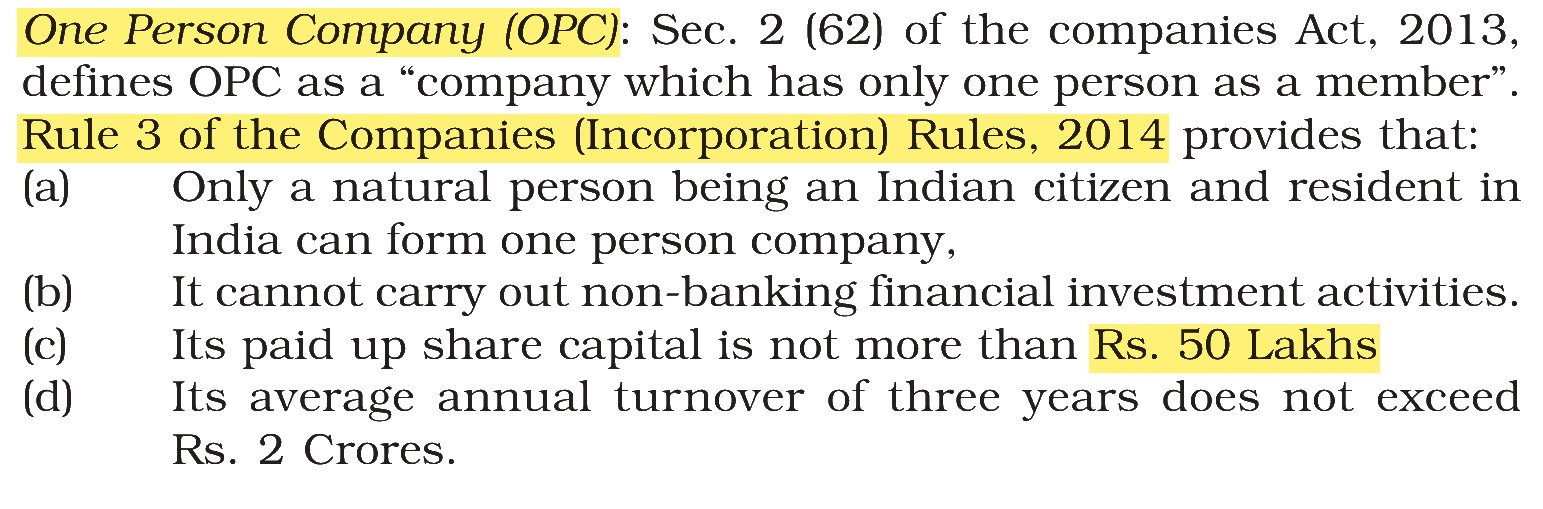
In the case of a One-Person Company, as per Rule 3 of the Companies (Incorporation) Rules, 2014, which of the following statement is not true?

Answer & explanation+

Correct answer: option 3

The correct answer is Option (3) → Its paid up share capital is not more than Rs. 1 crore

Rule 3 of the Companies (Incorporation) Rules, 2014 puts the limit for a One Person Company at a paid-up share capital of not more than Rs. 50 lakhs, not Rs. 1 crore. The other three statements, a natural person who is an Indian citizen and resident, no non-banking financial investment activities, and an average annual turnover of three years not above Rs. 2 crores, are the conditions of the rule as given.

NCERT (2026-27 edition):
Kinds of Companies

Extract from the NCERT textbook

Advertisement

Practise more on Accounting for Shares

Chapter-wise mocks on the real NTA exam screen, with solutions and your rank. Your first mocks are free.

Start free mocks →

Advertisement

Next questions

  1. Choose the most appropriate option to fill in the blank:The school organised a cancer awareness programme in ____with AIIMS.English · Fill Blanks
  2. Who was the Viceroy of India in 1939?History · Modern India: Mahatma Gandhi and the Nationalist movement
  3. Choose the correctly spelt word from the given options:English · Spelling Check
  4. In terms of drainage system of the Early Indus civilization, who noted that, “It is certainly the most complete ancient system as yet disco…History · Ancient India: Bricks, Beads and Bones
  5. Choose the correct synonym of the following word: OSTRACISEEnglish · Synonyms
  6. Probability of solving a specific problem independently by A and B are displaystyle1/2 and displaystyle1/3 respectively, then which of the…Maths. Section A · Probability
  7. For the function f(x)=2x^3-9x^2+12x-5,x∈[0,3] , which of the following statements are correct?A. The point of absolute maxima is x=3 .B. Th…Applied Maths. Section B2 · Calculus
  8. Which of the following is not mentioned in the passage?English · Comprehension - (Narrative / Factual)
  9. “Management is concerned with doing the right task, completing the activities and achieving goals”The concept of management highlighted in…Business Studies · Nature and significance of Management
  10. On the basis of liability of its members, the company cannot be classified into which of the following category:Accountancy Part A · Accounting for Shares