CUETMOCK
  • Pricing
  • Mentors
Log inStart freeStart free mocks→

First test, then trust

Try a free CUET mock test.

Join 5,00,000+ students who rehearsed exam day on the exact NTA screen before sitting CUET. On the web and on Android.

Start free mocks →Get the Android app
CUETMOCK

India's #1 CUET Mock Test Platform. Original NCERT-based questions on the exact NTA exam screen — trusted by 5,00,000+ students since CUET 2022.

Get it onGoogle PlayScan to download the CUETMOCK app

Mock tests

  • CUET mock test series
  • Browse all papers
  • Commerce mocks
  • Humanities (Arts) mocks
  • Science mocks
  • Languages & GAT mocks
  • Free practice questions
  • Pricing

Resources

  • CUET exam guide
  • CUET syllabus
  • Universities accepting CUET
  • Expert blogs
  • News & notifications
  • Webinars & counselling
  • CUET score calculator
  • How we estimate your rank
  • FAQs

Company

  • About us
  • Our leadership & team
  • Our toppers
  • Mentors
  • For schools
  • Contact us
  • Terms
  • Privacy
  • Refund policy

Talk to us

+91 7696 6630 56info@cuetmock.comWhatsApp us

Our other platforms

  • JEE Mock — For IIT-JEE aspirants
  • NEET Mock — For NEET aspirants

Newsletter

Exam updates, study material and offers — no spam.

© 2026 NYC Ventures Pvt. Ltd.

701-702, Royal Business Park, Zirakpur, Punjab - 140603

  • Terms of use
  • Privacy policy
  • Refund policy
  • Contact us

iCUETMOCK is an independent preparation platform, not affiliated with the National Testing Agency (NTA). Always check exam details on the official NTA website.

  • Home
  • Mock tests
  • CUET guide
  • Pricing
  • Log in
Home/Practice questions/Accountancy Part A
Accountancy Part AAdmission of a Partner

Match the LIST-I with LIST-IILIST-ILIST-IIA. Gaining RatioI. Average…

Match the LIST-I with LIST-II

LIST-ILIST-II
A. Gaining RatioI. Average Profit × 100/ Normal Rate of Return
B. GoodwillII. Old Ratio – New Ratio
C. Sacrificing RatioIII. Super Profit × 100/ Normal Rate of Return
D. Capitalised ValueIV. New Ratio – Old Ratio

Choose the correct answer from the options given below:

Answer & explanation+

Correct answer: option 1

The correct answer is Option (1) → A-IV, B-III, C-II, D-I

Two of the List-I items are ratios that compare a partner’s old and new shares; the other two use capitalisation, that is, finding the capital that would earn a given profit at the normal rate of return.

(A) Gaining Ratio — this matches (IV) New Ratio – Old Ratio. A continuing partner gains when his new share is larger than his old share, so his gain is the new share minus the old share.

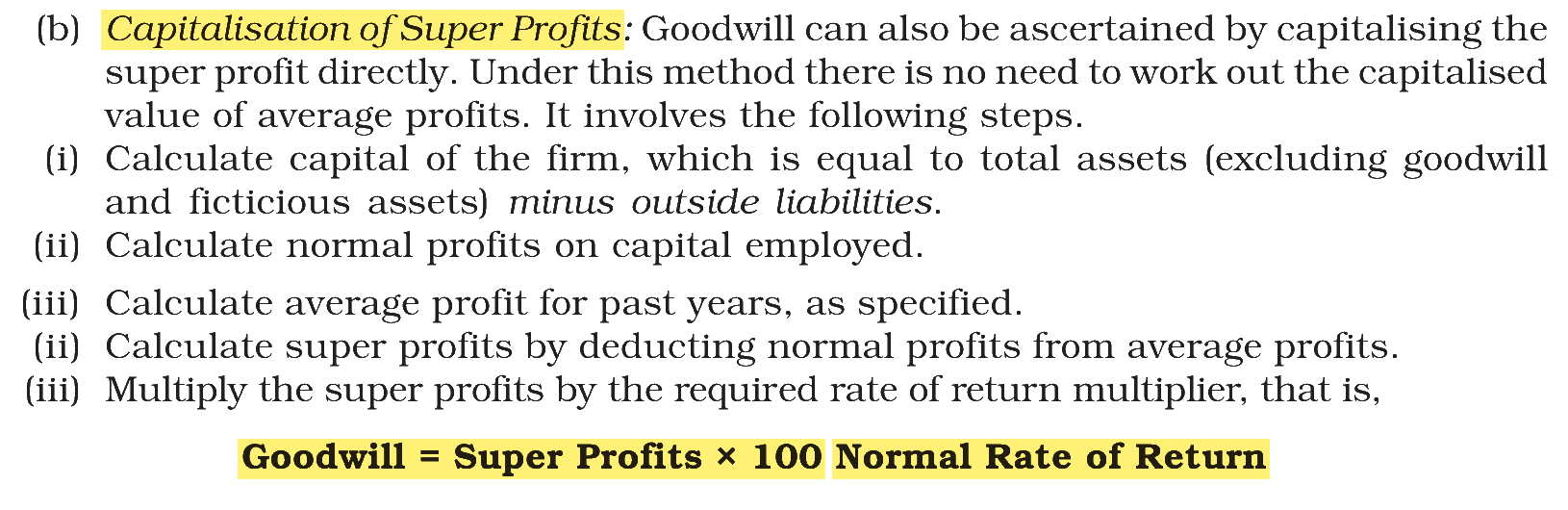
(B) Goodwill — this matches (III) Super Profit × 100/ Normal Rate of Return. Under the capitalisation of super profits method, goodwill is the capital that would earn the super profit at the normal rate.

(C) Sacrificing Ratio — this matches (II) Old Ratio – New Ratio. An old partner sacrifices the part of his share he gives up, so his sacrifice is the old share minus the new share.

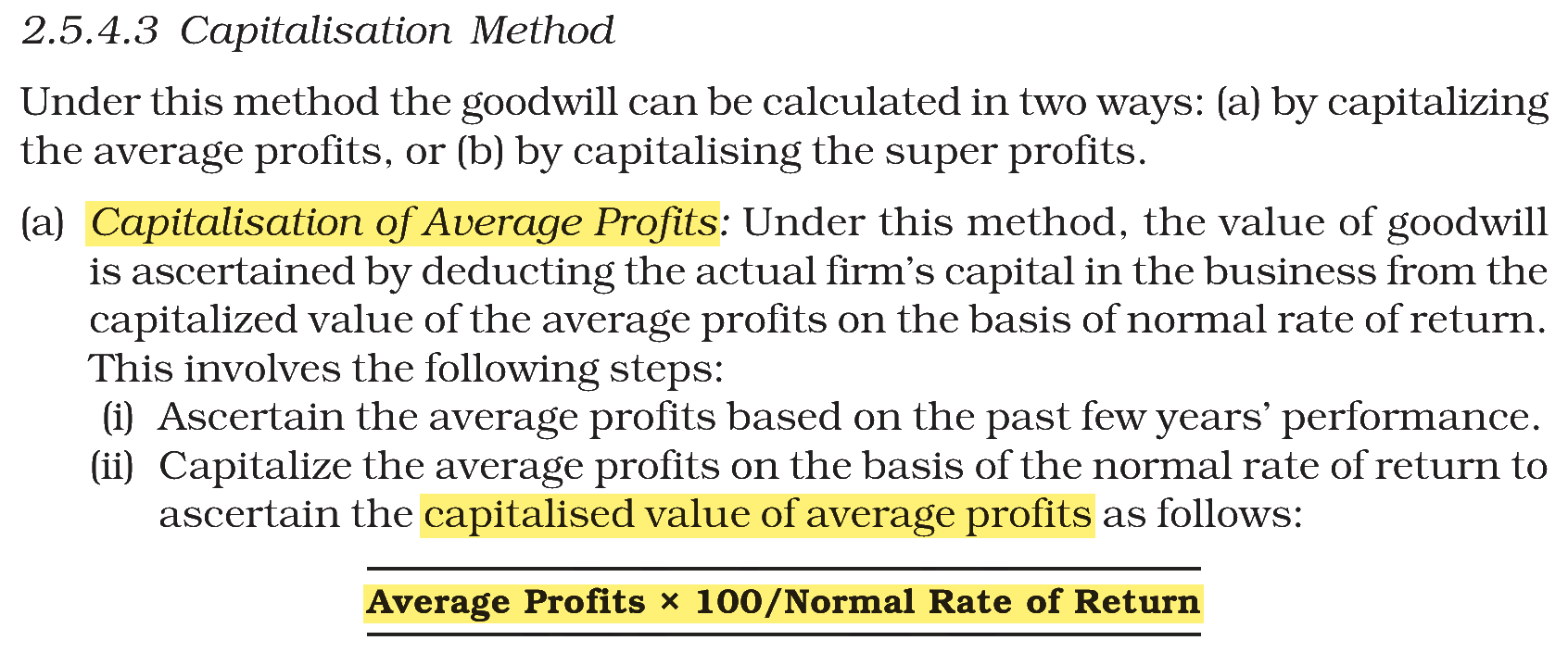
(D) Capitalised Value — this matches (I) Average Profit × 100/ Normal Rate of Return. The capitalised value of the average profit is the capital needed to earn the average profit at the normal rate; goodwill under that method is this value minus the actual capital employed.

NCERT (2026-27 edition):
Capitalisation Method

Extract from the NCERT textbook

Extract from the NCERT textbook

NCERT (2026-27 edition):
Sacrificing Ratio – “… The ratio is normally clearly given as agreed among the partners which could be the old ratio, equal sacrifice, or a specified ratio. The difficulty arises where the ratio in which the new partner acquires his share from the old partners is not specified. Instead, the new profit sharing ratio is given. In such a situation, the sacrificing ratio is to be worked out by deducting each partner’s new share from his old share.”

NCERT (2026-27 edition):
Gaining Ratio – “The ratio in which the continuing partners have acquired the share from the retiring/deceased partner is called the gaining ratio. … The problem of calculating gaining ratio arises primarily when the new profit sharing ratio of the continuing partners is specified. In such a situation, the gaining ratio should be calculated by, deducting the old share of each continuing partners from his new share i.e., new profit share minus old profit share, i.e., new profit share minus old profit share.”

Advertisement

Practise more on Admission of a Partner

Chapter-wise mocks on the real NTA exam screen, with solutions and your rank. Your first mocks are free.

Start free mocks →

Advertisement

Next questions

  1. In a couple, the father is normal, and mother is carrier for the gene of color blindness. What is the probability that their son will be co…Biology · Principles of Inheritance and Variation
  2. Internal resistance of a cell depends on following factors-(A) Nature of the electrolyte(B) Concentration of the electrolyte(C) Temperature…Physics · Current Electricity
  3. Rearrange the following parts in the correct sequence to form a meaningful sentence.(A) some of my childhood friends in the village(B) as t…English · Arrange in Meaningful Sequence
  4. Match the LIST-I with LIST-IILIST-ILIST-IIA. M1I. Currency held by public + Demand DepositB. M1 + M2II. Aggregate monetary resourcesC. M3 +…Economics · Macro Economics: Money and Banking
  5. Amit invested Rs. 25,000 in a no-fee fund. After one year, the value of the fund rose to Rs. 30,000 then the nominal rate of return on the…Applied Maths. Section B2 · Financial Mathematics
  6. Select the word from the given options that is most similar in meaning to the word:- GregariousEnglish · Synonyms
  7. The longest wavelength of light that can cause emission of electrons from a photosensitive material of work function 2.2 eV will bePhysics · Dual Nature of Radiation and Matter
  8. The order for an Individual’s Need Satisfaction is:A. Stability of incomeB. StatusC. Self fulfillmentD. FriendshipChoose the correct answer…Business Studies · Directing
  9. The situation in which the equilibrium level of output is less than full employment of output, is called as:Economics · Macro Economics: Determination of Income and Employment
  10. In how many different ways can the letters of the word OPTICAL be arranged so that the vowels are never together?General Aptitude Test · Quantitative Reasoning