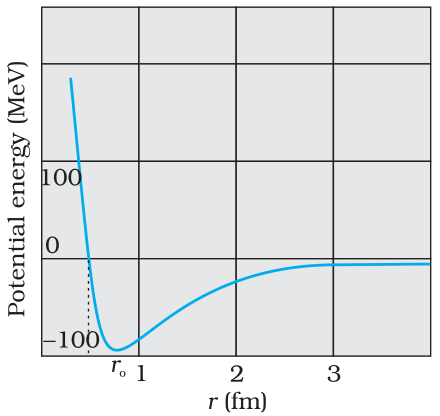
Which of the following is/are not the characteristics of nuclear forces.
A. They are stronger than Coulomb force and gravitational force.
B. They are short range forces.
C. They are always repulsive in nature.
D. They obey inverse square law.
Choose the correct answer from the options given below:
Answer & explanation
Correct answer: option 2
The correct answer is Option (2) → C and D only
The nuclear force holds nucleons together inside the nucleus. It is very strong, acts only over very short distances and does not depend on charge.
(A) They are stronger than Coulomb force and gravitational force. — Correct statement (a characteristic). The nuclear force is the strongest of these, which is why it can hold protons together against their Coulomb repulsion.
(B) They are short range forces. — Correct statement (a characteristic). It becomes negligible beyond a few femtometres.
(C) They are always repulsive in nature. — Incorrect statement (not a characteristic). The force is attractive for separations greater than about 0.8 fm and becomes repulsive only when nucleons are pushed closer than that.
(D) They obey inverse square law. — Incorrect statement (not a characteristic). The force falls off far more rapidly than \( 1/r^{2} \) and follows no simple inverse-square law.
NCERT (2026-27):
Nuclear Force – “… (i) The nuclear force is much stronger than the Coulomb force acting between charges or the gravitational forces between masses. … (ii) The nuclear force between two nucleons falls rapidly to zero as their distance is more than a few femtometres. … The potential energy is a minimum at a distance \( r_0 \) of about 0.8 fm. This means that the force is attractive for distances larger than 0.8 fm and repulsive if they are separated by distances less than 0.8 fm. … Unlike Coulomb’s law or the Newton’s law of gravitation there is no simple mathematical form of the nuclear force.”