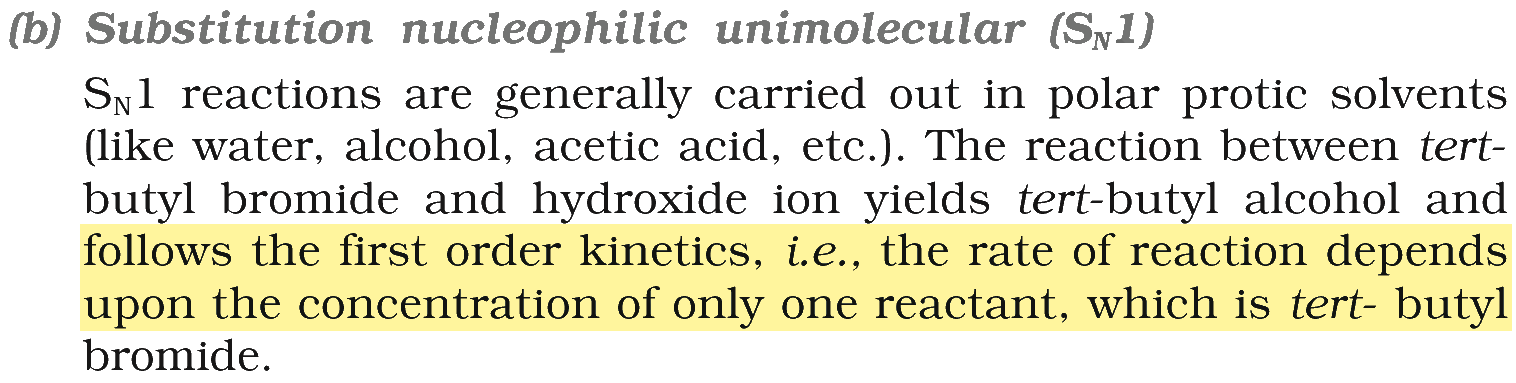
What is the order of nucleophilic substitution reaction of tert-butyl bromide and hydroxide ion?
Answer & explanation
Correct answer: option 2
The correct answer is Option (2) → One
Nucleophilic substitution of haloalkanes follows one of two mechanisms:
SN2: one step; the nucleophile attacks from the back as the halide leaves. Both species are in the rate-determining step, so Rate = k[RX][Nu−] (second order). Favoured by primary halides.
SN1: two steps; the halide first ionises slowly to a carbocation, which then reacts quickly with the nucleophile. Only the haloalkane is in the slow step, so Rate = k[RX] (first order). Favoured by tertiary halides.
tert-Butyl bromide is a tertiary halide: it forms a stable 3° carbocation, and its three methyl groups block backside attack. So it reacts by SN1:
\( \displaystyle \ce{(CH3)3C-Br} \xrightarrow{\text{slow}} \ce{(CH3)3C^+ + Br^-} \)
\( \displaystyle \ce{(CH3)3C^+ + OH^-} \xrightarrow{\text{fast}} \ce{(CH3)3C-OH} \)
\( \displaystyle \text{Rate}=k[\ce{(CH3)3CBr}] \)
The rate does not depend on \( \ce{[OH^{-}]} \), so the reaction is of order one.
Why the other options are incorrect
Option (1) Zero — Incorrect. The rate does depend on the concentration of tert-butyl bromide.
Option (3) Two — Incorrect. Second order is the SN2 case, e.g. \( \ce{CH3Br} \) with \( \ce{OH^{-}} \); a tertiary halide does not react this way.
Option (4) Three — Incorrect. No nucleophilic substitution of a haloalkane involves three species in its rate-determining step.
NCERT (2026-27 edition):
Substitution Nucleophilic Unimolecular (SN1)