What is the reason for high reactivity of benzylic halides towards SN1 reactions?
Answer & explanation
Correct answer: option 2
The correct answer is Option (2) → Resonance stabilized benzylic carbocation
An SN1 reaction takes place in two steps. The slow, rate-determining step is the loss of the halide ion to form a carbocation. So the more stable the carbocation, the faster the SN1 reaction.
A benzylic halide (\( \ce{C6H5CH2X} \)) ionises to the benzyl carbocation:
\( \displaystyle \ce{C6H5CH2-X} \xrightarrow{\text{slow}} \ce{C6H5CH2^+ + X^-} \)
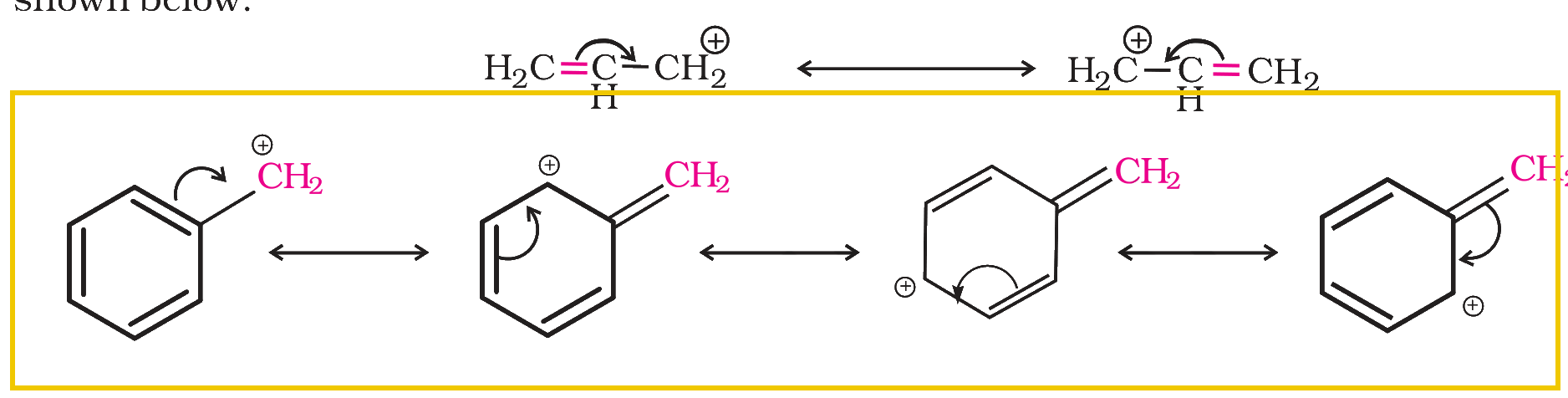
Its positive charge is delocalised by resonance into the benzene ring, onto the ortho and para carbons. This spreading of charge makes the benzyl cation much more stable than a simple primary carbocation, so benzylic halides react very fast by SN1 even though they are primary halides.
So the high reactivity is due to the resonance stabilised benzylic carbocation.
Why the other options are incorrect
Option (1) Polarity of carbon halogen bond — Incorrect. Every alkyl halide has a polar C–X bond, so polarity cannot explain why benzylic halides are special.
Option (3) Inductive effect of halogen — Incorrect. The halogen leaves in the slow step, so its inductive effect does not stabilise the carbocation.
Option (4) Resonance stabilized phenyl carbocation — Incorrect. The phenyl cation (\( \ce{C6H5^{+}} \)) has its empty orbital in the plane of the ring, so it cannot overlap with the π system and is very unstable. That is why aryl halides do not undergo SN1.
NCERT (2026-27 edition):
Substitution Nucleophilic Unimolecular (SN1) – “… Further, greater the stability of carbocation, greater will be its ease of formation from alkyl halide and faster will be the rate of reaction. … For the same reasons, allylic and benzylic halides show high reactivity towards the SN1 reaction. The carbocation thus formed gets stabilised through resonance (Unit 8, Class XI) as shown below:”