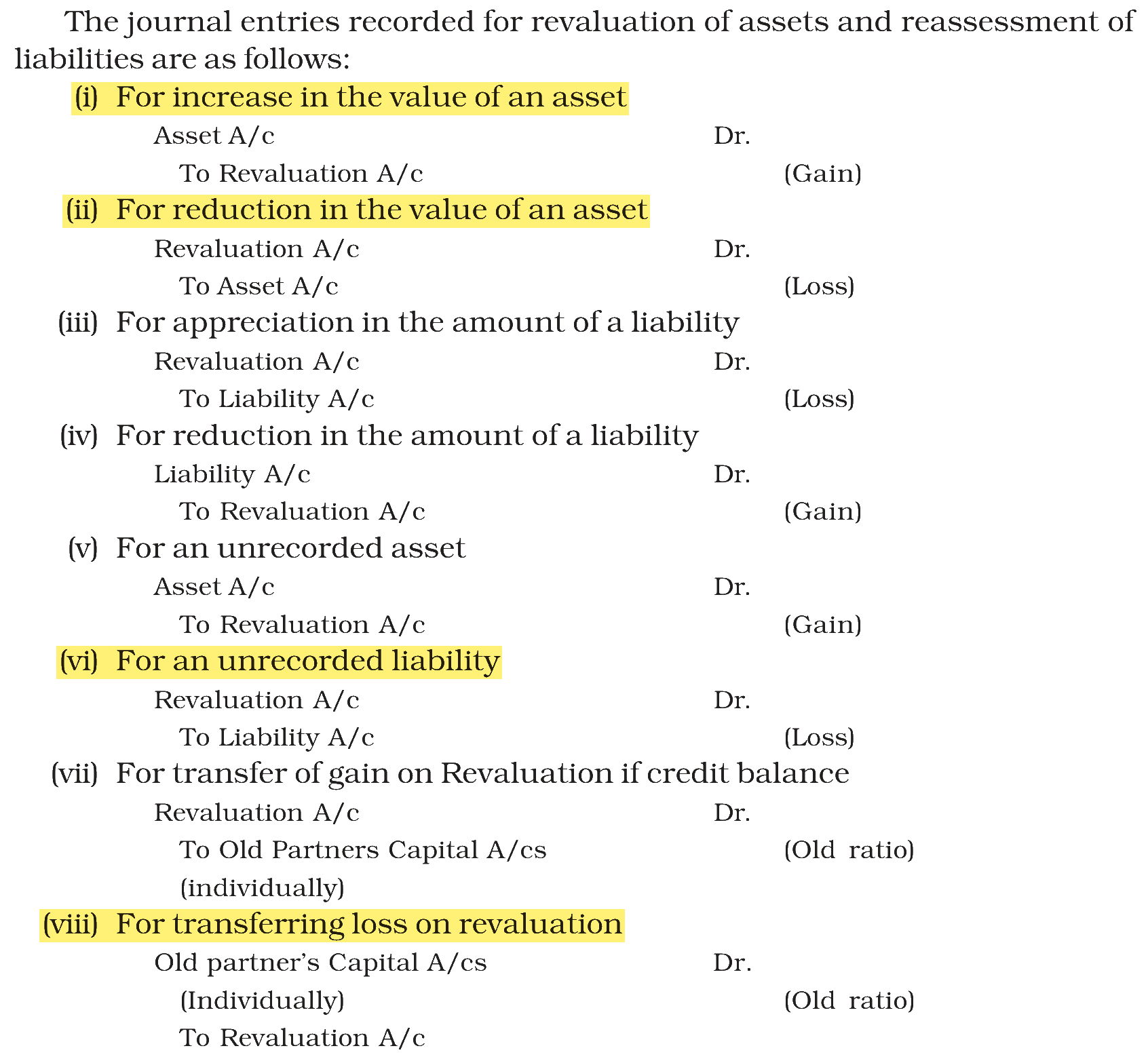
In case of admission of a partner, Match List-I with List-II.
| LIST-I | LIST-II | ||
|---|---|---|---|
| (A) | For Unrecorded Liability | (I) | Revaluation A/c Dr. To Asset A/c |
| (B) | For Over-Valuation of Asset | (II) | Partners' Capital A/c Dr. To Revaluation A/c |
| (C) | For transferring loss on revaluation | (III) | Revaluation A/c Dr. To Liability A/c |
| (D) | For Under-Valuation of Asset | (IV) | Asset A/c Dr. To Revaluation A/c |
Choose the correct answer from the options given below:
Answer & explanation
Correct answer: option 1
The correct answer is Option (1) → (A) - (III), (B) - (I), (C) - (II), (D) - (IV)
The Revaluation Account is debited with every loss and credited with every gain on revaluation. So read each item by asking whether it is a gain or a loss for the firm.
(A) For Unrecorded Liability — this matches (III) Revaluation A/c Dr. To Liability A/c. A liability left out of the books is brought in; the firm owes more than it showed, so it is a loss and Revaluation A/c is debited.
(B) For Over-Valuation of Asset — this matches (I) Revaluation A/c Dr. To Asset A/c. An overvalued asset is written down to its correct value; the reduction is a loss, so Revaluation A/c is debited and the asset credited.
(C) For transferring loss on revaluation — this matches (II) Partners’ Capital A/c Dr. To Revaluation A/c. A debit balance on the Revaluation Account is a loss, and it is closed by debiting the old partners’ capital accounts in their old ratio.
(D) For Under-Valuation of Asset — this matches (IV) Asset A/c Dr. To Revaluation A/c. An undervalued asset is raised to its correct value; the increase is a gain, so Revaluation A/c is credited.
NCERT (2026-27 edition):
|