Comprehension:
Nucleophilic Addition Reactions
Organic compounds containing carbon-oxygen double bond (>C=O ) are called carbonyl group, which is one of the most important functional group in organic chemistry. In aldehydes, the carbonyl group is bonded to a carbon and hydrogen while in ketones, it is bonded to two carbon atoms.The carbonyl compounds in which carbon of carbonyl group is bonded to carbon or hydrogen and oxygen of hydroxyl moiety (-OH) are known as carboxylic acids , while in compounds where carbon is attached to carbon or hydrogen and nitrogen of -NH2 moiety or to halogens are called amides and acyl halides respectively. Aldehydes, ketones, and carboxylic acids are widespread in plants and animal kingdom. They add fragrance and flavour to nature, for example, vanillin ( from vanilla bean), salicylaldehyde ( from meadow sweet ) and cinnamaldehyde ( cinnamon) have pleasant fragrances.
The carbonyl carbon atom is sp2-hybridised and forms three sigma ( σ ) bonds. The fourth valence electron of carbon remains in its p-orbital and forms a π-bond with oxygen by overlap with p-orbital of an oxygen. In addition , the oxygen atom also has two non bonding electron pairs. Thus, the carbonyl carbon and the three atoms attached to it lie in the same plane and the π-electron cloud is above and below this plane. The bond angles are approximately 120° and trigonal coplanar structure.
The carbon-oxygen double bond is polarised due to higher electronegativity of oxygen relative to carbon. Hence, the carbonyl carbon is an electrophilic (Lewis acid), and carbonyl oxygen , a nucleophilic (Lewis base) centre. Carbonyl compounds have substantial dipole moments and are more polar than ethers. Aldehyde and ketone can be prepared by oxidation of alcohols, dehydrogenation of alcohols, and ozonolysis of alkenes etc.
Identify the product in the following chemical reaction.
\( \ce{2 CH3-CHO} \xrightarrow[\text{ii) Heat}]{\text{i) dil. NaOH}} \text{Product} \)
Answer & explanation
Correct answer: option 4
The correct answer is Option (4) → But-2-enal
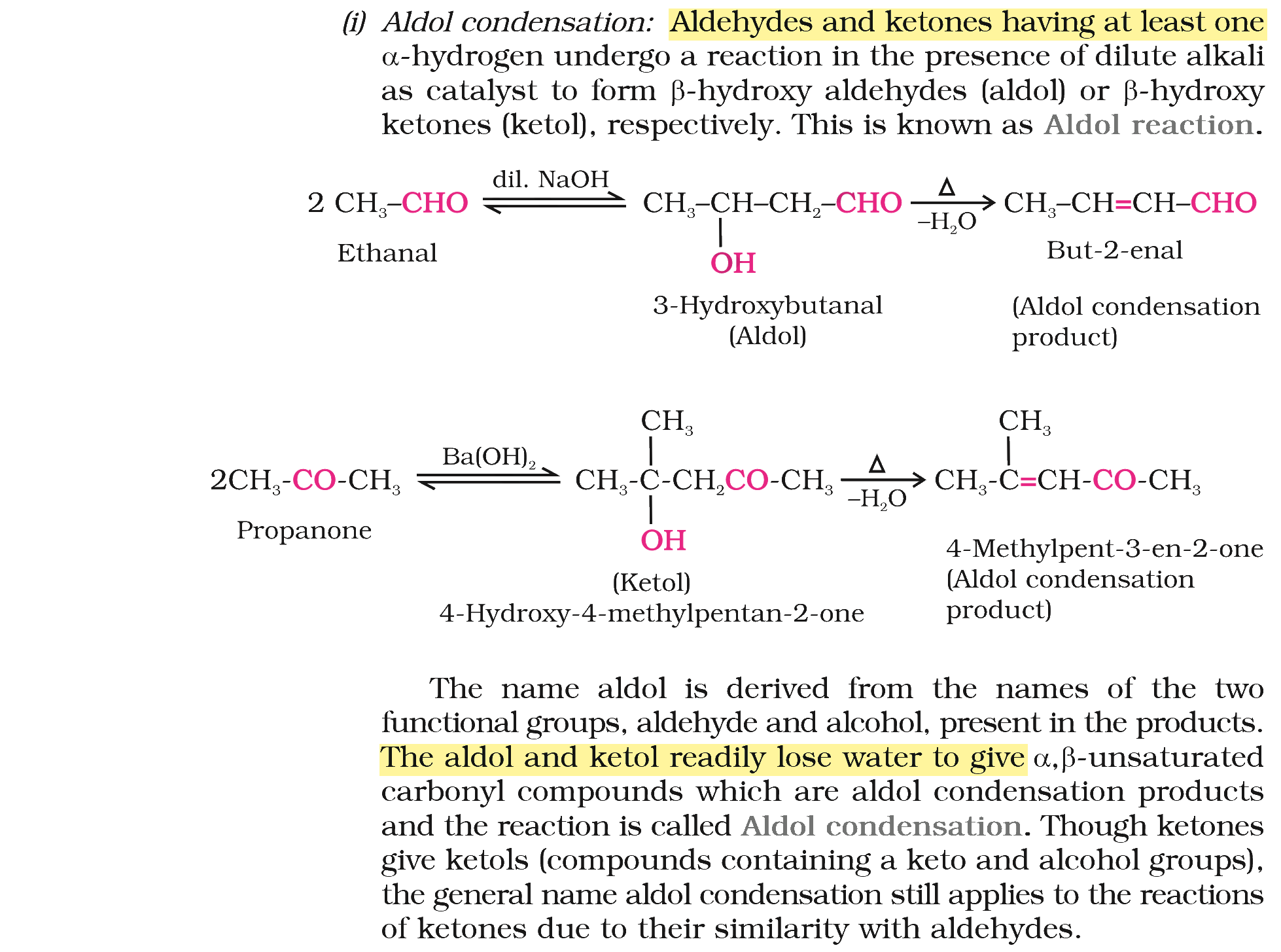
Aldehydes and ketones with at least one α-hydrogen undergo aldol condensation with dilute alkali:
Aldol addition: \( \ce{OH^{-}} \) removes an α-hydrogen to form a carbanion (enolate), which adds to the carbonyl carbon of a second molecule, giving a β-hydroxy aldehyde (an “aldol”).
Dehydration: on heating, the aldol loses water to give an α,β-unsaturated aldehyde.
Naming the product of ethanal, \( \ce{CH3-CH=CH-CHO} \): the chain has 4 carbons (two \( \ce{C2} \) units), the CHO carbon is C-1, and the double bond starts at C-2, so it is but-2-enal (crotonaldehyde).
Why the other options are incorrect
Option (1) Pent-1-enal — Incorrect. Five carbons cannot come from two molecules of a two-carbon aldehyde.
Option (2) Hex-1-enal — Incorrect. Six carbons would need three ethanal units; aldol condensation joins only two.
Option (3) But-1-enal — Incorrect. The carbon count is right, but C-1 is the CHO carbon, so a double bond cannot start there; the double bond in the product is between C-2 and C-3.
NCERT (2026-27 edition):
Aldol Condensation