The following name reaction is
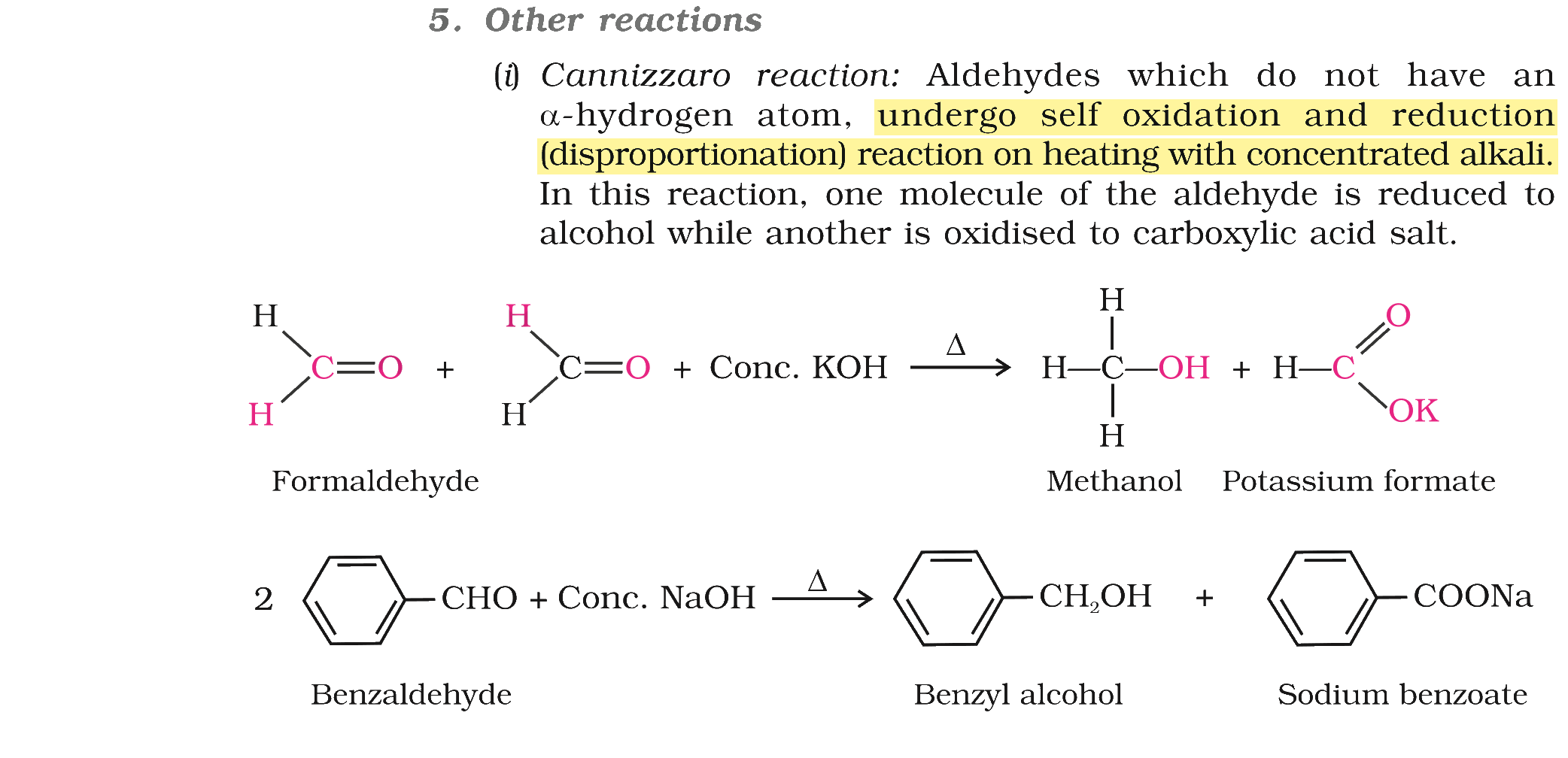
2 HCHO + conc. NaOH → CH3OH + HCOONa
Answer & explanation
Correct answer: option 4
The correct answer is Option (4) → Cannizzaro reaction
Aldehydes react with alkali in two different ways, depending on whether they have an α-hydrogen (an H on the carbon next to C=O):
Aldehydes with an α-hydrogen give the aldol reaction with dilute alkali; those without α-hydrogen give the Cannizzaro reaction with concentrated alkali.
Methanal has no α-carbon at all, and with conc. NaOH it gives methanol and sodium methanoate:
\( \displaystyle \ce{2HCHO + NaOH} \xrightarrow{\text{conc.}} \ce{CH3OH + HCOONa} \)
So the reaction is the Cannizzaro reaction.
Why the other options are incorrect
Option (1) Wurtz Reaction — Incorrect. Two alkyl halides join with sodium in dry ether to give an alkane.
\( \displaystyle \ce{2R-X + 2Na} \xrightarrow{\text{dry ether}} \ce{R-R + 2NaX} \)
Option (2) Rosenmund Reaction — Incorrect. An acyl chloride is reduced to an aldehyde by hydrogen over Pd/\( \ce{BaSO4} \).
\( \displaystyle \ce{RCOCl + H2} \xrightarrow{\ce{Pd-BaSO4}} \ce{RCHO + HCl} \)
Option (3) Aldol reaction — Incorrect. It needs an α-hydrogen and dilute alkali, which HCHO does not have.
\( \displaystyle \ce{2CH3CHO} \xrightarrow{\text{dil. NaOH}} \ce{CH3CH(OH)CH2CHO} \)
NCERT (2026-27 edition):
Other Reactions