
CUETMOCK
  • Pricing
  • Mentors
Log inStart freeStart free mocks→

First test, then trust

Try a free CUET mock test.

Join 5,00,000+ students who rehearsed exam day on the exact NTA screen before sitting CUET. On the web and on Android.

Start free mocks →Get the Android app
CUETMOCK

India's #1 CUET Mock Test Platform. Original NCERT-based questions on the exact NTA exam screen — trusted by 5,00,000+ students since CUET 2022.

Get it onGoogle PlayScan to download the CUETMOCK app

Mock tests

  • CUET mock test series
  • Commerce mocks
  • Humanities (Arts) mocks
  • Science mocks
  • Languages & GAT mocks
  • Free practice questions
  • Pricing

Resources

  • CUET exam guide
  • CUET syllabus
  • Universities accepting CUET
  • Expert blogs
  • News & notifications
  • Webinars & counselling
  • CUET score calculator
  • How we estimate your rank
  • FAQs

Company

  • About us
  • Our leadership & team
  • Our toppers
  • Mentors
  • For schools
  • Contact us
  • Terms
  • Privacy
  • Refund policy

Talk to us

+91 7696 6630 56info@cuetmock.comWhatsApp us

Our other platforms

  • JEE Mock — For IIT-JEE aspirants
  • NEET Mock — For NEET aspirants

Newsletter

Exam updates, study material and offers — no spam.

© 2026 NYC Ventures Pvt. Ltd.

701-702, Royal Business Park, Zirakpur, Punjab - 140603

  • Terms of use
  • Privacy policy
  • Refund policy
  • Contact us

iCUETMOCK is an independent preparation platform, not affiliated with the National Testing Agency (NTA). Always check exam details on the official NTA website.

  • Home
  • Mock tests
  • CUET guide
  • Pricing
  • Log in
Home/Practice questions/Chemistry
ChemistryInorganic: Coordination Compounds

Which of the following is an example of a spin-free complex?

Which of the following is an example of a spin-free complex?

Answer & explanation+

Correct answer: option 3

The correct answer is Option (3) → [CoF6]3−

In an octahedral complex the five d orbitals split into a lower t2g set and a higher eg set, separated by the crystal field splitting energy Δo. For d4 to d7 ions, the extra electrons have two choices:

  • Δo < P (pairing energy): electrons enter eg unpaired. The complex is high spin, also called spin-free. This happens with weak field ligands such as \( \ce{F^{-}} \), \( \ce{Cl^{-}} \) and \( \ce{H2O} \).

  • Δo > P: electrons pair up in t2g. The complex is low spin, or spin-paired. This happens with strong field ligands such as \( \ce{CN^{-}} \), and with \( \ce{NH3} \) on a highly charged ion like \( \ce{Co^{3+}} \).

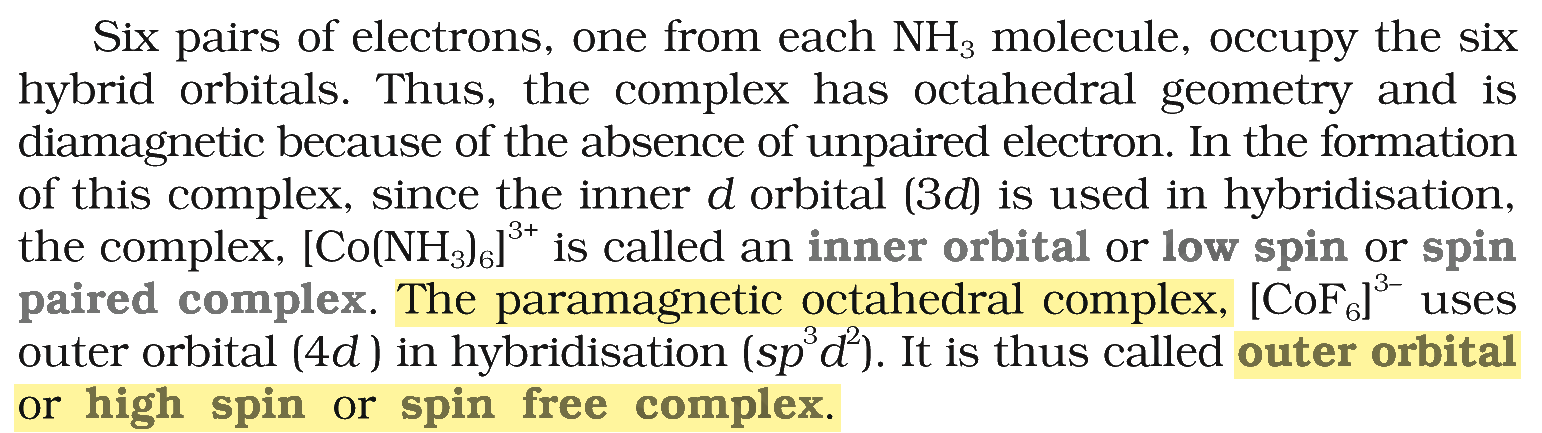
In \( \ce{[CoF6]^{3-}} \) cobalt is +3 (x + 6(−1) = −3). Co (Z = 27) is [Ar]3d74s2; removing the two 4s electrons and one 3d electron gives \( \ce{Co^{3+}} \): 3d6. \( \ce{F^{-}} \) is a weak field ligand. The configuration is t2g4eg2 with four unpaired electrons, and the complex uses outer sp3d2 orbitals. So it is spin-free.

Why the other options are incorrect

  • Option (1) [Fe(CN)6]4− — Incorrect. Fe (Z = 26) is [Ar]3d64s2, so \( \ce{Fe^{2+}} \) (both 4s electrons removed) is 3d6, and strong field \( \ce{CN^{-}} \) pairs all six electrons in t2g (inner d2sp3). It is diamagnetic and spin-paired.

  • Option (2) [Co(NH3)6]3+ — Incorrect. \( \ce{Co^{3+}} \) is again 3d6, and for this highly charged ion \( \ce{NH3} \) acts as a strong field ligand, so the configuration is t2g6. It is diamagnetic and spin-paired.

  • Option (4) [Mn(CN)6]3− — Incorrect. Mn (Z = 25) is [Ar]3d54s2; removing the two 4s electrons and one 3d electron gives \( \ce{Mn^{3+}} \): 3d4. With \( \ce{CN^{-}} \) all four electrons stay in t2g, leaving two unpaired electrons instead of four. It is spin-paired.

NCERT (2026-27 edition):
Valence Bond Theory – …
Textbook extract

Note: The same/similar question has been asked in different years by NTA as per the details given below:

20262025202420232022
15-05 S1––30-05 S1–

Advertisement

Practise more on Inorganic: Coordination Compounds

Chapter-wise mocks on the real NTA exam screen, with solutions and your rank. Your first mocks are free.

Start free mocks →

Advertisement

Next questions

  1. The IUPAC name and structure of compound “A” is:Chemistry · Organic: Alcohols, Phenols and Ethers
  2. Choose the appropriate word similar in meaning to the underlined word in the sentence given below:-The newly initiated monk is a neophyte w…English · Synonyms
  3. The narrator appears to be _______ about money matters.English · Comprehension - (Poetry / Literary)
  4. Which month and year is associated with the beginning of the Great Calcutta Killings?History · Modern India: Framing the Constitution
  5. Match the LIST-I with LIST-IILIST-IExamplesLIST-IIPopulation interactionsA. Cuscuta and hedge plantI. CommensalismB. Wasp laying eggs in fi…Biology · Organisms and Populations
  6. Which among the following is correct about the ‘non-congressism’ phenomena?(A) Parties that were entirely different and disparate in their…Political Science · Politics in India Since Independence: Challenges to and Restoration of the Congress System
  7. Choose the most appropriate option to fill in the blank.Manish would offer his chair to the visitor and would stand leaning ____ the wall.English · Grammar: Preposition
  8. Match List-I with List-IIList-IReagents and SubstratesList-IIName Reaction(A) Alkyl chloride + NaI + dry acetone(I) Wurtz reaction(B) Alkyl…Chemistry · Organic: Haloalkanes and Haloarenes
  9. Match List-I with List-II:List-ITermList-IIClassification of Land/Meaning(A)Parauti(I)Annually cultivated(B)Chachar(II)Fallow for three or…History · Medieval India: Peasants, Zamindars and the State
  10. Test cross refers to the cross between:Biology · Principles of Inheritance and Variation