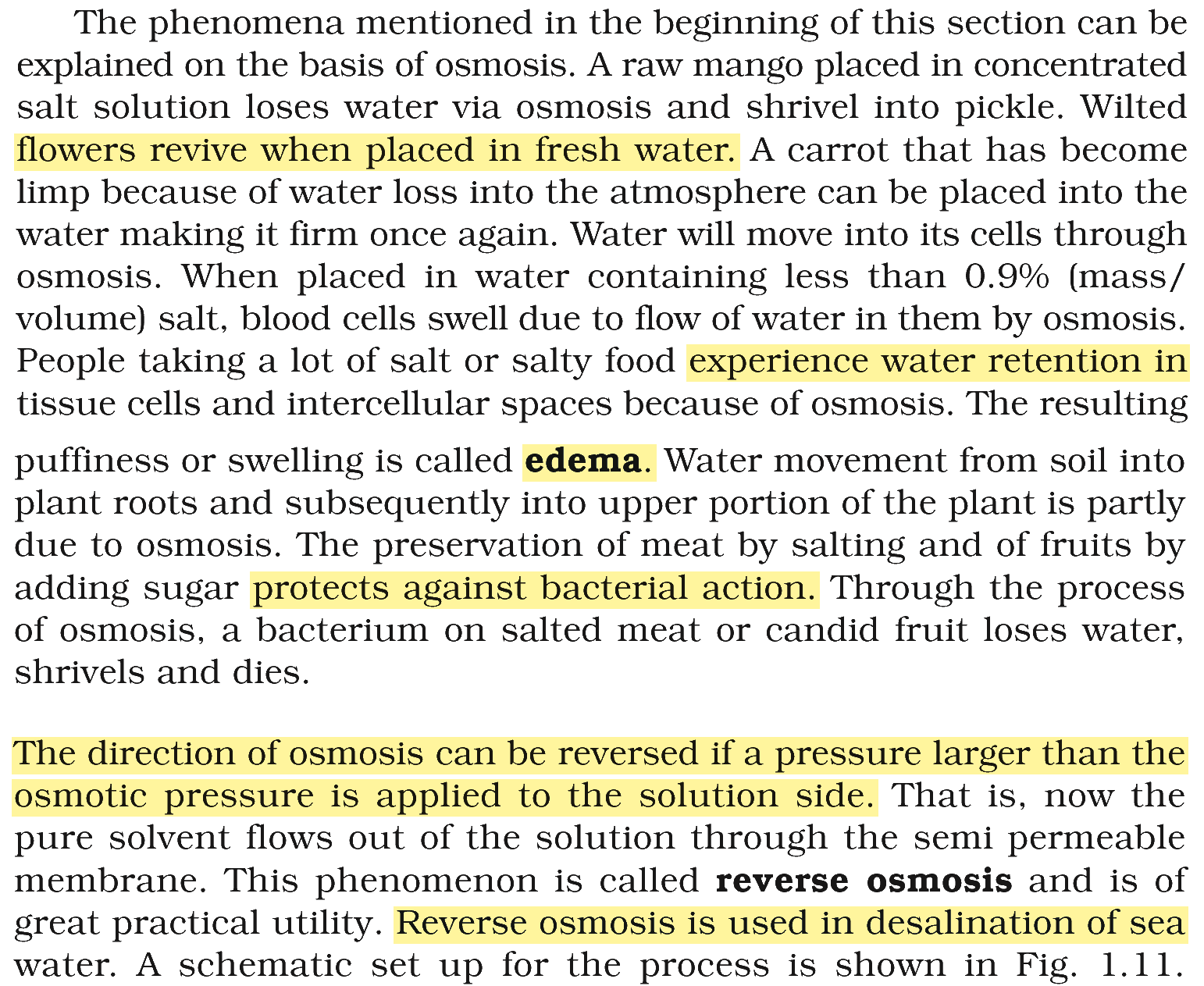
Match the LIST-I with LIST-II.
| LIST-I Osmotic phenomenon | LIST-II Characteristics |
| A. Edema | I. Pressure larger than the osmotic pressure when applied to the solution side |
| B. Preservation of food items by salting | II. When placed in fresh water |
| C. Wilted flowers revive | III. Protects against bacterial action due to osmosis. |
| D. Desalination of seawater | IV. Water retention in tissue cells due to high salt consumption. |
Choose the correct answer from the options given below:
Answer & explanation
Correct answer: option 1
The correct answer is Option (1) → A-IV, B-III, C-II, D-I
Osmosis is the flow of water through a semipermeable membrane from the dilute side to the more concentrated side. A pressure larger than the osmotic pressure applied on the solution side reverses this flow (reverse osmosis). All four phenomena follow from these two ideas:
A. Edema — This matches IV. Water retention in tissue cells due to high salt consumption. Excess salt raises the concentration of the fluid around the cells, water moves there by osmosis, and the tissues swell (puffiness).
B. Preservation of food items by salting — This matches III. Protects against bacterial action due to osmosis. A bacterium on salted meat or pickles loses water by osmosis, shrivels and dies.
C. Wilted flowers revive — This matches II. When placed in fresh water. The cell sap is more concentrated than fresh water, so water enters the cells and they become firm again.
D. Desalination of seawater — This matches I. Pressure larger than the osmotic pressure when applied to the solution side. This is reverse osmosis: pure water is pushed out of the seawater through the membrane.
Shortcut: The pair B–III appears in Options (1) and (3), and A–IV then leaves only Option (1).
NCERT (2026-27 edition):
Osmosis and Osmotic Pressure – …