Calculate the value of the government expenditure multiplier at a given MPC = 0.80 and tax rate = 0.25.
Answer & explanation
Correct answer: option 1
The correct answer is Option (1) → 2.5
When the government spends more, income rises by more than the extra spending, because each round of new income is partly spent again. The government expenditure multiplier tells how many times income rises for each rupee of extra government spending, ΔY/ΔG.
Given:
Marginal propensity to consume, c = 0.80
Proportional tax rate, t = 0.25
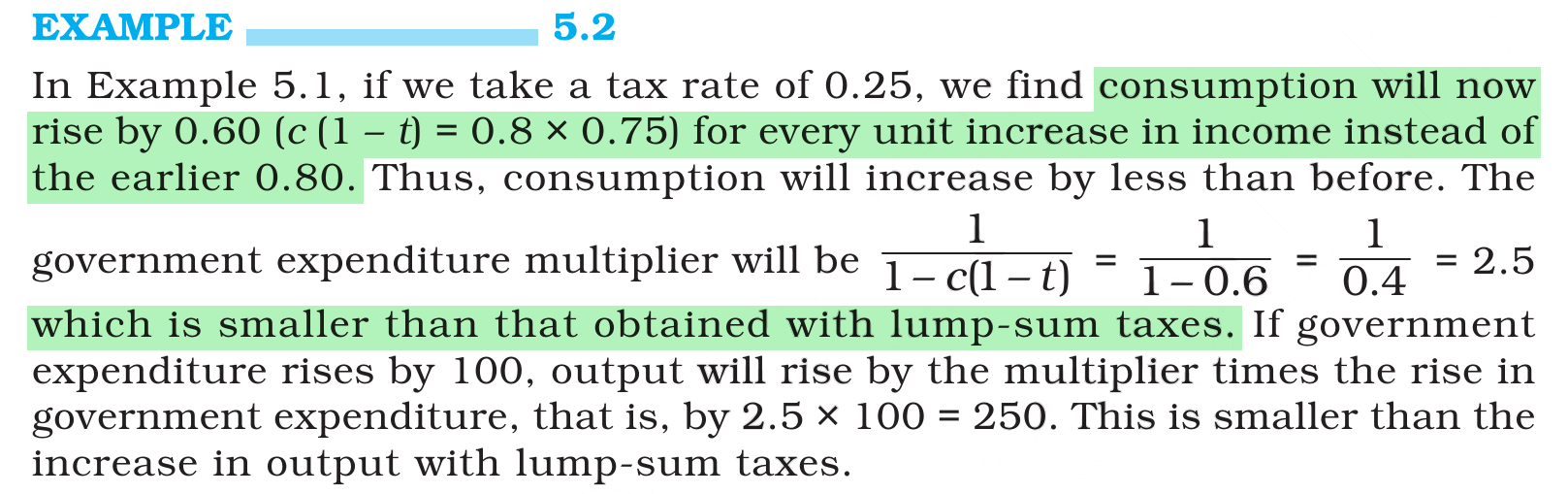
With a proportional income tax, every rise in income is partly taken away as tax, so consumption rises by c(1 − t) and not by c for each unit of income. Without the tax the multiplier would be 1 ÷ (1 − 0.8) = 5, the figure in Option (3); with the tax it becomes smaller:
Multiplier = 1 ÷ [1 − c(1 − t)]
Substituting the values:
c(1 − t) = 0.80 × 0.75 = 0.60
1 − c(1 − t) = 1 − 0.60 = 0.40
Multiplier = 1 ÷ 0.40 = 2.5, Option (1)
NCERT: Introductory Macroeconomics — Chapter 5: Government Budget and the Economy (2025-26)
|