
CUETMOCK
  • Pricing
  • Mentors
Log inStart freeStart free mocks→

First test, then trust

Try a free CUET mock test.

Join 5,00,000+ students who rehearsed exam day on the exact NTA screen before sitting CUET. On the web and on Android.

Start free mocks →Get the Android app
CUETMOCK

India's #1 CUET Mock Test Platform. Original NCERT-based questions on the exact NTA exam screen — trusted by 5,00,000+ students since CUET 2022.

Get it onGoogle PlayScan to download the CUETMOCK app

Mock tests

  • CUET mock test series
  • Browse all papers
  • Commerce mocks
  • Humanities (Arts) mocks
  • Science mocks
  • Languages & GAT mocks
  • Free practice questions
  • Pricing

Resources

  • CUET exam guide
  • CUET syllabus
  • Universities accepting CUET
  • Expert blogs
  • News & notifications
  • Webinars & counselling
  • CUET score calculator
  • How we estimate your rank
  • FAQs

Company

  • About us
  • Our leadership & team
  • Our toppers
  • Mentors
  • For schools
  • Contact us
  • Terms
  • Privacy
  • Refund policy

Talk to us

+91 7696 6630 56info@cuetmock.comWhatsApp us

Our other platforms

  • JEE Mock — For IIT-JEE aspirants
  • NEET Mock — For NEET aspirants

Newsletter

Exam updates, study material and offers — no spam.

© 2026 NYC Ventures Pvt. Ltd.

701-702, Royal Business Park, Zirakpur, Punjab - 140603

  • Terms of use
  • Privacy policy
  • Refund policy
  • Contact us

iCUETMOCK is an independent preparation platform, not affiliated with the National Testing Agency (NTA). Always check exam details on the official NTA website.

  • Home
  • Mock tests
  • CUET guide
  • Pricing
  • Log in
Home/Practice questions/Physics
PhysicsRay Optics

The following three lenses L1, L2 and L3 are given here with the desc…

The following three lenses L1, L2 and L3 are given here with the description given below-

L1 - Power 3 D, Aperture 8 cm

L2 - Power 6 D, Aperture 1 cm

L3 - Power 10 D, Aperture 1 cm

Which two of the above lenses will you select as objective and eyepiece for constructing best possible Telescope?

Answer & explanation+

Correct answer: option 1

The correct answer is Option (1) → L1 as objective, L3 as eye piece

A good astronomical telescope needs a large magnifying power and a large aperture for the objective, so that it gathers more light and resolves finer detail. The magnifying power (normal adjustment) is the ratio of the focal lengths, which is the ratio of the powers.

    \( \displaystyle m = \frac{f_o}{f_e} = \frac{P_e}{P_o} \)

So the objective should be the lens of least power and largest aperture, L1 (3 D, 8 cm), and the eyepiece the lens of greatest power, L3 (10 D).

    \( \displaystyle m = \frac{10\,\mathrm{D}}{3\,\mathrm{D}} \approx 3.3 \)

Why the other options are incorrect

  • Option (2) L2 as objective, L1 as eye piece — Incorrect. L2 has a 1 cm aperture, and with L1 as eyepiece \( m = 3/6 = 0.5 \), which is less than 1.

  • Option (3) L3 as objective, L1 as eye piece — Incorrect. With L3 as objective, \( m = 3/10 = 0.3 \), and its aperture is only 1 cm.

  • Option (4) L1 as objective, L2 as eye piece — Incorrect. L1 is the right objective, but L2 gives \( m = 6/3 = 2 \), smaller than the 3.3 obtained with L3.

NCERT (2026-27):
Telescope – “The telescope is used to provide angular magnification of distant objects …. It also has an objective and an eyepiece. But here, the objective has a large focal length and a much larger aperture than the eyepiece. … The magnifying power \( m \) is the ratio of the angle \( \beta \) subtended at the eye by the final image to the angle \( \alpha \) which the object subtends at the lens or the eye. Hence

    \( \displaystyle m \approx \frac{\beta}{\alpha} \approx \frac{h}{f_e}\cdot\frac{f_o}{h} = \frac{f_o}{f_e} \qquad (9.46) \)”
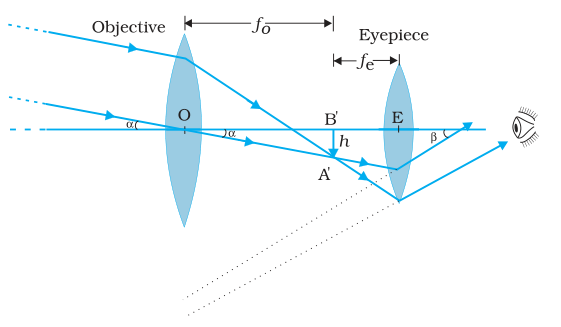
Textbook figure

Advertisement

Practise more on Ray Optics

Chapter-wise mocks on the real NTA exam screen, with solutions and your rank. Your first mocks are free.

Start free mocks →

Advertisement

Next questions

  1. Which of the following are TRUE?(A) The inverse of […] is displaystyle1/27 […] .(B) The determinant of […] is 29.(C) The inverse of […] is…Applied Maths. Section B2 · Algebra
  2. Fill in the blanks with the appropriate Phrasal Verb from the options given below:-A snake might be hidden in this garden. You are advised…English · Grammar: Phrasal Verb
  3. What was launched in 2007 by the Indian government to sustain productivity gains?General Aptitude Test · General Knowledge
  4. Choose the correct option to fill in the blank in the given sentence:The beautiful __________ of Manali is worth seeing.English · Homonyms
  5. Match the LIST-I with LIST-IILIST-ILIST-IIA.Electric potential in equatorial plane of a dipoleI.has r^-2 dependenceB.Electrostatic potentia…Physics · Electrostatic Potential and Capacitance
  6. In the following question, choose the correct water-image of the figure (X) from amongst the four alternatives (1), (2), (3) and (4) given…General Aptitude Test · Non-Verbal Reasoning
  7. A charged particle is projected with velocity v = (2×10^6\ m/s)imath into a region in which magnetic field B = [(0.2\ T)imath + (0.5\ T)jma…Physics · Moving Charges and Magnetism
  8. A random variable X has the following probability distribution:X1234567P(X)K2K3K2K2K2K27K2+Kthen P(X =5) isApplied Maths. Section B2 · Probability Distributions
  9. Fill in the blank with the most appropriate word from the given options:-I found a _____ number of books in the library than what I found l…English · Grammar: Determiner
  10. In case of admission of a partner, if a new partner is unable to bring the goodwill amount, then his/her goodwill premium will be taken fro…Accountancy Part A · Admission of a Partner