
AIDS
Read the following passage carefully and answer the given questions.
AIDS is caused by the Human Immunodeficiency Virus, which has an envelope enclosing RNA genome. Transmission of HIV infection generally occurs by (a) sexual contact with infected person, (b) transfusion of contaminated blood and blood products, (c) sharing infected needles, as in case of intravenous drug abusers; and (d) from infected mother to her child through placenta. It is important to note that HIV/AIDS is not spread by mere touch or physical contact; it spreads only through body fluids. It is, hence, imperative, for physical and psychological well-being, that they are not isolated from family and society. Infection with HIV or having AIDS is something that should not be hidden – since then, the infection may spread to many more people. HIV/AIDS-infected people need help and sympathy instead of being shunned by society.
Cells that act like HIV factories are:
Answer & explanation
Correct answer: option 1
The correct answer is Option (1) → Macrophages
After HIV enters the body, it first enters the macrophages. There its RNA is copied into viral DNA by reverse transcriptase. This viral DNA joins the DNA of the host cell and directs the cell to make new virus particles. The macrophages go on making virus in this way, so they act like an ‘HIV factory’. At the same time, HIV enters helper T-lymphocytes and multiplies there, and their number keeps falling.
(1) Macrophages — Correct. They keep producing the virus.
(2) Red blood cells — Incorrect. Red blood cells are not the cells that HIV enters to multiply.
(3) Epithelial Cells — Incorrect. Epithelial cells are not the cells that act as the HIV factory.
(4) Nerve Cells — Incorrect. Nerve cells are not the cells that act as the HIV factory.
Note: The passage is taken from NCERT. NTA has put lines of the NCERT text together to make it. Most CUET (UG) questions come straight from NCERT, so study the book line by line, including figures and their titles.
NCERT Extract:
AIDS – …
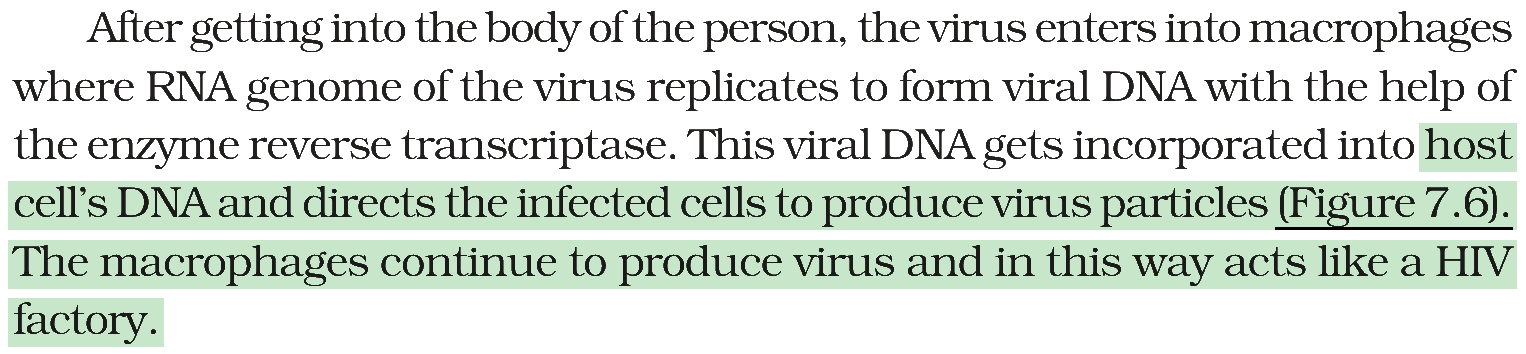
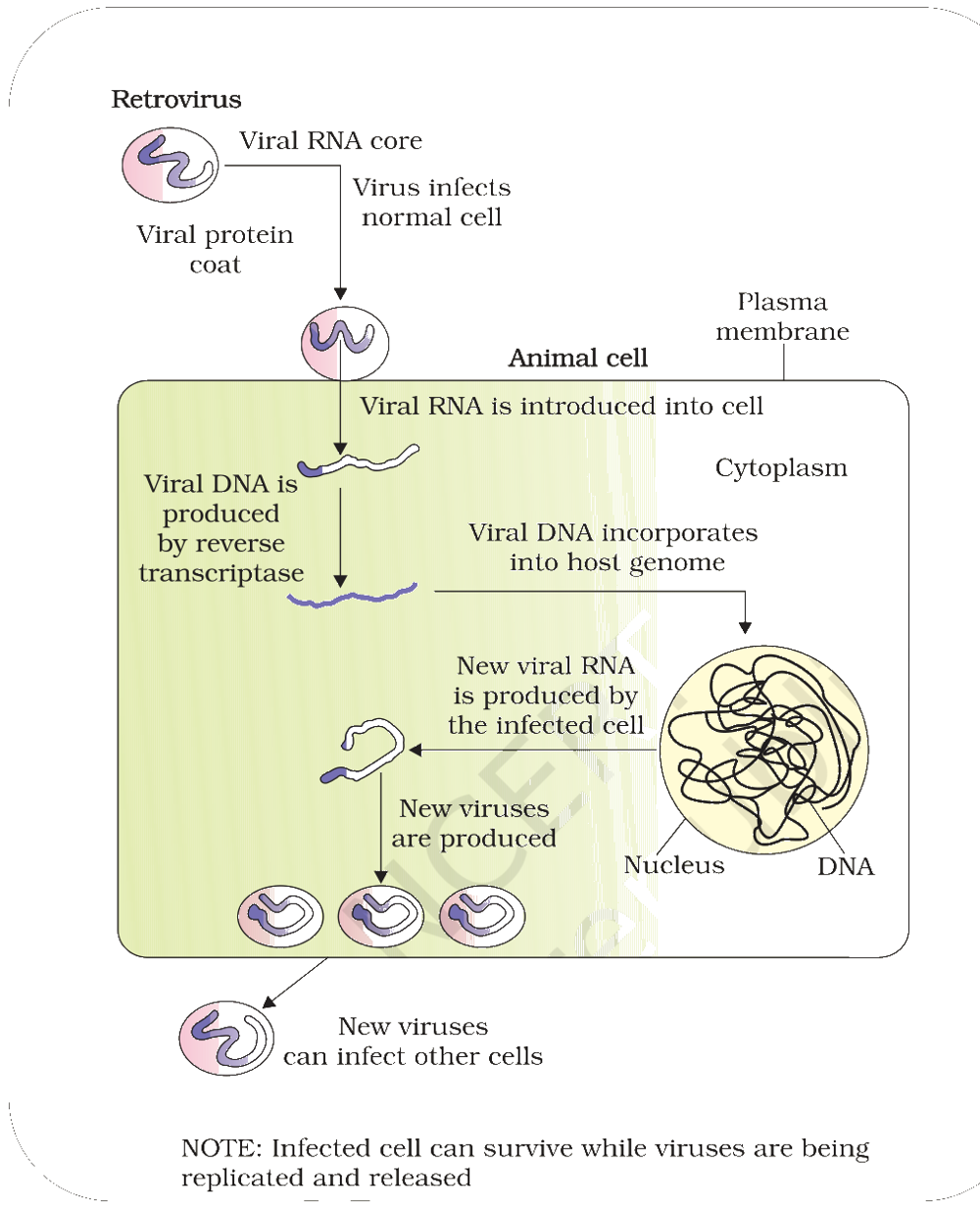
Figure 7.6 Replication of retrovirus