
CUETMOCK
  • Pricing
  • Mentors
Log inStart freeStart free mocks→

First test, then trust

Try a free CUET mock test.

Join 5,00,000+ students who rehearsed exam day on the exact NTA screen before sitting CUET. On the web and on Android.

Start free mocks →Get the Android app
CUETMOCK

India's #1 CUET Mock Test Platform. Original NCERT-based questions on the exact NTA exam screen — trusted by 5,00,000+ students since CUET 2022.

Get it onGoogle PlayScan to download the CUETMOCK app

Mock tests

  • CUET mock test series
  • Commerce mocks
  • Humanities (Arts) mocks
  • Science mocks
  • Languages & GAT mocks
  • Free practice questions
  • Pricing

Resources

  • CUET exam guide
  • CUET syllabus
  • Universities accepting CUET
  • Expert blogs
  • News & notifications
  • Webinars & counselling
  • CUET score calculator
  • How we estimate your rank
  • FAQs

Company

  • About us
  • Our leadership & team
  • Our toppers
  • Mentors
  • For schools
  • Contact us
  • Terms
  • Privacy
  • Refund policy

Talk to us

+91 7696 6630 56info@cuetmock.comWhatsApp us

Our other platforms

  • JEE Mock — For IIT-JEE aspirants
  • NEET Mock — For NEET aspirants

Newsletter

Exam updates, study material and offers — no spam.

© 2026 NYC Ventures Pvt. Ltd.

701-702, Royal Business Park, Zirakpur, Punjab - 140603

  • Terms of use
  • Privacy policy
  • Refund policy
  • Contact us

iCUETMOCK is an independent preparation platform, not affiliated with the National Testing Agency (NTA). Always check exam details on the official NTA website.

  • Home
  • Mock tests
  • CUET guide
  • Pricing
  • Log in
Home/Practice questions/Chemistry
ChemistryPhysical: Chemical Kinetics

Which of the following are pseudo first order reactions?(A) C12H22O11…

Which of the following are pseudo first order reactions?

(A) \( \displaystyle \ce{C12H22O11 + H2O} \xrightarrow{\ce{H^+}} \ce{C6H12O6 + C6H12O6} \)

(B) \( \displaystyle \ce{CH3COOC2H5 + H2O} \xrightarrow{\ce{H^+}} \ce{CH3COOH + C2H5OH} \)

(C) \( \displaystyle \ce{C2H4(g) + H2(g)} \xrightarrow{\ce{H^+}} \ce{C2H6(g)} \)

(D) \( \displaystyle \ce{2NH3(g)} \xrightarrow[\text{Pt catalyst}]{\text{1130K}} \ce{N2(g) + 3H2(g)} \)

Choose the correct answer from the options given below:

Answer & explanation+

Correct answer: option 2

The correct answer is Option (2) → (A) and (B) only

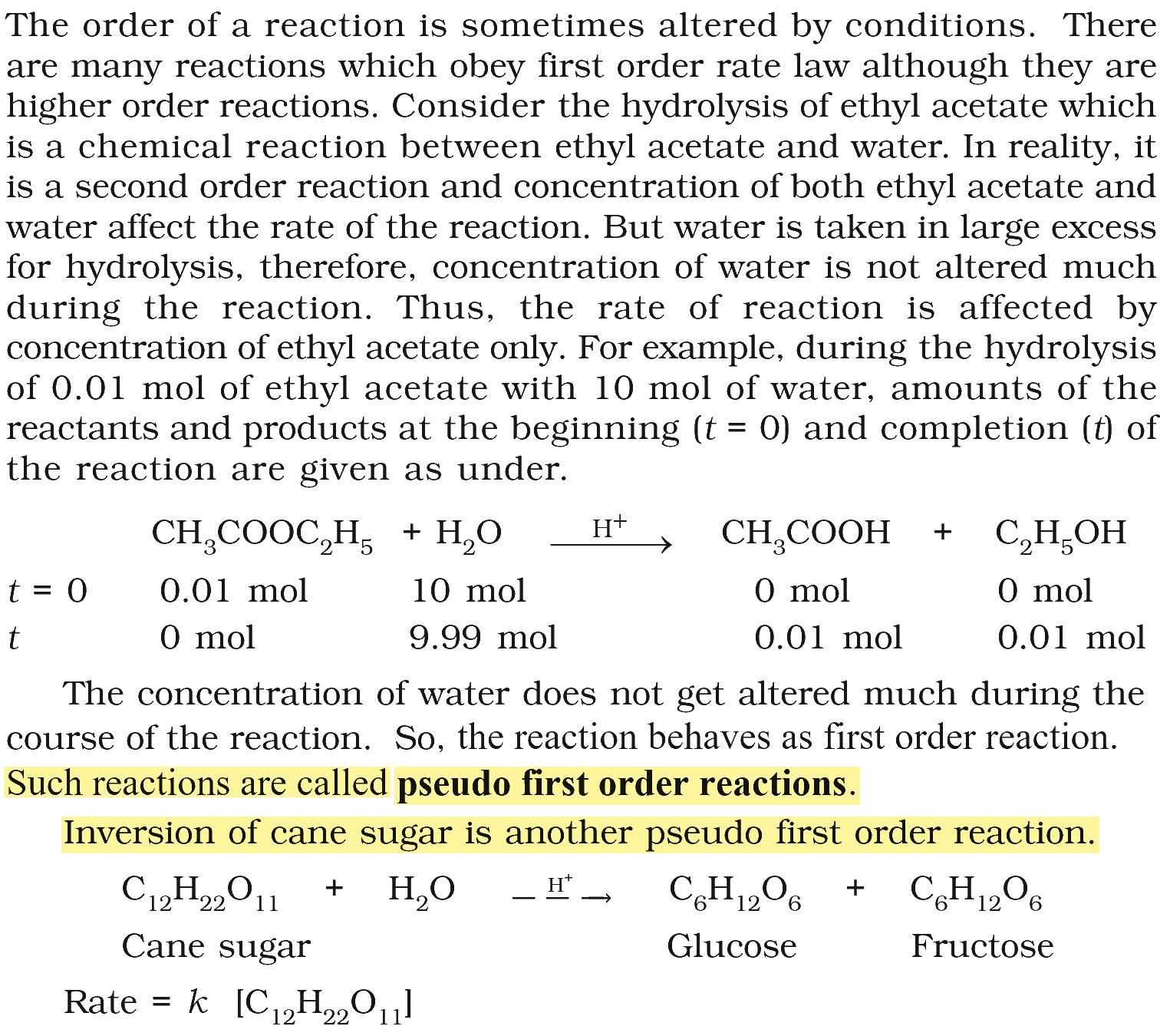
A pseudo first order reaction is a reaction of higher molecularity that behaves as a first order reaction because one reactant is present in large excess. Its concentration hardly changes during the reaction, so it is absorbed into the rate constant. Typical examples are reactions in water where water is the solvent and a reactant:

    \( \displaystyle \text{Rate}=k'[\text{substrate}][\ce{H2O}]=k[\text{substrate}]\quad\text{where }k=k'[\ce{H2O}] \)

  • (A) \( \ce{C12H22O11 + H2O} \xrightarrow{\ce{H^+}} \ce{C6H12O6 + C6H12O6} \) (inversion of cane sugar) — Correct. Water is in large excess, so Rate = k[C12H22O11]; the products are glucose and fructose.

  • (B) \( \ce{CH3COOC2H5 + H2O} \xrightarrow{\ce{H^+}} \ce{CH3COOH + C2H5OH} \) (acid hydrolysis of ethyl acetate) — Correct. Again water is in large excess, so Rate = k[CH3COOC2H5].

  • (C) \( \ce{C2H4(g) + H2(g)} \xrightarrow{\ce{H^+}} \ce{C2H6(g)} \) (hydrogenation of ethene) — Incorrect. This is an addition of hydrogen to ethene between two gases. Neither reactant is a solvent present in large excess, so there is nothing to absorb into the rate constant; it is not a pseudo first order reaction.

  • (D) \( \ce{2NH3(g)} \xrightarrow[\text{Pt catalyst}]{\text{1130K}} \ce{N2(g) + 3H2(g)} \) (decomposition of ammonia on hot platinum) — Incorrect. At high pressure the platinum surface is fully covered with \( \ce{NH3} \) molecules, so the rate does not depend on the concentration: it is a zero order reaction.

Note: It seems that there is a mistake in the original NTA paper, which prints H+ over the arrow for C2H4 + H2 → C2H6 when it should read Ni (or Pt/Pd).

NCERT (2026-27 edition):
Pseudo First Order Reaction
Textbook extract

Zero Order Reaction – “… The decomposition of gaseous ammonia on a hot platinum surface is a zero order reaction at high pressure. … In this reaction, platinum metal acts as a catalyst. At high pressure, the metal surface gets saturated with gas molecules. So, a further change in reaction conditions is unable to alter the amount of ammonia on the surface of the catalyst making rate of the reaction independent of its concentration.”

Advertisement

Practise more on Physical: Chemical Kinetics

Chapter-wise mocks on the real NTA exam screen, with solutions and your rank. Your first mocks are free.

Start free mocks →

Advertisement

Next questions

  1. Choose the correctly spelt word given in the options:English · Spelling Check
  2. In a pure semiconductor, the number of conduction electrons is 6 × 10¹⁸ per cubic metre. In a sample of this semiconductor of dimensions 1…Physics · Semiconductors and Electronic Devices
  3. Match the LIST-I with LIST-IILIST-I(Electromagnetic waves)LIST-II(Uses)A. Ultra-violet raysI. Aircraft navigation for radar systemB. X-rays…Physics · Electromagnetic Waves
  4. The solution set x:x∈ R,3x-2lt x+2≤ 2x+6 (Where R is set of real numbers) is :Applied Maths. Section B2 · Numbers, Quantification and Numerical Applications
  5. Which of the following options will correspond to the lowest coefficient of correlation with reference to the hereditary influences on inte…Psychology · Variations in Psychological Attributes
  6. A, B and C were partners sharing profits and losses in the ratio of 3 : 2 : 1. C died on 1st August, 2022 and his share of profit from the…Accountancy Part A · Reconstitution of Partnership Firm: Retirement and Death
  7. Which country’s revolution was led by the Communist Party of China?Sociology · Social Change and Development in India: Social Movements
  8. UNESCO has added this festival to its 2021 list of Intangible Cultural Heritage:General Aptitude Test · Current Affairs
  9. Choose the correct alternatives.abca_bcaab_ca_bbc_aGeneral Aptitude Test · Verbal Reasoning
  10. Which one of the following contrasting traits was not studied by Mendel?Biology · Principles of Inheritance and Variation