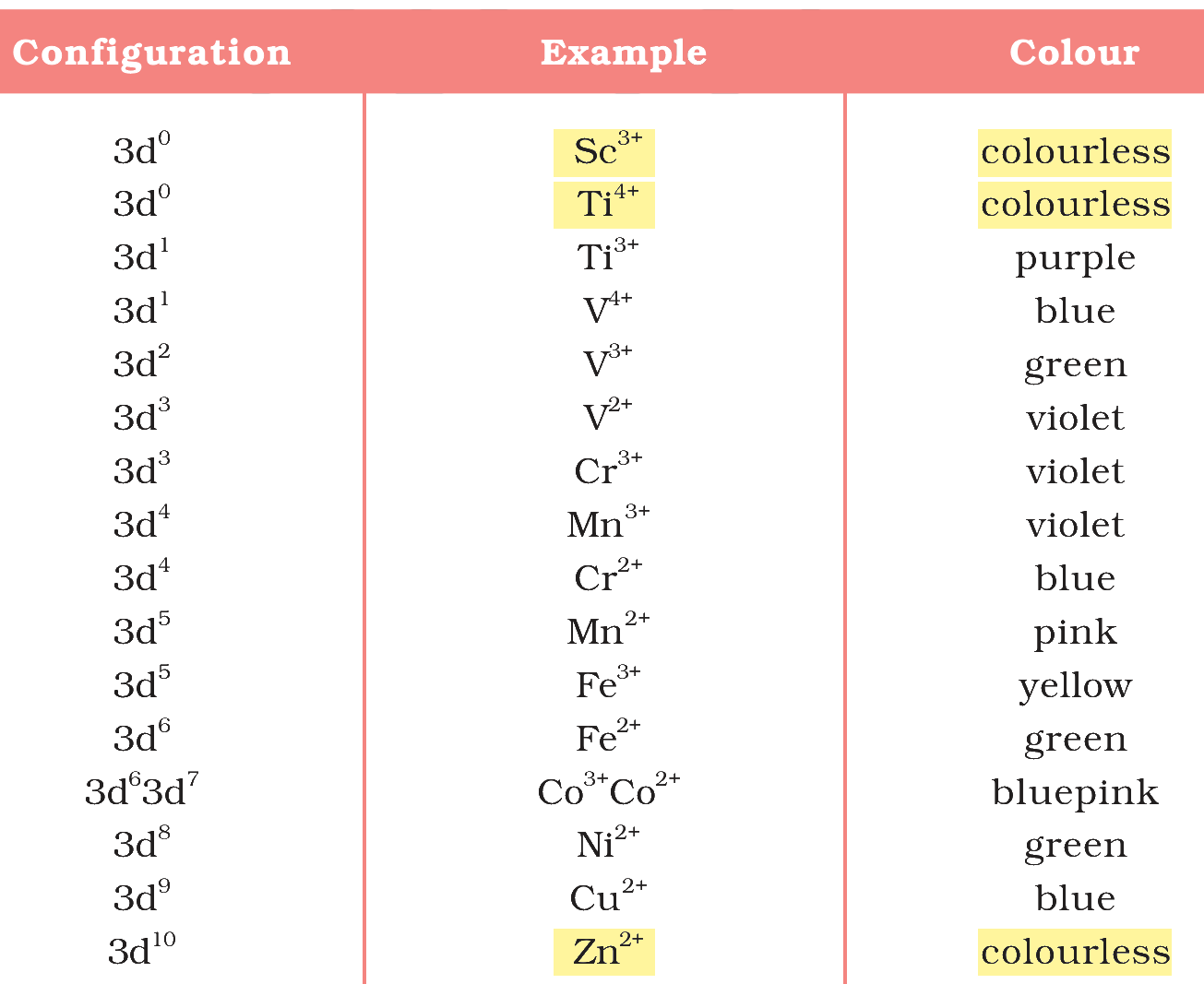
Which of the following is colourless?
(A) [Sc(H2O)6]3+
(B) [Zn(H2O)6]2+
(C) [Fe(H2O)6]2+
(D) [Ti(H2O)6]4+
Choose the correct answer from the options given below:
Answer & explanation
Correct answer: option 1
The correct answer is Option (1) → (A), (B) and (D) only
Most transition metal ions are coloured because of d–d transitions. Water ligands split the five d orbitals into two sets of slightly different energy. When visible light falls on the ion, an electron in the lower set absorbs light of a particular wavelength and jumps to the higher set; we see the complementary colour.
A d–d transition needs a partly filled d subshell. An ion with d0 (no d electron to jump) or d10 (no empty d orbital to jump into) is colourless.
(A) \( \ce{[Sc(H2O)6]^{3+}} \) — Correct. Sc (Z = 21) is [Ar]3d14s2; removing three electrons gives \( \ce{Sc^{3+}} \): 3d0.
(B) \( \ce{[Zn(H2O)6]^{2+}} \) — Correct. Zn (Z = 30) is [Ar]3d104s2; losing the two 4s electrons gives \( \ce{Zn^{2+}} \): 3d10.
(C) \( \ce{[Fe(H2O)6]^{2+}} \) — Incorrect. It is green. Fe (Z = 26) is [Ar]3d64s2; losing the two 4s electrons gives \( \ce{Fe^{2+}} \): 3d6, a partly filled subshell.
(D) \( \ce{[Ti(H2O)6]^{4+}} \) — Correct. Ti (Z = 22) is [Ar]3d24s2; removing four electrons gives \( \ce{Ti^{4+}} \): 3d0.
NCERT (2026-27 edition):
Formation of Coloured Ions – …